
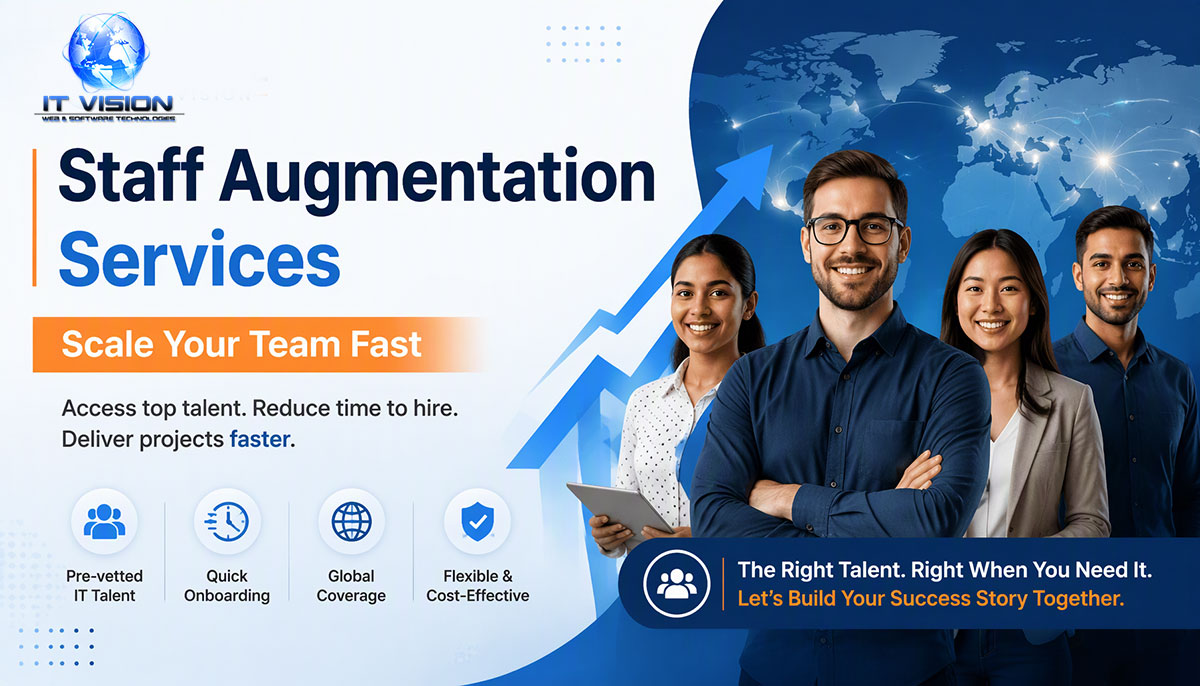
Staff augmentation lets you hire vetted developers, QA engineers, designers, and project managers who join your existing team on flexible contracts—without the overhead of full-time hiring. Global IT Vision provides offshore staff augmentation with 7-10 day onboarding, transparent pricing, and no lock-in contracts. With 700+ projects delivered across 60+ software products, we understand how to scale development capacity fast.
Whether you need React developers for a 3-month sprint, DevOps engineers to migrate infrastructure, or dedicated QA testers for an enterprise release, staff augmentation fills skill gaps quickly without long-term commitments.
What is Staff Augmentation?
Staff augmentation is a flexible hiring model where external contractors join your in-house team temporarily to increase capacity, fill skill gaps, or accelerate project timelines. Unlike project-based outsourcing (where a vendor manages the entire project), staff-augmented developers work as extensions of your team—following your processes, attending your standups, and reporting directly to your managers.
How it works:
- You identify skill gaps (e.g., “need 2 senior React developers for 6 months”)
- The staff augmentation provider pre-screens candidates matching your requirements
- You interview shortlisted candidates and select team members
- Contractors onboard to your workflow, tools, and codebase within days
- You manage day-to-day tasks; the provider handles payroll, contracts, and HR administration
When to use staff augmentation:
- Short-term capacity needs: Product launch sprints, seasonal workload spikes, urgent bug fixes
- Skill gaps: Your team lacks specific expertise (e.g., Kubernetes, machine learning, Flutter)
- Cost efficiency: Hiring full-time employees is too slow or expensive for temporary needs
- Scaling flexibility: Ramp team size up or down based on project phases without layoffs
Benefits of staff augmentation:
- Speed: Onboard developers in 7-10 days vs. 60-90 days for full-time hires
- Cost control: Pay only for active work months; no benefits, training, or office overhead
- Knowledge retention: Contractors work alongside your team, transferring knowledge to in-house staff
- No lock-in: Replace non-performing contractors or end contracts with 30-day notice
Why Choose Global IT Vision for Staff Augmentation?
Global IT Vision combines offshore cost savings with deep technical expertise proven across 60+ products and 700+ delivered projects. Unlike generic staffing agencies, we understand complex business software—ERP, POS, healthcare systems, SaaS platforms—because we’ve built them.
1. Proven Delivery Across 60+ Products
Our staff-augmented developers aren’t just coders-for-hire—they’re specialists who’ve shipped production software at scale. Global IT Vision’s portfolio includes:
- POS systems: Retail, restaurant, pharmacy, multi-terminal cloud POS
- ERP platforms: Financial accounting, inventory, manufacturing, procurement
- Vertical software: Hospital management, school management, hotel PMS, pharmacy, lab management
- Custom development: Bespoke SaaS, e-commerce, CRM, HRMS, logistics platforms
Why this matters: Staff augmentation candidates from Global IT Vision have hands-on experience with real-world codebases, not just academic portfolios. When you need a Laravel developer for your ERP project or a React specialist for your SaaS dashboard, you get someone who’s built similar systems before.
2. White-Label Software Expertise (Unique Differentiator)
Global IT Vision combines staff augmentation with a white-label software portfolio—60+ rebrandable products (POS, ERP, CRM, HRMS, vertical software). Our developers understand:
- Source code licensing: Full codebase ownership, independent deployment, vendor lock-in prevention
- Multi-tenancy architecture: SaaS platform design for scalable customer onboarding
- Customization workflows: Extending base products to match unique business requirements
Why this matters: If you’re building a SaaS product, customizing ERP software, or white-labeling platforms for resale, our staff-augmented developers have done it—not just theoretically, but in production systems serving real customers.
3. Competitive Offshore Pricing
Global IT Vision operates from Lahore, Pakistan—a tier-1 offshore development hub with strong English fluency, UTC+5 timezone coverage, and competitive rates. Unlike US-based staff augmentation providers (premium onshore rates), offshore teams deliver 50-70% cost savings without quality trade-offs.
Transparent pricing model: Contact us for custom quotes based on skill level, contract length, and team size. No hidden fees, no surprise markups.
4. Fast Onboarding (7-10 Days)
Industry average: 30-60 days from request to developer start (vetting, interviews, contracts, security clearances)
Global IT Vision: 7-10 days from requirements to onboarded developer writing code
Our process:
- Day 1-3: You submit requirements; we pre-screen candidates from our vetted talent pool
- Day 4-6: You interview shortlisted candidates (2-3 per role); we handle technical assessments
- Day 7-10: Contracts signed, NDAs executed, developers onboard to your repos/tools/workflows
Why we’re faster: Pre-vetted talent pool across tech stacks, streamlined onboarding playbooks, and no bureaucratic approval layers.
5. No Lock-In Contracts
Flexible engagement terms:
- 30-day notice: End contracts or reduce team size with one month’s notice (vs. 6-12 month minimums)
- Performance replacement: Replace non-performing contractors at no additional cost
- Month-to-month billing: No upfront fees, no annual commitments
Why this matters: Your staffing needs change as projects evolve. Lock-in contracts force you to keep paying for contractors you no longer need or tolerate underperformers to avoid penalties. We align pricing with value delivered.
6. Timezone Coverage & English Fluency
Pakistan timezone (UTC+5) overlaps with:
- Europe: 4-5 hour overlap (9 AM London = 1 PM Lahore)
- Middle East: Full overlap (Dubai and Lahore operate in near-identical hours)
- US East Coast: 3-4 hour morning overlap (7 AM New York = 5 PM Lahore)
English fluency: Pakistan’s IT workforce is English-first (university instruction, technical documentation, client communication all in English). No translation barriers, no miscommunication friction.
7. Multilingual & International Experience
Global IT Vision operates offices in Lahore, Pakistan | Bari, Italy | Baku, Azerbaijan—serving clients across Europe, Middle East, South Asia, and Africa. Our staff-augmented developers have delivered projects in:
- English (primary)
- Arabic (Middle East clients)
- Italian (European clients)
- Azerbaijani (Central Asia clients)
Why this matters: If you’re expanding internationally or building multilingual products, our developers understand localization, right-to-left UI design, and cultural UX considerations—not just language translation.
Our Staff Augmentation Process
Global IT Vision’s staff augmentation follows a 4-step framework designed for fast onboarding and long-term team fit.
Step 1: Requirements & Skill Profiling
You provide:
- Role definition: Job title, seniority level (junior/mid/senior), primary responsibilities
- Tech stack: Required technologies (e.g., React, Node.js, PostgreSQL, AWS, Docker)
- Team size: Number of contractors needed
- Contract length: Estimated duration (3 months, 6 months, ongoing)
- Working hours: Expected overlap with your team’s timezone
We deliver:
- Shortlist criteria: Minimum years of experience, must-have vs. nice-to-have skills
- Pre-screening results: 2-3 candidates per role who meet 80%+ of requirements
Step 2: Talent Matching & Technical Assessment
Our vetting process:
- Resume screening: Filter by years of experience, project portfolio, tech stack matches
- Technical assessment: Live coding test or GitHub portfolio review (language-specific)
- English fluency check: Written + verbal communication assessment (CEFR B2+ minimum)
- Reference verification: Contact previous clients/employers for performance feedback
Your involvement: We send shortlisted profiles with assessment scores. You select 2-3 candidates per role to interview.
Step 3: Client Interviews & Final Selection
Interview format (you control):
- Technical interview: Live coding, architecture discussion, problem-solving
- Cultural fit interview: Work style, communication preferences, collaboration approach
- Portfolio walkthrough: Past projects, code samples, contributions
Timeline: Schedule 30-60 minute interviews within 2-3 days. We handle coordination.
Selection: You choose final candidates. We prepare contracts and onboarding documentation.
Step 4: Onboarding & Integration
Onboarding checklist (completed in 7-10 days):
- Legal & compliance: NDA signed, IP assignment agreement, contractor agreement
- Access & tools: Repo access (GitHub/GitLab), project management tools (Jira/Asana), communication (Slack/Teams)
- Knowledge transfer: Codebase walkthrough, architecture documentation, coding standards, deployment workflow
- First sprint: Assign starter tasks (bug fixes, small features) to build familiarity
Ongoing management: Contractors attend your standups, report to your managers, follow your sprint cycles. Global IT Vision handles payroll, HR administration, and performance monitoring.
Staff Augmentation vs. Outsourcing vs. Consulting
Not sure which engagement model fits your needs? Here’s how staff augmentation compares to project-based outsourcing and consulting.
| Criteria | Staff Augmentation | Project-Based Outsourcing | IT Consulting |
|---|---|---|---|
| Control | You manage contractors daily (your processes, your timelines) | Vendor manages project (their processes, their PM) | Consultant advises; you implement |
| Cost Model | Hourly or monthly retainer per contractor | Fixed price or milestone-based per project | Hourly advisory fees (no implementation) |
| Best For | Scaling existing teams, filling skill gaps, ongoing capacity | One-time projects with defined scope (MVP, website, migration) | Strategy, architecture design, vendor selection |
| Knowledge Retention | High (contractors work alongside your team, knowledge transfers in-house) | Low (vendor delivers finished product, no internal learning) | Medium (consultant documents recommendations, you learn strategy) |
| Timeline | Flexible (scale up/down as needed, month-to-month) | Fixed (project start → delivery → end) | Short-term (days to weeks for assessments/roadmaps) |
| When to Choose | You need extra capacity but want to keep control of workflow and priorities | You lack in-house dev team or need a specific deliverable without internal involvement | You need expert guidance but have the team to execute |
Example scenarios:
Choose staff augmentation if:
- Your SaaS product needs 3 React developers for a 6-month feature sprint, but you don’t want to hire full-time
- Your ERP implementation requires Kubernetes expertise for 4 months to migrate infrastructure
- Your QA team is overwhelmed before a major release; you need 2 testers for 8 weeks
Choose project-based outsourcing if:
- You need a mobile app built from scratch but have no internal mobile developers
- Your WordPress site needs a complete redesign and migration to a new host
- You want a fixed-price deliverable with defined milestones (e.g., “deploy MVP in 12 weeks for $80k”)
Choose consulting if:
- You’re deciding between microservices vs. monolith architecture and need an expert’s assessment
- You need a cloud migration roadmap but your team will execute it
- You’re evaluating ERP vendors and want independent guidance (no implementation)
Who We Serve: 4 Use Cases for Staff Augmentation
Global IT Vision’s staff augmentation serves four primary customer profiles:
1. Startups Scaling Fast
Challenge: You raised Series A and need to ship 3 major features in 6 months. Your 5-person dev team can’t handle the workload. Hiring 10 full-time developers takes too long and locks you into high salaries before product-market fit is proven.
Solution: Staff-augment 5 contractors (3 backend, 2 frontend) for 6 months. Scale your team to 10 without equity dilution, benefits overhead, or long-term commitments. When the feature sprint ends, reduce team size or pivot contractors to new priorities.
Tech stacks we support: Node.js, React, Vue.js, Python, Django, Flask, PostgreSQL, MongoDB, AWS, Firebase
2. Software Companies Building SaaS Products
Challenge: Your SaaS product serves 1,000 customers, but you need to ship enterprise features (SSO, advanced permissions, audit logs) to close a $500k annual contract. Your 8-person dev team is already maintaining the existing product.
Solution: Staff-augment 2 senior developers (full-stack + DevOps) for 4 months to build enterprise features in parallel. Your core team maintains the product; augmented contractors focus solely on the enterprise tier. When features launch, contractors transition to optimization or end contracts.
Tech stacks we support: Ruby on Rails, Laravel, .NET Core, Spring Boot, Kubernetes, Docker, Terraform
3. Agencies & MSPs Serving Multiple Clients
Challenge: Your agency manages 12 client projects simultaneously. One client requests a custom CRM integration; another needs a mobile app. Your 15-person team is fully allocated. Turning down work costs revenue; hiring full-time staff for temporary projects isn’t sustainable.
Solution: Staff-augment specialists per project (1 CRM integration developer, 2 mobile app developers) for 8-12 weeks. Deliver client projects on time without stretching your core team. When projects complete, reallocate or end contracts.
Tech stacks we support: WordPress, WooCommerce, HubSpot API, Salesforce, Shopify, Flutter, React Native
4. Enterprises Replacing Legacy Systems
Challenge: Your Fortune 500 company is migrating from a 20-year-old on-premise ERP to a cloud-based system. The migration will take 18 months, but your 50-person IT department lacks cloud architecture expertise. Hiring full-time cloud engineers for a one-time migration is expensive.
Solution: Staff-augment 5 cloud specialists (2 AWS architects, 2 DevOps engineers, 1 data migration specialist) for 18 months. They work alongside your IT team, transferring knowledge while executing the migration. When the project completes, contractors offboard and your team maintains the new system.
Tech stacks we support: AWS, Azure, Google Cloud, Oracle Cloud, SAP, Microsoft Dynamics 365, data migration tools
Technology Expertise: 6 Core Skill Areas
Global IT Vision’s staff-augmented developers cover six primary technology stacks:
1. Full-Stack Web Development
Frontend: React, Vue.js, Angular, Next.js, TypeScript, Tailwind CSS, Bootstrap
Backend: Node.js, Laravel (PHP), Django (Python), Ruby on Rails, ASP.NET Core, Spring Boot (Java)
Databases: MySQL, PostgreSQL, MongoDB, Redis
Use cases: SaaS dashboards, e-commerce platforms, CRM systems, admin panels
2. Mobile Development
Native: Swift (iOS), Kotlin (Android)
Cross-platform: Flutter, React Native
Backend integration: REST APIs, GraphQL, Firebase, AWS Amplify
Use cases: Consumer apps, enterprise mobile apps, hybrid solutions
3. Cloud & DevOps
Platforms: AWS, Azure, Google Cloud
CI/CD: Jenkins, GitHub Actions, GitLab CI/CD, CircleCI
Infrastructure as Code: Terraform, Ansible, CloudFormation
Containerization: Docker, Kubernetes, ECS
Use cases: Cloud migrations, CI/CD pipeline setup, infrastructure automation, microservices deployment
4. ERP & Business Software
ERP systems: Financial accounting, inventory management, manufacturing, procurement, HR/payroll
Vertical software: Hospital management, school management, hotel PMS, pharmacy, logistics
Customization: Extending base ERP modules, API integrations, custom workflows
Use cases: Custom ERP development, ERP implementation, white-label software customization
5. QA & Testing
Manual testing: Test case design, regression testing, exploratory testing
Automation: Selenium, Cypress, Playwright, Jest, pytest
Performance testing: JMeter, Gatling, LoadRunner
Use cases: Pre-release QA cycles, test automation framework setup, regression test coverage
6. Database & Backend Engineering
Relational databases: PostgreSQL, MySQL, SQL Server
NoSQL: MongoDB, Cassandra, DynamoDB
Data pipelines: ETL workflows, data warehousing, BI integrations
API development: RESTful APIs, GraphQL, microservices architecture
Use cases: Backend refactoring, API development, database optimization, data migration
Pricing & Engagement Models
Global IT Vision offers transparent, flexible pricing for staff augmentation with no hidden fees.
Pricing Model
Contact us for custom pricing based on:
- Skill level: Junior (1-3 years), Mid-level (3-5 years), Senior (5+ years)
- Tech stack complexity: Standard web development vs. specialized skills (machine learning, blockchain, embedded systems)
- Contract length: Longer engagements (6+ months) qualify for volume discounts
- Team size: Discounts apply for teams of 5+ contractors
Typical offshore rates (for reference):
- Offshore providers (Pakistan, India, Ukraine): Contact for custom pricing
- US-based providers: Premium onshore rates (contact vendors for current pricing)
- Global IT Vision: Competitive offshore pricing with 50-70% savings vs. US-based rates
No hidden costs:
- ✅ Included: Payroll, HR administration, performance management, replacement contractors (if needed)
- ❌ Not included: Your team’s project management time, third-party tools (Jira, GitHub), contractor equipment (if remote work-from-home)
Engagement Terms
Flexible contracts:
- Month-to-month billing: No annual commitments
- 30-day notice: End or reduce team size with one month’s notice
- Performance replacement: Replace non-performing contractors at no cost
Payment schedule:
- Net 15 or Net 30 terms (invoice due 15 or 30 days after month-end)
- Billing cycle: Monthly invoices with detailed timesheets
Contract minimums:
- No upfront fees: Pay only for active work months
- Minimum engagement: Some roles require 3-month minimum contracts (disclosed upfront)
Why Offshore Staff Augmentation?
Many companies hesitate to hire offshore contractors due to concerns about cost, communication, IP security, and cultural fit. Here’s how Global IT Vision addresses the top 4 objections:
Objection 1: “Offshore contractors are cheaper, but quality suffers”
Reality: Pakistan is a tier-1 offshore development hub with strong English fluency (IT education is English-first) and proven delivery for Fortune 500 clients. Global IT Vision’s developers have shipped production software across 60+ products and 700+ projects—real-world experience, not just academic credentials.
Quality safeguards:
- Pre-screening: Technical assessments, GitHub portfolio review, reference checks
- Trial period: 30-day performance evaluation before long-term commitment
- Client interviews: You select final candidates after technical interviews
Objection 2: “Communication is difficult with offshore teams”
Reality: Pakistan operates in UTC+5, providing 3-5 hour overlap with Europe and Middle East (full day overlap) and 3-4 hour morning overlap with US East Coast. English is the primary language of IT education and client communication—no translation barriers.
Communication best practices:
- Daily standups: Scheduled during timezone overlap hours
- Async updates: Written status reports for non-overlapping hours
- Tools: Slack, Teams, Zoom, Jira (your preferred stack)
Objection 3: “How do I protect intellectual property with offshore contractors?”
Reality: IP protection is a legal and operational issue—not a geographic one. Global IT Vision executes the same IP safeguards as US-based providers:
Legal safeguards:
- NDA (Non-Disclosure Agreement): Signed before project details are shared
- IP assignment clause: All code, designs, and deliverables transfer to you upon payment
- Contractor agreements: Explicit terms prohibiting code reuse, client poaching, or competitive work
Operational safeguards:
- Access control: Contractors access only the repos/tools needed for their role
- Code reviews: All commits reviewed by your team before merging
- Exit offboarding: Revoke access within 24 hours of contract end
Objection 4: “Will offshore contractors fit our company culture?”
Reality: Cultural fit depends on work style alignment—not nationality. Global IT Vision’s developers have worked with US, European, Middle Eastern, and Asian clients, adapting to diverse communication styles, agile methodologies, and company cultures.
Cultural fit assessment:
- Work style interview: We assess contractor’s collaboration preferences, feedback receptiveness, and autonomy level
- Trial tasks: Assign starter tasks to observe work quality, responsiveness, and communication before full onboarding
- Team integration: Contractors attend standups, participate in Slack channels, and engage in team rituals (retrospectives, demos)
Example Use Cases: Staff Augmentation in Action
Example Use Case 1: SaaS Startup Scales React/Node.js Team for Series A Feature Sprint
Challenge: A healthcare SaaS startup with 8 developers raised $5M Series A. Investors wanted 4 major features (telemedicine, patient portal, insurance integrations, reporting dashboard) delivered in 6 months to close 3 enterprise contracts. Hiring 6 full-time developers would take 90+ days and lock the company into high salaries before revenue scaled.
Solution: Staff-augmented 4 contractors (2 senior React, 1 Node.js backend, 1 QA automation) for 6 months. Contractors integrated into existing sprint cycles, attended daily standups, and shipped features alongside the core team.
Results:
- 4 major features delivered in 6 months (on schedule)
- 3 enterprise contracts closed ($500k ARR)
- Team scaled down to 10 developers (core team + 2 retained contractors for maintenance)
- Cost savings: 50% lower than full-time hires (no equity, benefits, or office space overhead)
Example Use Case 2: Healthcare ERP Dev Capacity for Hospital Management System
Challenge: A mid-size hospital needed custom modules (radiology integration, insurance billing, lab workflows) added to its hospital management ERP. The internal IT team (3 developers) was fully allocated to maintenance and helpdesk support. The hospital couldn’t afford to hire 3 full-time ERP developers for a 9-month project.
Solution: Staff-augmented 2 senior PHP/Laravel developers for 9 months. Contractors worked on custom modules while the internal team handled BAU tasks. Knowledge transfer sessions ensured the internal team could maintain modules after contractor offboarding.
Results:
- 3 custom modules delivered (radiology, billing, lab workflows)
- Hospital went live with new ERP features in 10 months
- Internal team trained to maintain code (knowledge retention achieved)
- Contractors offboarded after project completion (no long-term commitment)
Example Use Case 3: Agency Multi-Client Capacity for WordPress & Shopify Projects
Challenge: A digital marketing agency managed 15 client projects (WordPress sites, Shopify stores, HubSpot integrations). Two major clients requested simultaneous projects (one Shopify migration, one custom WordPress plugin). The agency’s 12-person dev team was fully allocated. Turning down work would cost $120k in revenue.
Solution: Staff-augmented 3 contractors (1 Shopify specialist, 2 WordPress developers) for 3 months. Contractors worked directly on client projects under agency branding (white-label arrangement). Agency billed clients at standard rates while paying discounted offshore rates.
Results:
- Both client projects delivered on time and within budget
- $120k revenue retained (vs. turning down work)
- Agency margin: 40%+ markup on contractor rates (profitable even with augmented staff)
- Contractors ended after project completion (no long-term overhead)
Frequently Asked Questions
What is staff augmentation?
Staff augmentation is a flexible hiring model where external contractors join your team temporarily to fill skill gaps or increase capacity. Unlike outsourcing, staff-augmented developers work as extensions of your team—following your processes and reporting to your managers. Contracts are month-to-month with 30-day notice. Ideal for short-term needs (3-12 months), skill gaps, or scaling flexibility.
How much does staff augmentation cost?
Staff augmentation pricing depends on skill level, tech stack, contract length, and team size. Offshore providers offer 50-70% savings vs. US-based rates. Global IT Vision provides custom quotes with no hidden fees (payroll, HR, performance management included). Month-to-month billing, no upfront fees or annual commitments. Performance replacement at no cost if needed.
Staff augmentation vs. outsourcing: which is better?
Staff augmentation is better if you want control of workflow and priorities. Contractors join your team, follow your processes, and report to your managers. Best for ongoing capacity, skill gaps, knowledge retention. Project-based outsourcing is better for specific deliverables without internal involvement. The vendor manages and delivers a finished product. Best for one-time projects with defined scope.
How fast can I onboard staff-augmented developers?
Global IT Vision onboards staff-augmented developers in 7-10 days from requirements to developer writing code. Day 1-3: Submit requirements, we pre-screen candidates. Day 4-6: Interview shortlisted candidates. Day 7-10: Contracts signed, developers onboard to your repos. Industry average is 30-60 days. We’re faster because of our pre-vetted talent pool across multiple tech stacks and streamlined onboarding playbooks.
Can I replace non-performing contractors?
Yes. Global IT Vision replaces non-performing contractors at no additional cost. If a contractor doesn’t meet performance expectations, notify us within 30 days and we’ll provide a replacement who better fits your requirements. No penalties, no fees. We also offer 30-day notice terms—end or reduce team size with one month’s notice if project needs change.
What tech stacks do you support?
Global IT Vision staff-augments developers across six core skill areas: Full-stack web (React, Vue.js, Node.js, Laravel, Django, .NET Core), Mobile (Flutter, React Native, Swift, Kotlin), Cloud/DevOps (AWS, Azure, Kubernetes, Docker), ERP/business software (custom ERP, vertical software), QA/testing (Selenium, Cypress, manual testing), Database/backend (PostgreSQL, MySQL, MongoDB, API development). Contact us for candidate availability.
Do you offer white-label staff augmentation?
Yes. Global IT Vision offers white-label staff augmentation—our staff-augmented developers work on white-label arrangements (your branding, your client relationships). Our 60+ rebrandable products (POS, ERP, CRM, HRMS, vertical software) mean our contractors understand source code licensing, multi-tenancy architecture, and customization workflows. Ideal for agencies, resellers customizing software, or SaaS companies building rebrandable platforms.
How do you handle IP protection with offshore contractors?
Global IT Vision executes the same IP safeguards as US-based providers: NDA signed before project details are shared, IP assignment clause (all code transfers to you upon payment), access control (contractors access only needed repos/tools), and exit offboarding (access revoked within 24 hours). IP protection is a legal and operational issue, not geographic. We enforce strict confidentiality and ownership policies.
What timezone do offshore contractors work in?
Global IT Vision operates in UTC+5 (Pakistan timezone), which provides 4-5 hour overlap with Europe, full day overlap with Middle East, and 3-4 hour morning overlap with US East Coast. This allows daily standups, real-time collaboration, and async updates outside overlap hours. Contractors work flexible hours to match your schedule. English is the primary communication language.
Can I hire staff-augmented contractors for long-term projects?
Yes. While staff augmentation is designed for flexible short-to-medium term engagements (3-12 months), many clients retain contractors for longer periods (12-24+ months) when ongoing capacity is needed. Month-to-month billing and 30-day notice mean you’re never locked in but can extend indefinitely. For contractor teams that scale with your business, staff augmentation is the right fit.
Get Started with Staff Augmentation Today
Ready to scale your development team without long-term commitments? Global IT Vision delivers vetted staff-augmented developers in 7-10 days with transparent offshore pricing, no lock-in contracts, and performance guarantees.
Primary CTAs:
- Contact us for custom pricing — Tell us your skill requirements, team size, and timeline. We’ll send a custom quote within 24 hours.
- Explore our software development services — Need project-based outsourcing instead? We deliver turnkey software projects (MVP to enterprise systems).
With 700+ projects delivered across 60+ software products, Global IT Vision understands how to scale development capacity fast—whether you need React developers for a 6-month sprint or DevOps engineers for cloud migration. Contact us today to start your staff augmentation journey.
Internal Links
Staff Augmentation vs Outsourcing: Which Hiring Model Is Right for Your Business in 2026?
Staff Augmentation Services — Scale Your Development Team in 7-10 Days
Best Toptal Alternatives 2026: 5 Platforms for Staff Augmentation & Offshore Dev Teams
Software Development Outsourcing for Enterprise Solutions
External Link