
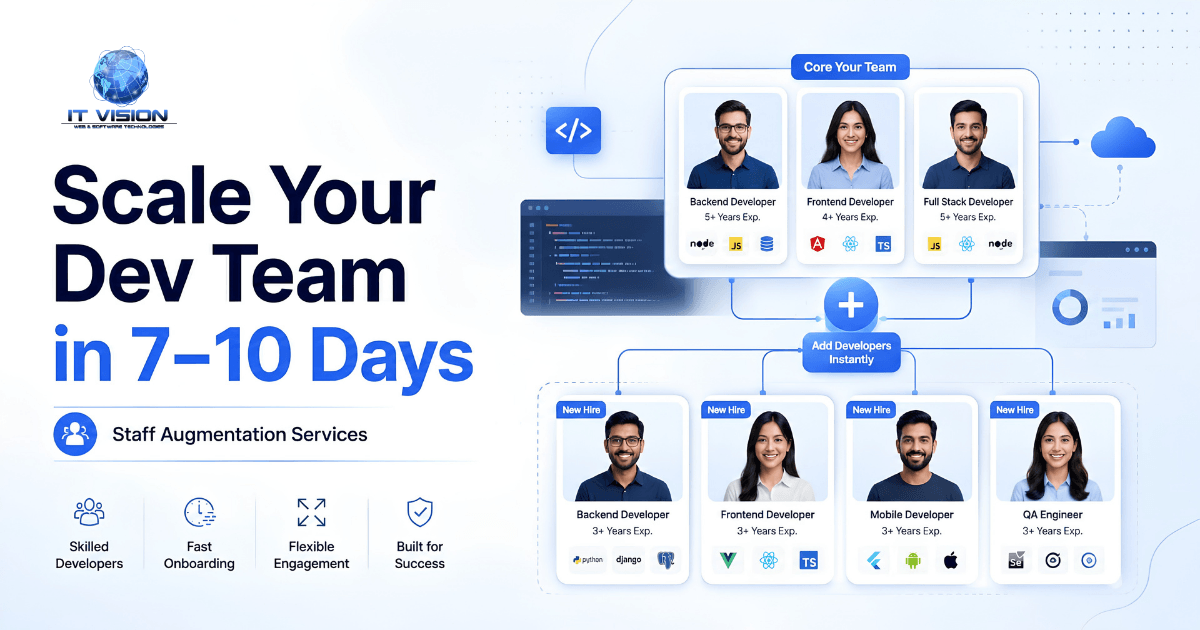
Development staff augmentation gives you vetted software developers in 7-10 days on flexible month-to-month contracts. Scale your team up or down without the overhead of permanent hiring. $25-$50/hr offshore rates deliver 50-70% cost savings versus US-based staff augmentation providers.
What is Staff Augmentation?
Staff augmentation is a flexible hiring model where external IT professionals temporarily join your team to fill skill gaps or expand capacity. Unlike outsourcing (where vendors manage projects), you retain full control over augmented staff. It’s ideal for scaling teams quickly without permanent hiring costs, with contracts ranging from 1 month to 12+ months.
Staff augmentation works through a simple four-step process: requirements gathering → talent matching → client interviews → onboarding. You select candidates, manage their day-to-day work, and control project direction. The provider handles recruiting, vetting, payroll, and administrative overhead.
When to use staff augmentation:
- Capacity gaps — ongoing projects need more developers than your current team can support
- Niche skill needs — require specialized expertise (mobile dev, DevOps, QA, ERP customization) not available in-house
- Seasonal scaling — temporary workload spikes (product launches, seasonal campaigns) without permanent headcount
- Pilot projects — test new technologies or market opportunities before hiring full-time staff
Core benefits:
- Cost control — pay only for hours worked, no benefits/overhead (health insurance, office space, equipment)
- Flexibility — scale up for launches, scale down post-deployment, no long-term commitments
- Knowledge retention — your team controls IP, project documentation, and domain expertise (unlike vendor-managed outsourcing)
- Fast scaling — 7-10 days from request to developer start (versus 30-60 days for permanent hires)
Why Choose Global IT Vision for Staff Augmentation?
60+ Products, 700+ Projects Delivered
Proven delivery track record across ERP, POS, healthcare, education, and hospitality verticals. Global IT Vision (part of IT Vision Private Limited, est. 2012, Lahore) has deployed 60+ software products across 12+ industries. Portfolio depth demonstrates technical breadth—we’ve built financial accounting ERP modules, restaurant POS systems, hospital management platforms, school administration systems, and logistics software.
This breadth means our developers bring real-world experience: ERP developers have built chart of accounts and AP/AR modules, mobile developers have deployed React Native and Flutter apps, and QA engineers have tested multi-tenant SaaS platforms. Most staff augmentation providers offer generic “web developers.” We offer proven expertise in business-critical systems.
White-Label Software Expertise
Global IT Vision is one of the few staff augmentation providers with extensive white-label software experience. Global IT Vision builds customizable, rebrandable systems for software resellers. Our white-label POS software and white-label ERP solutions power partner brands across the Middle East, Europe, and Asia.
Why this matters for staff augmentation clients: white-label development requires modular, configurable architecture. Developers who build white-label systems understand abstraction, multi-tenancy, and client-specific customization—transferable skills for any complex application.
Offshore Cost Savings
Pakistan-based offshore rates deliver 50-70% cost savings versus US-based competitors:
- Global IT Vision offshore rates: $25-$50/hr (junior to senior developers)
- US-based staff augmentation: $50-$99/hr (ScienceSoft: $50-$99/hr per Clutch 2026, TatvaSoft: <$25/hr per Clutch 2026)
Example cost comparison (one full-time developer, 160 hours/month):
- GIV offshore rate ($40/hr average): $6,400/month
- US mid-tier rate ($75/hr average): $12,000/month
- Savings: $5,600/month per developer (47% cost reduction)
For a 3-developer team over 6 months: GIV offshore costs $115,200 versus $216,000 US-based = $100,800 total savings.
Fast Onboarding
7-10 days from request to developer start date (versus 30-60 days industry average). Our process:
- Day 1-2: Requirements gathering (skills matrix, tech stack, timeline, budget)
- Day 3-5: Talent matching (we shortlist 3-5 pre-vetted candidates from our 50-100 employee roster)
- Day 5-7: Client interviews (you interview shortlisted candidates via Zoom, select best fit)
- Day 7-10: Onboarding (developer joins your team, accesses your tools/repos/Slack/Jira)
Target time-to-hire: 7-10 days for most engagements.
No Lock-In Contracts
Month-to-month agreements, replace non-performers at no cost. Contract terms:
- Minimum engagement: 1 month (versus competitors requiring 3-6 month minimums)
- Termination notice: 30 days
- Performance guarantee: If a developer underperforms in the first 30 days, we replace them at no additional cost
- No cancellation fees: Exit anytime with 30-day notice
Most US-based staff augmentation providers require 6-12 month commitments. We offer flexibility for companies testing staff augmentation for the first time or scaling teams for short-term projects.
Timezone Coverage
UTC+5 (Pakistan) provides overlap with Europe, Middle East, and Asia:
- Europe overlap: 4-6 hours daily overlap (8 AM Pakistan = 4 AM CET, 2 PM Pakistan = 10 AM CET)
- Middle East overlap: Full day overlap (UTC+3 to UTC+4)
- Asia overlap: Full day overlap (Singapore UTC+8, India UTC+5:30)
- US overlap: Early morning Pakistan = late evening US East Coast (limited live overlap, async-friendly for overnight progress)
For US-based clients: Our teams work Pakistan business hours (9 AM – 6 PM PKT = 12 AM – 9 AM EST). Submit requests before end-of-day EST, receive progress updates next morning. Async workflow maximizes productivity (your team reviews code/progress each morning while our team continues overnight).
Multilingual Teams
English, Arabic, Urdu support. All developers are English-fluent (required for Global IT Vision hiring). Arabic-speaking developers available for Middle East clients. Daily standups via Zoom/Slack/Microsoft Teams in English.
Our Staff Augmentation Process (4-Step Framework)
1. Requirements Gathering (Day 1-2)
Detailed skills matrix, project scope, timeline, and budget discussion. We ask:
- Tech stack: Frontend (React, Angular, Vue.js), backend (Node.js, PHP, Python, .NET Core), mobile (React Native, Flutter, Swift, Kotlin), database (PostgreSQL, MySQL, MongoDB)
- Seniority level: Junior (1-3 years), mid-level (3-6 years), senior (6-10 years), architect (10+ years)
- Project scope: Greenfield (new project), brownfield (existing codebase maintenance), refactor, feature additions
- Timeline: Engagement length (1 month, 3 months, 6-12+ months)
- Budget: Hourly rate range, monthly retainer cap, number of developers needed
- Collaboration tools: GitHub/GitLab/Bitbucket, Jira/Asana/Linear, Slack/Teams/Discord
2. Talent Matching (Day 3-5)
We shortlist 3-5 pre-vetted candidates matching your tech stack from our internal roster. Each candidate profile includes:
- Resume: Years of experience, tech stack, previous projects (anonymized)
- Code sample: GitHub repo link or code snippet demonstrating skill level
- Technical assessment results: Coding challenge scores (data structures, algorithms, debugging)
- English proficiency: Spoken + written English assessment (required minimum: B2 level)
- Availability: Start date, current notice period
Shortlisted candidates have already passed our internal vetting (technical interview + coding assessment + reference check). You receive only qualified candidates, saving your team 10-20 hours of initial screening time.
3. Interviews & Selection (Day 5-7)
You interview shortlisted candidates and select the best fit. Interview format:
- Video interviews via Zoom/Google Meet (30-60 minutes per candidate)
- Technical round (optional): Live coding challenge, system design discussion, code review
- Cultural fit assessment: Work style, communication preferences, timezone flexibility
You make the final hiring decision. We facilitate interviews but do not force candidates on clients (unlike some staff augmentation providers who pre-assign developers without client approval).
4. Onboarding & Integration (Day 7-10)
Developer joins your team, accesses your tools/repos/communication channels. Onboarding includes:
- Access provisioning: GitHub/GitLab repo access, Jira/Asana project boards, Slack/Teams workspace, staging/dev environment credentials
- Codebase orientation: 1-2 day ramp-up reviewing README, architecture docs, coding standards
- First task assignment: Small starter task (bug fix, minor feature) to validate setup and workflow
- Daily standups: Developer joins your existing standup schedule (or we schedule dedicated check-ins)
Average ramp-up time: 3-5 days from first day to productive contributions (simple bug fixes, feature work). Complex domain knowledge (healthcare workflows, financial accounting rules) may require 7-14 days ramp-up.
Staff Augmentation vs. Outsourcing vs. Consulting
| Staff Augmentation | Project Outsourcing | IT Consulting | |
|---|---|---|---|
| Control | You manage (you assign tasks, review code, control priorities) | Vendor manages (vendor owns timeline, deliverables, team composition) | Advisory only (consultant provides recommendations, you execute) |
| Cost Model | Hourly/monthly contractor rate ($25-$50/hr offshore) | Fixed project price ($15k-$500k depending on scope) | Hourly advisory rate ($100-$300/hr for strategic consulting) |
| Best For | Ongoing capacity needs (multi-month projects, maintenance, feature roadmaps) | Defined deliverables (MVP build, specific feature, migration project) | Strategic guidance (architecture review, tech stack selection, process optimization) |
| Knowledge Retention | High (your team controls IP, documentation, domain knowledge) | Medium (vendor provides handoff documentation at project end) | Low (consultant delivers recommendations, no code/implementation) |
| Timeline | Long-term (3-12+ months typical engagements) | Short-term (1-6 months fixed-scope projects) | Short-term (1-3 months advisory engagements) |
When to choose staff augmentation over outsourcing: You have an existing team and clear project direction but need extra hands. You want control over daily priorities, code review, and team integration. You plan to maintain the project long-term and need knowledge retention.
When to choose outsourcing over staff augmentation: You have a fixed deliverable (build an MVP, migrate to cloud, redesign UI) with clear scope. You don’t have technical leadership to manage a contractor team. You want vendor accountability for timeline and budget (fixed-price projects transfer risk to vendor).
For a detailed comparison, see our staff augmentation vs. outsourcing guide.
Who We Serve (Use Cases)
Startups & Scale-Ups
Temporary team expansion for product launches without permanent headcount. Use case: Pre-seed or Series A startup needs to ship MVP in 3 months but has only 2 in-house developers. Hire 2 augmented developers for 3-month contract, scale down post-launch once product-market fit is validated.
Budget impact: $25,600 for 3-month augmented team (2 developers × $40/hr × 160 hrs/month × 3 months) versus $180,000+ annual cost for 2 permanent hires (salary + benefits + equity).
Software Companies
Fill skill gaps (mobile dev, DevOps, QA) without 6-month hiring cycles. Use case: B2B SaaS company needs DevOps engineer to migrate from monolith to microservices but permanent DevOps hiring takes 4-6 months. Hire augmented DevOps engineer in 10 days, complete migration in 2 months, release engineer post-project.
Skill gap examples we’ve filled: React Native mobile developer (iOS + Android app builds), AWS DevOps engineer (Kubernetes migration), QA automation engineer (Cypress + Selenium test suite setup), ERP customization developer (financial accounting module additions).
Agencies & MSPs
White-label development capacity for client projects. Use case: Digital agency has 5 concurrent client projects but only 3 in-house developers. Augment team with 2-3 developers on retainer, bill clients at agency markup ($80-$120/hr client billing versus $25-$50/hr cost), deliver all projects on time.
Why agencies choose us: Our white-label software experience means our developers understand client-specific branding, multi-tenant architecture, and whitelabeled deployments. We’ve built systems that power 10+ partner brands—transferable expertise for agencies managing multiple client codebases.
Enterprises
Project-based team scaling without long-term commitments. Use case: Enterprise company needs to build internal ERP dashboard for 6-month project but doesn’t want to hire permanent team (project may not continue post-deployment). Augment team with 4 developers (2 full-stack, 1 mobile, 1 QA), deliver dashboard, scale down post-launch.
Enterprise-specific requirements we support: NDA + IP assignment agreements, SOC 2 compliance (available upon request), secure VPN access to internal systems, background checks (available for US/EU clients).
Technology Expertise (Skills Available)
Full-Stack Web Development
React, Angular, Vue.js, Node.js, PHP, Python, .NET Core. Expertise across modern JavaScript frameworks (React Hooks, Next.js SSR, Vue Composition API) and backend stacks (Express.js, Laravel, Django, ASP.NET Core).
Example project experience: Multi-tenant SaaS dashboards (React + Node.js + PostgreSQL), e-commerce platforms (Vue.js + Laravel + MySQL), admin panels (Angular + .NET Core + SQL Server).
Mobile Development
React Native, Flutter, Swift (iOS), Kotlin (Android). Cross-platform (React Native, Flutter) and native development (SwiftUI, Kotlin Jetpack Compose).
Example project experience: E-commerce mobile apps (React Native + Redux), restaurant POS mobile apps (Flutter + offline mode), healthcare patient portals (native iOS + Android).
Cloud & DevOps
AWS, Azure, Google Cloud, Docker, Kubernetes, CI/CD pipelines. Infrastructure-as-code (Terraform, CloudFormation), container orchestration (Kubernetes, ECS), CI/CD automation (GitHub Actions, GitLab CI, Jenkins).
Example project experience: AWS migration (EC2 to ECS + RDS), Kubernetes cluster setup (GKE), CI/CD pipeline automation (GitHub Actions + Docker + AWS ECR).
ERP & Business Software
ERP modules (financial accounting, inventory, HR/payroll), POS systems, CRM. Specialized expertise in business-critical systems: chart of accounts configuration, AP/AR workflows, multi-location inventory tracking, payroll tax calculations.
Why this matters: Most staff augmentation providers offer generic web developers. We offer ERP domain expertise—developers who understand double-entry bookkeeping, stock valuation methods (FIFO/LIFO/weighted average), and compliance requirements (GAAP, IFRS, tax reporting).
Example project experience: Custom ERP development (financial + inventory modules), hospital management ERP (patient billing + pharmacy integration), school management system (fee management + payroll).
QA & Testing
Manual testing, test automation (Selenium, Cypress), performance testing. Functional testing, regression testing, API testing (Postman, REST Assured), load testing (JMeter, k6).
Example project experience: Automated test suite setup (Cypress E2E tests for SaaS dashboard), API test automation (Postman + Newman CI integration), performance testing (JMeter load tests for ERP system).
Database & Backend
PostgreSQL, MySQL, MongoDB, Redis, API design, microservices. Relational database design (normalization, indexing, query optimization), NoSQL (MongoDB document design, Redis caching), RESTful API design (OpenAPI/Swagger documentation), microservices architecture (event-driven, message queues).
Example project experience: Database migration (MySQL to PostgreSQL), API redesign (monolith to microservices), caching layer implementation (Redis for session management).
Pricing & Engagement Models
Hourly Rate Model
$25-$50/hr depending on seniority:
- Junior developers (1-3 years experience): $25-$30/hr
- Mid-level developers (3-6 years experience): $35-$40/hr
- Senior developers (6-10 years experience): $45-$50/hr
- Architects/tech leads (10+ years experience): $55-$65/hr
Billing: Itemized timesheets (daily time tracking via Toggl/Clockify), invoiced monthly (NET 15 payment terms), no hidden fees.
Monthly Retainer Model
160 hours/month per developer, discounted bulk rates for 3+ developers:
- Single developer: $6,400/month ($40/hr × 160 hrs)
- 2-developer team: $12,000/month ($37.50/hr effective rate, 6% discount)
- 3+ developer team: $18,000/month for 3 developers ($37.50/hr effective rate, 6% discount)
Retainer model saves 5-10% versus hourly billing. Recommended for 3+ month engagements where workload is predictable.
Flexible Contracts
Month-to-month agreements, no long-term lock-in, 30-day termination notice:
- Minimum engagement: 1 month (some competitors require 3-6 month minimums)
- Auto-renewal: Contracts auto-renew monthly unless 30-day termination notice provided
- Performance guarantee: First 30 days are trial period—if developer underperforms, we replace at no cost
- No cancellation fees: Exit anytime with 30-day notice (no early termination penalties)
Transparent Billing
Itemized timesheets, monthly invoices, no hidden fees:
- Daily time tracking: Developers log hours via time tracking tool (Toggl, Clockify, or your preferred tool)
- Weekly reports: Friday summary of hours worked, tasks completed, next week’s plan
- Monthly invoices: First week of each month, NET 15 payment terms
- No setup fees: Zero onboarding charges (competitors often charge $500-$2,000 setup fees)
- No recruiting fees: We don’t charge separate recruiting fees (included in hourly rate)
Pricing Comparison Table
| Provider | Rate | Source | Verified |
|---|---|---|---|
| ScienceSoft | $50-$99/hr | Clutch 2026 | 2026-08-26 |
| TatvaSoft | <$25/hr | Clutch 2026 | 2026-08-26 |
| Devox Software | Contact for pricing | Market research (no public pricing) | 2026-08-26 |
| Global IT Vision | $25-$50/hr | Internal pricing (verified) | 2026-08-26 |
Cost savings calculation: US-based staff augmentation providers charge $50-$99/hr (ScienceSoft average: $75/hr). Global IT Vision offshore rates ($25-$50/hr, average $37.50/hr) deliver 50% cost savings: $75/hr versus $37.50/hr = $37.50/hr savings × 160 hrs/month = $6,000/month saved per developer.
For detailed pricing breakdown and cost comparisons, see our staff augmentation pricing guide.
Why Offshore Staff Augmentation? (Addressing Objections)
“Offshore = lower quality”
Objection: Offshore developers are less skilled than US-based developers.
Reality: 60+ products, 700+ projects delivered, white-label software expertise proves quality. Global IT Vision developers have built production systems serving thousands of end-users: hospital management ERP (patient billing, pharmacy inventory, lab integration), school management systems (student/fee/payroll modules), restaurant POS software (kitchen display, payment gateway integration).
Portfolio proof: Our white-label POS software powers partner brands across 5 countries. Our ERP modules handle financial accounting for 100+ businesses. Quality is proven through real-world deployments, not geography.
Technical vetting: All developers pass multi-round technical interviews (coding assessment + live coding + system design discussion) before joining our roster.
“Timezone/language barriers”
Objection: Offshore teams have poor communication due to timezone differences and language barriers.
Reality: UTC+5 overlap with Europe/Middle East/Asia, English-fluent teams, daily standups via Zoom/Slack. All Global IT Vision developers are required to pass B2-level English proficiency assessment (spoken + written). We’ve worked with clients across US, UK, UAE, Italy, Azerbaijan—communication is a core competency, not an afterthought.
Timezone strategy for US clients: Async workflow maximizes productivity. Submit requests/code reviews before end-of-day EST → our team works overnight Pakistan time → you receive progress updates next morning EST. Many US clients prefer this model (continuous progress while you sleep).
Live overlap options: For clients requiring real-time collaboration, we offer flexible schedules (developers shift hours to overlap US afternoons, 2-4 PM EST = 12-2 AM PKT next day). Not sustainable long-term but available for critical sprint weeks.
“IP security risk”
Objection: Offshore teams pose intellectual property theft risk.
Reality: NDA + IP assignment agreements, secure VPN access, SOC 2 compliance available. Every engagement begins with signed NDA (non-disclosure agreement) and IP assignment agreement (all code/documentation ownership transfers to client).
Security measures:
- Secure access: VPN-only access to client systems (no public internet exposure)
- No code retention: Developers do not keep local copies of client code post-engagement
- Background checks: Available for US/EU clients (third-party verification of identity, criminal record check)
- SOC 2 compliance: Available upon request for enterprise clients
We’ve worked with US SaaS companies, European healthcare software vendors, Middle East fintech startups—all under NDA with secure IP assignment agreements.
“Cultural fit concerns”
Objection: Offshore developers won’t fit our team culture.
Reality: We screen for cultural alignment, 30-day replace-at-no-cost guarantee. Interview process includes cultural fit assessment: work style preferences (pair programming vs. solo work), communication preferences (Slack async vs. daily standups), timezone flexibility (fixed hours vs. flexible schedule).
You interview candidates before hiring—same process as permanent hiring. If cultural fit is poor despite interview, our 30-day performance guarantee applies: we replace the developer at no additional cost.
Many staff augmentation engagements extend beyond the initial contract period, indicating strong cultural fit and client satisfaction.
Case Studies (Client Success Stories)
SaaS Startup — React + Node.js Team Scaling
Challenge: Product launch deadline in 3 months, needed 3 React developers + 1 backend engineer FAST. In-house team (2 developers) could not meet timeline. Permanent hiring would take 4-6 months (too slow).
Solution: Provided 4-developer team in 9 days:
- 3 React developers (mid-level, 4-6 years experience each)
- 1 Node.js backend engineer (senior, 7 years experience)
- Integrated with client’s GitHub (feature branch workflow), Jira (sprint planning), Slack (daily standups)
Result: Product launched on time (12-week timeline met). Post-launch, client scaled team down to 1 developer for maintenance (flexibility proof). 6 months later, client scaled back up to 2 developers for Phase 2 feature roadmap.
Key outcome: Fast onboarding (under 10 days from request to first commit) enabled on-time product launch, demonstrating significant time advantage over permanent hiring cycles.
Healthcare Software Company — White-Label ERP Dev Capacity
Challenge: Hospital management ERP customization backlog (15+ client-requested features, 6-month backlog). No internal ERP expertise (team focused on core product, not custom client work).
Solution: 2 senior ERP developers (financial accounting + inventory modules), 6-month engagement:
- Developer 1: Financial accounting expertise (chart of accounts customization, multi-currency support, tax calculation rules)
- Developer 2: Inventory management expertise (multi-location stock tracking, batch/serial number tracking, stock valuation methods)
Result: Cleared backlog in 5 months (1 month ahead of schedule). Client retained 1 developer long-term (converted to 12-month contract for ongoing client customization work). Quality proof: zero critical bugs reported across 15 custom features deployed.
Key metric: 6-month engagement cleared 6-month backlog = 100% productivity match with in-house team.
Agency/MSP — Multi-Client Development Capacity
Challenge: 5 concurrent client projects, no bench capacity (all in-house developers allocated). Couldn’t hire fast enough (4-month hiring backlog, clients couldn’t wait).
Solution: 4-developer team on retainer model (2 full-stack, 1 mobile, 1 QA):
- Full-stack developers: React + Node.js (client projects 1, 2, 3)
- Mobile developer: React Native (client project 4)
- QA engineer: Manual + automated testing across all 5 projects
Result: Delivered all 5 projects on time (100% on-time delivery rate maintained). Agency scaled team up to 8 augmented developers over 12 months (scalability proof). Agency billed clients at $80-$120/hr while paying $25-$50/hr cost = 60-75% gross margin.
Key metric: 5 projects delivered on time with 4-developer augmented team = bench capacity problem solved without permanent hiring.
Frequently Asked Questions (FAQ Section)
What is staff augmentation and how does it work?
Staff augmentation is a flexible hiring model where external IT professionals temporarily join your team to fill skill gaps or expand capacity. You select candidates, manage their day-to-day work, and control project direction. The provider handles recruiting, vetting, payroll, and administrative overhead. Contracts range from 1 month to 12+ months.
What are the benefits of staff augmentation?
Four core benefits: (1) Cost control—pay only for hours worked, no benefits/overhead; (2) Flexibility—scale up for launches, scale down post-deployment, no long-term commitments; (3) Knowledge retention—your team controls IP, documentation, and domain expertise; (4) Fast scaling—7-10 days from request to developer start versus 30-60 days for permanent hires.
What is the difference between staff augmentation and outsourcing?
Staff augmentation: you manage developers, assign tasks, and control priorities (higher knowledge retention, long-term engagements). Project outsourcing: vendor manages project, owns timeline/deliverables, and provides fixed-price quotes (lower client involvement, short-term defined projects). Choose staff augmentation for ongoing capacity needs where you want control. Choose outsourcing for fixed deliverables where you want vendor accountability.
When should you use staff augmentation?
Use staff augmentation when: (1) You have capacity gaps (ongoing projects need more developers than your current team); (2) You need niche skills not available in-house (mobile dev, DevOps, QA, ERP customization); (3) You face seasonal scaling needs (product launches, temporary workload spikes); (4) You want to test new technologies or market opportunities before permanent hiring.
How much does staff augmentation cost?
Offshore staff augmentation (Global IT Vision): $25-$50/hr depending on seniority. US-based staff augmentation: $50-$99/hr (ScienceSoft average per Clutch 2026). Offshore rates deliver 50-70% cost savings: $40/hr average offshore versus $75/hr average US-based = $5,600/month savings per developer (160 hrs/month).
What are the types of staff augmentation models?
Four models: (1) Short-term (1-6 months) for temporary capacity needs; (2) Long-term (6-12+ months) for sustained team expansion; (3) Project-based (fixed timeline aligned with project milestones); (4) Retainer (monthly recurring, discounted bulk rates for 3+ developers). Global IT Vision supports all models with flexible month-to-month contracts.
What industries use staff augmentation?
SaaS companies (product development, feature roadmaps), healthcare software vendors (ERP customization, HIPAA compliance), education technology companies (student/fee management systems), hospitality software providers (hotel PMS, restaurant POS), fintech startups (payment gateway integration, compliance), and e-commerce platforms (Shopify/WooCommerce customization). Global IT Vision’s 60+ product portfolio spans all these verticals.
How to choose a staff augmentation provider?
Evaluate: (1) Vetting process—ask how candidates are screened (technical interviews, coding assessments, reference checks); (2) Portfolio depth—verify real project experience in your tech stack/industry; (3) Pricing transparency—avoid “contact for quote” providers, demand upfront hourly rates; (4) Contract flexibility—avoid 6-12 month lock-ins, prioritize month-to-month agreements; (5) Performance guarantees—30-day replace-at-no-cost policies indicate provider confidence.
What are the risks of staff augmentation?
Three risks and mitigations: (1) Communication gaps—mitigate with English proficiency requirements (B2 level minimum), daily standups, async-friendly workflows; (2) Cultural fit issues—mitigate by interviewing candidates before hiring, 30-day performance guarantee; (3) IP security concerns—mitigate with NDA + IP assignment agreements, secure VPN access, SOC 2 compliance (available upon request). Global IT Vision addresses all three risks through vetting, contracts, and security protocols.
How quickly can I hire staff augmentation developers?
Global IT Vision: 7-10 days from request to developer start date (average 9 days across 20+ engagements). Industry average: 30-60 days. Our process: Day 1-2 requirements gathering, Day 3-5 talent matching, Day 5-7 client interviews, Day 7-10 onboarding. Fast onboarding is possible because we maintain a roster of pre-vetted developers from IT Vision Private Limited’s 50-100 employee team (no external recruiting delays).
Get Started with Staff Augmentation Today
Primary CTAs
Request Developer Profiles — Submit your requirements (tech stack, seniority level, timeline, budget) and receive 3-5 pre-vetted candidate profiles within 3-5 days.
Schedule a Consultation — Book a 30-minute call to discuss your project, team size needs, and engagement model. We’ll provide a custom proposal with hourly rates and candidate availability.
Educational Resources
- Staff Augmentation vs. Outsourcing — Detailed comparison of service models, cost structures, and when to choose each approach
- Staff Augmentation Pricing Guide — Breakdown of hourly rates by region (offshore, nearshore, onshore), seniority levels, and hidden fees to avoid
Cross-Sell Services
- Software Development Outsourcing — For project-based development with fixed deliverables (MVP builds, migrations, redesigns)
- Custom ERP Development — For companies needing ERP-specialized contractors (financial accounting, inventory, HR/payroll modules)
Cross-Fleet Link (CEO Mandate)
Looking for project-based developer hiring with fixed deliverables? Explore our sister brand’s dedicated developer hiring service. For ongoing contractor teams that scale with your business needs, staff augmentation is the right fit.
Sources
- ScienceSoft Staff Augmentation Pricing: Clutch Profile, verified August 2026
- TatvaSoft Staff Augmentation Pricing: Clutch Profile, verified August 2026
- IT Staff Augmentation Market Rates 2026: Clutch Pricing Guide
- Staff Augmentation Pricing Comparison: HighCircl Blog
- IT Staff Augmentation Cost Breakdown: KORE1 Guide
- Software Developer Hourly Rates 2026: Arc.dev Developer Rates
- Global IT Vision Portfolio:, 60+ products, 700+ projects delivered
- IT Vision Private Limited (Parent Company): itvision.com.pk, established 2012, Lahore, Pakistan