
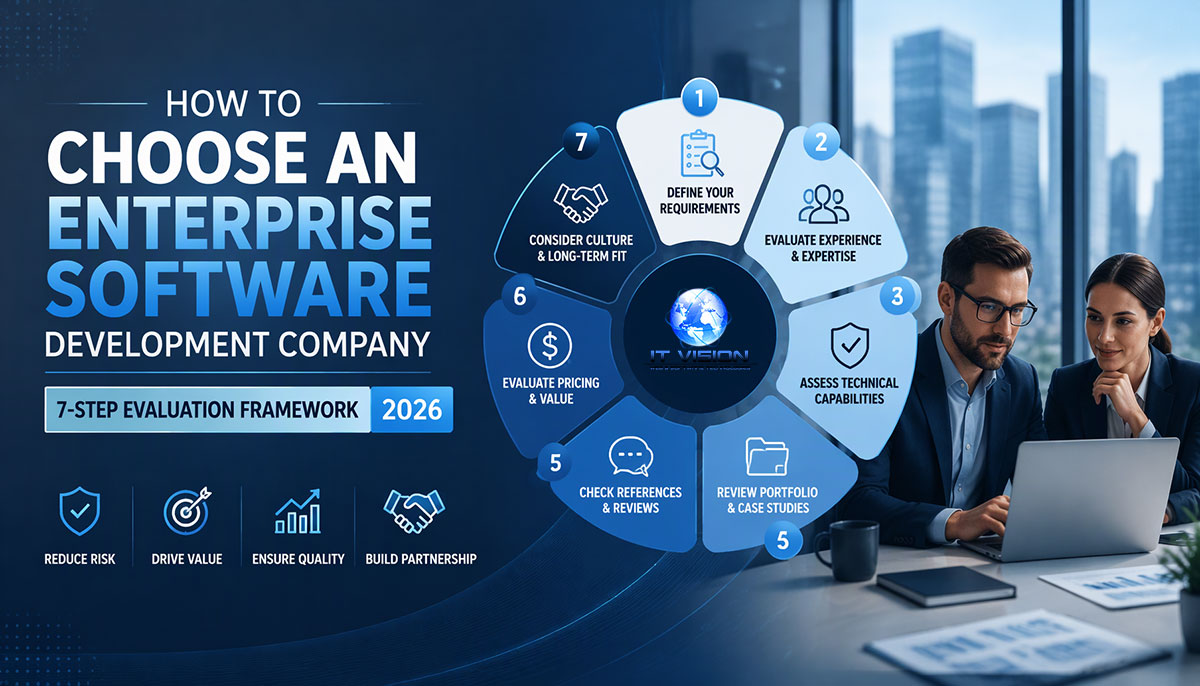
Why Choosing the Right Enterprise Software Development Partner Matters
Choosing the right enterprise software development company requires evaluating seven key factors: technical expertise and team quality, industry-specific experience and compliance knowledge, communication and project management practices, pricing transparency and contract terms, security certifications and data protection, portfolio and client references, and cultural fit and time zone alignment.
The 7-step evaluation process:
- Evaluate Technical Expertise & Team Quality — Stack, seniority mix, in-house vs staff aug
- Verify Industry Experience & Compliance — HIPAA, SOC 2, PCI DSS, vertical case studies
- Assess Communication & Project Management — Methodology, transparency, stakeholder updates
- Compare Pricing Models & Contract Terms — Fixed-price vs T&M, source code ownership, exit clauses
- Check Security Certifications & Data Protection — ISO 27001, penetration testing, data residency
- Review Portfolio & Client References — Case studies, testimonials, interview past clients
- Test Cultural Fit & Time Zone Overlap — Work culture, English proficiency, collaboration hours
The stakes are high: 55-75% of ERP projects fail, with median budget overruns of 50% and delays averaging 6 months past original timelines. Switching vendors mid-project costs 40-70% of completed work, loses 3-6 months of time, and damages team morale. A structured selection process reduces failure risk from 55-75% to under 20%, ensures budget alignment before commitment, and establishes clear exit terms if things go wrong.
This guide provides an objective framework for evaluating enterprise software vendors, backed by a downloadable scorecard to compare up to 5 companies side-by-side.
Step 1 — Evaluate Technical Expertise & Team Quality
Verify Technology Stack Alignment
Your vendor’s core technology stack should match your project needs. Hiring a .NET shop for a Python microservices project — or vice versa — creates unnecessary friction and risk.
How to verify stack alignment:
- Ask for detailed technology breakdown (languages, frameworks, databases, cloud platforms)
- Review GitHub repositories or open-source contributions to assess code quality
- Request architecture diagrams from 3-5 past projects in similar domains
Modern vs legacy stacks: Modern architectures (microservices, cloud-native, API-first) enable easier scaling and faster iteration. Legacy stacks (monolithic, on-premise) are harder to maintain but sometimes required for regulated industries with strict data residency requirements.
Red flag: Vendor claims deep expertise in 20+ unrelated technologies. True expertise requires focus — a vendor that does everything well likely does nothing exceptionally.
Assess Team Seniority Mix
The optimal development team includes 30-40% senior developers (5+ years experience), 40-50% mid-level developers (2-5 years), and 10-20% junior developers (under 2 years). This ratio balances architectural decision-making, hands-on coding efficiency, and cost management.
Why seniority matters:
- Senior developers handle architectural decisions, solve complex technical problems, and mentor junior team members
- Mid-level developers carry bulk of implementation work with proven reliability
- Junior developers support routine tasks, testing, and documentation
How to verify team composition:
- Request team profiles (LinkedIn links, resume samples)
- Ask directly: “What’s your senior-to-junior developer ratio?”
- Interview proposed team leads before signing contracts
Red flags: Teams that are 80%+ junior developers signal cost-cutting at the expense of quality, high turnover risk, and potential delivery issues. Equally concerning: vendors who refuse to share team composition, saying “trust us, we’ll assign the right people.”
Distinguish In-House Teams vs Staff Augmentation
In-house teams consist of dedicated employees the company invests in training. This model provides continuity across projects, lower turnover, and consistent process adherence.
Staff augmentation relies on contract developers hired per-project. This creates higher turnover risk, less institutional knowledge, and variable quality across engagements.
Hybrid models combine core in-house teams with specialized contractors (for example, permanent backend engineers plus contract UX designers for specific projects). This approach can work well when managed properly.
How to verify employment model:
- Ask: “Are your developers full-time employees or contractors?”
- Ask: “What’s your average developer tenure?”
- Ask: “What’s your annual turnover rate?”
Acceptable turnover: Industry average is 10-15% annually. Under 20% is good; over 30% is a major red flag indicating team instability.
Global IT Vision advantage: With 60+ products across 12+ industry verticals and 700+ completed projects, our in-house team has proven expertise across healthcare, hospitality, education, and logistics domains.
Step 2 — Verify Industry-Specific Experience & Compliance Knowledge
Prioritize Vertical Expertise
Every industry has unique requirements. Healthcare software needs HIPAA compliance and HL7/FHIR integration standards. Financial software requires PCI DSS for payments and KYC/AML workflows. Manufacturing systems need ERP and MES integration.
Domain knowledge dramatically reduces discovery time and project risk. A healthcare-experienced vendor already knows HL7/FHIR standards, eliminating the learning curve. A fintech vendor understands KYC/AML compliance flows without trial-and-error implementation.
How to verify industry expertise:
- Request 3+ detailed case studies in your specific vertical
- Ask for client references within your industry
- Inquire about industry-specific certifications
Warning: Generic development shops without vertical expertise require longer discovery phases (higher cost), make regulatory mistakes (compliance failures), and deliver feature gaps because they don’t understand industry-specific workflows.
Validate Compliance Certifications
Different industries mandate different compliance standards. Verify your vendor’s certifications match your regulatory requirements before signing any contracts.
| Industry | Required Compliance | What to Verify |
|---|---|---|
| Healthcare | HIPAA, HL7/FHIR, 21 CFR Part 11 (if FDA-regulated) | Ask for HIPAA-compliant project examples, HL7 integration experience, BAA (Business Associate Agreement) readiness |
| Finance | PCI DSS (payments), SOC 2 (data security), KYC/AML | Request SOC 2 Type II report, PCI DSS audit history, past fintech client references |
| SaaS | SOC 2 Type II, GDPR (if EU customers), ISO 27001 | Verify SOC 2 report date (must be under 12 months old), GDPR compliance documentation, data residency options |
| Manufacturing | ISO 9001 (quality), ISO 27001 (security), industry-specific standards | Ask for ISO certifications, quality management processes, regulatory audit experience |
| Government | FedRAMP (US federal), FISMA, NIST 800-53 | Verify FedRAMP authorization level (Low/Moderate/High), NIST compliance documentation, clearance levels |
How to verify compliance claims:
- Request actual certification documents (SOC 2 report, ISO 27001 certificate, PCI attestation)
- Check certificate validity dates (SOC 2 expires annually, ISO 27001 every 3 years)
- Verify the issuing auditor (Big 4 accounting firms are credible; unknown firms are suspect)
Red flag: Vendor claims “We’re SOC 2 compliant” but refuses to share the actual audit report. This likely means they’re lying or the certification is severely outdated.
Ask for Industry-Specific References
Request 3 client references within your industry with permission to interview them directly. Contact information should include both email and phone.
Interview questions to ask references:
- “Did the vendor understand industry workflows without extensive training from your team?”
- “Were they aware of regulatory requirements upfront, or did you have to educate them?”
- “Did the project pass compliance audits (HIPAA, SOC 2, PCI) on the first attempt?”
- “Would you hire them again for another industry-specific project?”
Red flag: Vendors with zero clients in your industry, or those who refuse to provide references claiming “all our clients are under NDA.” Legitimate NDAs allow for reference checks with client permission.
Step 3 — Assess Communication & Project Management Practices
Evaluate Project Management Methodology
Agile/Scrum (recommended for enterprise): Two-week sprints, daily standups, demonstrations every sprint, adaptable to changing requirements. This methodology works best when requirements evolve during development.
Waterfall (acceptable for fixed-scope projects): Detailed upfront planning, sequential phases (requirements → design → development → testing → deployment). Harder to change scope mid-project, but appropriate for regulated industries with fixed compliance requirements.
Hybrid approach (common in practice): Waterfall discovery phase to define requirements, followed by Agile implementation. This combines structured planning with implementation flexibility.
How to verify methodology fit:
- Ask: “What’s your typical sprint length?”
- Ask: “How often do we see working software?”
- Ask: “What happens if requirements change mid-project?”
Red flags: No defined methodology (“we’re flexible” usually means no process), or rigid Waterfall for projects with evolving requirements (recipe for scope creep battles).
Verify Communication Transparency
What to expect from professional vendors:
- Weekly written status updates
- Access to project management tools (Jira, Asana, Monday.com)
- Monthly stakeholder demonstrations
- Transparent blocker reporting (problems raised immediately, not hidden until too late)
Communication channels should include:
- Dedicated Slack channel or Microsoft Teams space
- Daily asynchronous updates
- Weekly video synchronization calls
- Clear emergency escalation path with response SLAs
Time zone overlap requirements: Offshore teams need 2-4 hours of daily overlap for standups and urgent issues. Nearshore teams typically provide 4-6 hour overlap. Onshore teams offer full overlap but at higher cost.
How to verify communication practices:
- Ask: “How often will we receive status updates?”
- Ask: “Do we get access to your project management tool?”
- Ask: “What’s your response SLA for urgent issues — 2 hours? 8 hours? 24 hours?”
Red flags: Monthly updates only (too infrequent for enterprise projects), no PM tool access (“we’ll email you updates” creates a black box), offshore teams with zero overlap hours (async-only communication slows decision-making dramatically).
Test Responsiveness During Sales Process
How a vendor treats you during the sales process predicts how they’ll treat you during project delivery.
Green flags:
- Responds to emails within 24 hours
- Schedules calls promptly without repeated rescheduling
- Provides detailed answers to technical questions (not vague “we can do that”)
- Sends comprehensive proposal within 3-5 days of discovery call
Red flags:
- Takes 3-5 days to respond to straightforward emails
- Reschedules calls repeatedly
- Rushes sales process (“sign now to lock in this rate”)
- Sends generic proposal obviously copy-pasted from previous clients
Test this: Send a detailed technical question during the sales cycle. Do they answer thoroughly with specific examples, or dodge with “we’ll figure that out later”?
Step 4 — Compare Pricing Models & Contract Terms
Understand Pricing Model Trade-offs
Different project types require different pricing models. Choose the structure that aligns with your project’s scope clarity and risk tolerance.
| Pricing Model | When to Use | Pros | Cons | Negotiation Tips |
|---|---|---|---|---|
| Fixed-Price | Well-defined scope, regulated projects | Predictable budget, vendor assumes risk | Inflexible (change requests costly), requires detailed scope | Negotiate change request rate upfront (cap at 20-30% over base), define “out-of-scope” clearly |
| Time & Materials | Evolving requirements, discovery phase | Flexible, pay for actual work | Unpredictable budget, requires trust | Set monthly budget cap, require weekly burn-rate reports, negotiate hourly rate tiers (senior vs junior) |
| Dedicated Team | 6+ month projects, ongoing product development | Team continuity, full control | Requires in-house PM, commitment | Negotiate 1-3 month trial period, define team composition (ratio of senior/mid/junior), exit terms (30-day notice) |
| Outcome-Based | Revenue-generating systems (rare) | Aligns incentives | Hard to define metrics, uncommon | Define success metrics upfront (e.g., “20% revenue increase” = bonus), base fee + performance bonus structure |
Recommendation:
- Discovery phase: Always use time & materials (scope is unknown)
- Implementation: Fixed-price IF scope is detailed and frozen (protects your budget)
- Post-launch support: Monthly retainer (predictable support costs)
For custom ERP development services, most projects start with 2-4 week discovery sprints on time & materials, then transition to fixed-price for implementation once requirements are finalized.
Negotiate Source Code Ownership & IP Rights
Work-for-hire clause (STRONGLY RECOMMENDED): Client owns all code developed during the project. You can switch vendors anytime without restrictions. No ongoing royalties owed.
Vendor retains IP (AVOID): Vendor owns the code and licenses it to you. Often 20-30% cheaper upfront, but creates permanent vendor lock-in. The vendor can raise maintenance rates arbitrarily, and you can’t take the code elsewhere.
Hybrid model (acceptable for white-label products): Vendor retains base product IP, client owns customizations. This is common for white-label enterprise software solutions where the vendor has invested in core platform development.
Source code escrow: If vendor retains IP, negotiate an escrow agreement. If the vendor goes bankrupt or abandons the project, the code is released to you.
How to verify IP terms:
- Review the contract’s intellectual property clause carefully before signing
- Ask directly: “Will we own the source code outright?”
- Request a sample work-for-hire agreement to review
Red flag: Vendor refuses work-for-hire terms unless you’re purchasing a white-label product where shared IP is the business model.
Global IT Vision advantage: We offer source code licensing options for our 60+ products — rare flexibility in the enterprise software market that gives clients full IP transfer options.
Define Clear Exit Terms & Change Request Policies
Exit clause requirements:
- 30-60 day notice period (you can terminate for any reason)
- Prorated refund for unused retainer fees
- All code, documentation, and credentials transferred within 14 days of termination
Change request policy must define:
- Clear distinction between “in-scope” and “out-of-scope” work
- Change request approval process (written change order signed by both parties)
- Hourly rate for change requests (should match time & materials rate, not be inflated)
Payment terms:
- Milestone-based payments (pay upon deliverable acceptance, not 100% upfront)
- Holdback 10-20% of total payment until final acceptance
- Consider escrow for large projects over $500K
Red flags: No exit clause (you’re locked in forever), 100% upfront payment requirement (enormous risk), vague scope definition (“additional features as needed” creates open-ended billing).
Step 5 — Check Security Certifications & Data Protection Practices
Verify Security Certifications & Audit History
ISO 27001 (information security management): The gold standard for organizational security. Requires annual surveillance audits and 3-year recertification. Demonstrates systematic approach to information security.
SOC 2 Type II (service organization controls): Required for SaaS vendors. Audits security, availability, confidentiality, processing integrity, and privacy. Reports must be less than 12 months old to be credible.
Penetration testing: Annual penetration tests by reputable third-party security firms demonstrate proactive vulnerability management. Ask for summary reports (not full reports with exploit details).
Vulnerability scanning: Continuous vulnerability scanning tools, OWASP Top 10 coverage, and documented patch management with SLAs (critical patches within 24 hours).
How to verify security practices:
- Request ISO 27001 certificate plus most recent audit report
- Request SOC 2 Type II report (must be within 12 months)
- Ask for recent penetration test summary and remediation status
Red flag: Vendor claims “we’re secure” with zero certifications, outdated SOC 2 report (over 12 months old), or refusal to share any penetration test results.
Assess Data Protection & Privacy Practices
Data residency: Where will your data be physically stored? GDPR requires EU data to remain in EU data centers. Some industries require US-only data storage for compliance.
Encryption requirements:
- At-rest encryption using AES-256 or equivalent
- In-transit encryption using TLS 1.2 or higher
- Key management through secure services (AWS KMS, Azure Key Vault)
Access controls:
- Role-based access control (RBAC)
- Multi-factor authentication (MFA) for administrative access
- Comprehensive audit logs tracking who accessed what data and when
Data retention and deletion: Understand how long data is retained and whether you can request deletion (GDPR “right to be forgotten” compliance).
How to verify data protection:
- Ask: “Where will our data be hosted geographically?”
- Ask: “Is data encrypted both at-rest and in-transit?”
- Ask: “Can we request complete data deletion?”
Review NDA & Confidentiality Agreements
Mutual NDA: Both parties protect each other’s confidential information. This is standard practice for enterprise engagements.
Data processing agreement (DPA): Required for GDPR compliance. Defines vendor as “data processor” and your organization as “data controller” with clear obligations.
Background check policy: For sensitive projects (finance, healthcare), require background checks for all developers who will access production data.
Red flag: Vendor refuses to sign a mutual NDA (“we don’t do those” signals lack of professionalism), or proposes a DPA with terms suggesting the vendor claims ownership of your data.
Step 6 — Review Portfolio & Client References
Evaluate Portfolio Relevance & Depth
What to look for in vendor portfolios:
- 5-10 detailed case studies in your industry or similar complexity
- Specific project descriptions (problem statement, solution approach, measurable outcomes)
- Quantified results (40% cost savings, 60% faster time-to-market, 25% increase in user adoption)
Warning signs:
- Generic portfolio with no details, only screenshots
- Outdated projects all 3+ years old
- No measurable outcomes (“we built a system” vs “we reduced order processing time by 40%”)
How to verify portfolio quality:
- Ask: “Can you share 3 case studies similar to our project requirements?”
- Request live demonstrations of past work where applicable
- Check client testimonials on Clutch, GoodFirms, or similar platforms
Global IT Vision portfolio: 60+ products across 12+ verticals (healthcare, hospitality, education, logistics) with 700+ completed projects demonstrate proven track record across diverse enterprise requirements.
Interview Past Clients (Reference Calls)
Request 3 references ideally in your industry, with similar project size and complexity, completed within the last 12 months (not 5 years ago when processes may have been different).
Critical questions to ask references:
- “Did the project finish on time and on budget? If not, what percentage overrun occurred?”
- “How was communication throughout the project? Did you feel informed and consulted?”
- “How did the vendor handle unexpected problems or blockers? Transparent or defensive?”
- “What was the quality of delivered code? Were there major post-launch bugs?”
- “How was post-launch support? Responsive or did they disappear after go-live?”
- “Was there good cultural fit? Easy to work with, or constant friction?”
- “Would you hire them again? Why or why not?”
Red flags from references: “Communication was poor throughout,” “lots of bugs after launch,” “they disappeared after go-live,” “would not hire again under any circumstances.”
How to interpret mixed feedback: If 1-2 references say “great experience” but a third says “nightmare,” dig deeper. This may indicate inconsistent quality or specific team problems.
Check Third-Party Reviews (Clutch, GoodFirms, Google)
Review platforms to check:
- Clutch.co
- GoodFirms
- Google Business Profile
- Trustpilot
What to evaluate:
- Overall rating (4.5+ stars is good)
- Number of reviews (10+ reviews are credible; 1-2 reviews are suspect)
- Recency (reviews within last 12 months are most relevant)
- Response to negative reviews (professional responses vs ignoring criticism)
Red flags: Zero reviews (very new company or poor reputation), all 5-star reviews with generic language (potentially fake), vendor argues with negative reviewers (defensive culture).
Step 7 — Test Cultural Fit & Time Zone Alignment
Assess Work Culture & Collaboration Style
Work culture dimensions to evaluate:
- Formal vs casual communication style
- Documentation-heavy vs move-fast culture
- Hierarchical vs flat team structure
How to test culture during sales process:
- Notice communication style: Do they challenge your assumptions constructively, or just say “yes” to everything?
- Ask: “How do you handle disagreements with clients?”
- Observe team dynamics in video calls: Do junior developers speak up, or only senior staff?
Green flags:
- Vendor asks clarifying questions instead of just nodding along
- Challenges assumptions politely (“Have you considered this alternative approach?”)
- Admits when they don’t know something (“Let me research that and get back to you by tomorrow”)
Red flags:
- Always agrees with you (signals either lack of expertise or conflict-avoidance)
- Dismissive of your ideas or existing systems
- Condescending tone in technical discussions
Verify English Proficiency & Communication Skills
For offshore development teams, strong communication skills are critical to project success.
What “strong English proficiency” means:
- Clear written English for technical documentation and status updates
- Conversational spoken English for video calls and requirement discussions
- Ability to explain complex technical concepts clearly
How to test communication skills:
- Conduct video interview with your proposed team lead
- Ask them to explain a complex technical concept: Do they explain clearly or struggle?
- Review writing samples (past status updates, proposals, technical documentation)
Regional English proficiency levels:
- Pakistan/India: Generally strong English proficiency (English as official business language)
- Ukraine/Poland: Good English, especially in IT sector
- Vietnam/China: More variable, test thoroughly before committing
Red flag: Heavy accent you genuinely can’t understand, poor grammar in written proposals (typos everywhere, unclear sentences), inability to explain technical concepts clearly.
Confirm Time Zone Overlap & Availability
Minimum overlap requirements: Even for offshore teams, you need 2-4 hours of daily overlap for standups, urgent issue resolution, and real-time collaboration.
How to verify time zone management:
- Ask: “What hours will your team overlap with ours?”
- Ask: “Are you willing to adjust schedules during critical launch periods?”
- Ask: “What’s your holiday calendar?” (India: Diwali, Pakistan: Eid, Europe: August vacations)
Best practice: Schedule core collaboration hours (for example, 9am-11am your time = 6pm-8pm their time for Pakistan-based teams). Use asynchronous communication for everything else to maximize efficiency.
Red flag: Zero overlap proposed (“we’ll just email updates” leads to slow progress), inflexible schedule (“we only work 9am-5pm our time with no exceptions”).
Red Flags to Avoid When Choosing a Vendor
1. Refuses to Sign NDA or Provide References
Legitimate vendors routinely protect client confidentiality (NDAs are standard) and have satisfied clients willing to serve as references. Refusal signals either inexperience or a problematic track record.
2. Provides Instant Quote Without Discovery
Accurate cost estimates require understanding detailed requirements. A vendor who says “we can build that for $50K” after a 15-minute introductory call doesn’t understand the scope and will either underdeliver or demand expensive change orders.
3. 100% Junior Team or Unclear Team Composition
Quality enterprise software requires senior oversight (30-40% senior developers minimum). An all-junior team or refusal to share team composition indicates cost-cutting at the expense of quality and project success.
4. No Industry-Specific Experience or Certifications
Building healthcare software without HIPAA experience leads to compliance failures. Developing financial software without PCI DSS expertise results in security breaches. Industry expertise isn’t optional for regulated verticals.
5. Poor Communication During Sales Process
Slow email responses, vague answers to direct questions, and missed meetings during the sales process predict worse communication during project delivery. Remember: sales is the vendor’s BEST behavior — it typically declines from there.
6. Unrealistic Timeline Promises
Claims like “we can build a complete enterprise ERP in 2 months” (when industry average is 8-12 months) indicate either gross misunderstanding of requirements or deliberate overpromising. Realistic estimates signal a credible vendor.
7. Refuses Work-for-Hire or Source Code Ownership
When vendors retain intellectual property ownership, you’re permanently locked in. Legitimate custom development vendors offer work-for-hire terms where clients own the code. Refusal signals intention to hold your code hostage for ongoing fees.
8. No Exit Clause or Punitive Cancellation Terms
Contract terms like “3-year commitment with no cancellation allowed” or “$100K early termination fee” create vendor lock-in. Reasonable terms include 30-60 day notice period, prorated refunds, and code transfer.
9. Vague Scope Definition or “We’ll Figure It Out Later”
Statements like “we’ll build whatever you need” without detailed requirements documentation lead to scope creep disasters. Professional vendors insist on written, detailed scope before providing fixed-price quotes.
10. Outdated Portfolio (All Projects 3+ Years Old)
Technology evolves rapidly. A portfolio showing only projects from 5 years ago suggests outdated technical skills (legacy technologies, old frameworks, obsolete patterns). Look for projects completed within the last 12-24 months.
Vendor Evaluation Scorecard: Compare Up to 5 Companies Objectively
Use this weighted scoring system to evaluate enterprise software vendors objectively. Rate each vendor 0-100 points across seven categories.
Category 1: Technical Expertise (25 points total)
- Modern technology stack alignment with your needs (5 points)
- Team seniority mix with 30-40% senior developers (5 points)
- In-house team vs staff augmentation model (5 points)
- GitHub/open-source contributions demonstrating code quality (3 points)
- Technical interview performance with proposed team leads (7 points)
Category 2: Industry Experience (20 points total)
- Three or more case studies in your specific vertical (8 points)
- Required compliance certifications (HIPAA, SOC 2, PCI DSS, etc.) (7 points)
- Verifiable client references in your industry (5 points)
Category 3: Communication & PM (15 points total)
- Defined methodology (Agile/Scrum or appropriate alternative) (4 points)
- Transparency (PM tool access, weekly updates) (5 points)
- Time zone overlap of 2-4 hours minimum (3 points)
- Demonstrated responsiveness during sales process (3 points)
Category 4: Pricing & Contracts (15 points total)
- Transparent pricing with no hidden fees (4 points)
- Favorable IP terms (work-for-hire or source code licensing) (5 points)
- Reasonable exit clause (30-60 day notice period) (3 points)
- Clear change request policy defined upfront (3 points)
Category 5: Security & Compliance (15 points total)
- ISO 27001 or SOC 2 Type II certification (current) (7 points)
- Annual penetration testing by reputable firms (4 points)
- Data residency options (GDPR compliance support) (4 points)
Category 6: Portfolio & Reputation (5 points total)
- Relevant portfolio with 5-10 detailed case studies (2 points)
- Positive third-party reviews (Clutch 4.5+ stars, 10+ reviews) (3 points)
Category 7: Cultural Fit (5 points total)
- Work culture alignment with your organization (2 points)
- Strong English proficiency (written and spoken) (3 points)
Scoring Guide
Total Score Interpretation:
- 80-100 points: Excellent fit — proceed to contract negotiation
- 60-79 points: Good fit — address identified gaps before proceeding
- 40-59 points: Marginal fit — high project risk, strongly consider alternatives
- Under 40 points: Poor fit — do not proceed with this vendor
Download the Scorecard
Note: The Enterprise Software Vendor Evaluation Scorecard PDF is currently in production. A spreadsheet template is available as an interim solution for comparing vendors using this framework. Contact us to request the current template or for assistance using this evaluation framework for your specific project requirements.
Post-download nurture sequence (once PDF is available):
- Email 1 (immediate): Scorecard PDF download link plus 3-minute “How to use this scorecard” video
- Email 2 (Day 3): “10 Red Flags to Avoid When Choosing a Vendor” educational content
- Email 3 (Day 7): “White-Label vs Custom Development: Which is Right for You?” comparison
- Email 4 (Day 14): “Book a free vendor evaluation consultation” demo booking CTA
Frequently Asked Questions
What should I look for when choosing an enterprise software development company?
Evaluate seven factors: technical expertise (modern stack, 30-40% senior developers), industry experience (three or more case studies, required certifications like HIPAA or SOC 2), communication practices (Agile methodology, PM tool access), transparent pricing (work-for-hire IP terms), security certifications (ISO 27001, penetration testing), relevant portfolio, and cultural fit (time zone overlap, English proficiency).
How do I verify a software vendor’s technical expertise?
Request team profiles (LinkedIn, resumes), ask about technology stack and seniority mix (30-40% senior developers ideal), review GitHub contributions, conduct technical interviews with proposed team leads, check for modern frameworks (microservices, cloud-native, API-first versus legacy monoliths), and verify in-house team versus staff augmentation model (in-house teams have lower turnover).
What questions should I ask vendor references?
Ask seven questions: Did project finish on time and budget? How was communication? How did vendor handle problems? What was code quality? How was post-launch support? Was there good cultural fit? Would you hire them again? Request three references in your industry, completed within last 12 months, and verify answers match portfolio claims.
Should I choose fixed-price or time & materials pricing?
Use time & materials pricing for discovery phase (scope is unknown), fixed-price for implementation (if detailed requirements exist and scope is frozen), and retainer model for post-launch maintenance. Fixed-price requires detailed scope definition upfront and protects budget but limits flexibility. Time & materials offers flexibility for evolving requirements but needs trust and sprint-based budget management.
What are red flags when evaluating software vendors?
Ten critical red flags: refuses NDA or references, provides instant quotes without discovery, 100% junior team composition, no industry certifications, poor communication during sales, unrealistic timeline promises, refuses work-for-hire IP terms, no exit clause in contracts, vague scope definition, and outdated portfolio with all projects 3+ years old. Any of these signals inexperience or problematic practices.
Need Help Evaluating Enterprise Software Vendors?
Choosing the right development partner is critical to project success. If you need guidance evaluating vendors for your specific requirements, request a free vendor evaluation consultation to discuss your selection criteria, compliance needs, and technical requirements with our team.
Considering white-label enterprise software instead? Skip the lengthy vendor selection process entirely. Explore Global IT Vision’s 60+ pre-built products with 14-30 day deployment timelines and source code licensing options. Our hospital management ERP, education management systems, and other vertical solutions serve clients across 12+ industries worldwide.
For custom development needs, review our comprehensive enterprise software development cost guide and top 10 enterprise software development companies 2026 comparison.
Sources
- Selection criteria: Blackthorn Vision, Apptunix, CodeStore Solutions vendor selection guides
- ERP failure rates (55-75%): Industry research and analyst reports
- Compliance standards: HIPAA, SOC 2, PCI DSS, ISO 27001, GDPR, FedRAMP official documentation
- Global IT Vision capabilities: 60+ products, 700+ projects delivered (company verified data)
- Developer turnover benchmarks (10-15% industry average): widely cited industry research standard