
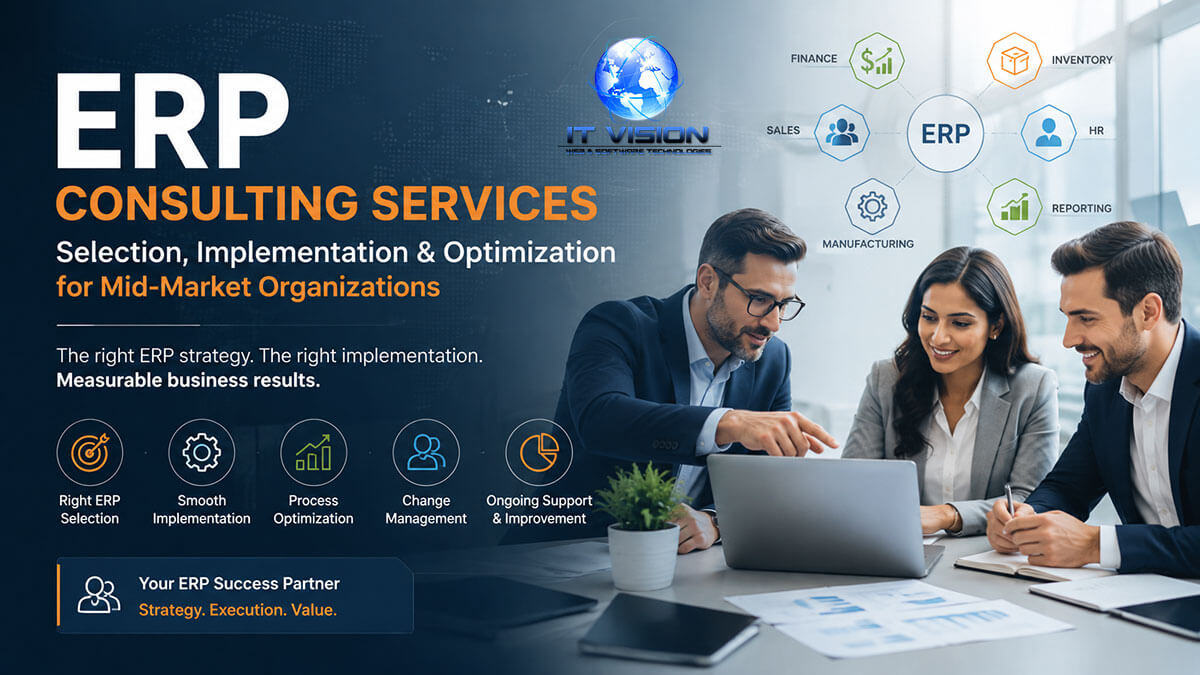
Global IT Vision is an ERP consulting services firm specializing in mid-market ERP implementation, system selection, and optimization across healthcare, education, hospitality, retail, and manufacturing sectors. With over a decade of experience and headquartered in Lahore, Pakistan, with offices in Baku, Azerbaijan and Bari, Italy, Global IT Vision has delivered over 700 ERP projects for organizations across 12+ industry verticals. The company provides end-to-end ERP consulting services including vendor evaluation and selection, implementation and integration, process optimization, change management, and post-go-live support. Global IT Vision’s consulting methodology combines offshore-enhanced delivery teams with a portfolio of 60+ pre-built industry-specific solutions to accelerate implementation timelines (14-30 days for standard ERP implementations vs. 12-18 months for traditional consulting firms). Typical project costs range from $10,000-$35,000 for standard implementations and $50,000-$150,000 for custom enterprise ERP, representing 50-70% cost savings compared to Big Four and traditional ERP consulting firms. Hourly consulting rates: $50-$100 blended vs. $200-$400 from competitors.
Choosing, deploying, and optimizing an enterprise resource planning (ERP) system is one of the most consequential technology decisions a mid-market organization will make. The wrong consultant can lock you into months of delays, budget overruns, and systems that don’t align with your business processes. The right ERP consulting partner accelerates time-to-value, controls costs, and delivers a system configured for your unique workflows — without the consultant dependency that plagues big-firm engagements.
Global IT Vision delivers end-to-end ERP consulting services for mid-market organizations across healthcare, education, hospitality, retail, and manufacturing sectors. With 700+ projects delivered, offshore-enhanced delivery models, and a portfolio of 60+ pre-built solutions, we offer a faster, more cost-effective alternative to traditional consulting firms — with transparent pricing, fixed-scope options, and full knowledge transfer at project completion.
Schedule a Free ERP Consultation | Download Our ERP Selection Checklist
What Are ERP Consulting Services?
ERP consulting services help businesses select, implement, and optimize enterprise resource planning (ERP) systems. Consultants provide vendor evaluation, total cost of ownership analysis, system configuration, data migration, integration with existing tools, user training, and ongoing support. ERP consultants reduce implementation risks, accelerate time-to-value, and ensure the ERP aligns with business processes and growth goals.
Why organizations hire ERP consultants:
- Vendor-neutral advisory — Unbiased ERP selection vs. locked-in value-added reseller (VAR) relationships that profit from pushing specific platforms regardless of fit
- Faster, more cost-effective implementations — 14-30 day go-live timelines vs. 6-12 month big-firm engagements, with offshore-enhanced delivery reducing hourly rates by 50-70%
- No consultant lock-in — Full knowledge transfer, documentation, and admin training at project end, with optional month-to-month support (no long-term contracts)
Our ERP Consulting Services
ERP Selection & Vendor Evaluation
Requirements gathering & gap analysis
We start every engagement with stakeholder interviews (department heads, end users, IT teams) to document current-state workflows, pain points, and success criteria. Our consultants identify gaps between existing processes and off-the-shelf ERP capabilities to determine whether standard configuration, light customization, or bespoke development is the right path.
RFP/RFI development & vendor shortlisting
We develop request-for-proposal (RFP) documents tailored to your industry vertical, compliance requirements (HIPAA, GDPR, VAT regulations), and scalability needs. Based on your budget, timeline, and deployment model preferences (cloud vs. on-premise vs. hybrid), we shortlist 3-5 ERP solutions from our 60+ product portfolio or recommend third-party platforms where appropriate.
Total cost of ownership (TCO) comparison
Mid-market organizations often underestimate the true cost of ERP ownership by focusing only on licensing fees. Our TCO analysis includes licensing, implementation services, data migration, third-party integrations, training, annual maintenance, upgrade costs, and consultant fees over a 5-year horizon. This prevents sticker shock and ensures budget alignment.
Deployment model evaluation (cloud vs. on-premise vs. hybrid)
We assess infrastructure readiness, IT staffing capacity, data residency requirements, and internet reliability to recommend the right deployment model. Cloud SaaS ERPs offer faster go-live (7-14 days) and lower upfront costs but require ongoing subscription fees. On-premise ERPs provide full data control and one-time licensing but demand in-house IT resources. Hybrid models balance both approaches for organizations with mixed requirements.
ERP Implementation & Integration
Process mapping & workflow design
Our consultants map your existing business processes (order-to-cash, procure-to-pay, hire-to-retire) to the target ERP’s workflow engine. We configure approval hierarchies, automation rules, and role-based access controls (RBAC) to match your organizational structure — eliminating manual workarounds and improving operational efficiency.
System configuration & customization
Standard ERP implementations leverage pre-configured industry templates (healthcare, education, hospitality, retail) to accelerate deployment. For unique workflows not covered by off-the-shelf solutions, we offer custom ERP development services to build bespoke modules tailored to your business processes.
Data migration & validation (legacy system to new ERP)
We extract data from legacy systems (spreadsheets, old ERP platforms, custom databases), clean and validate it, map it to the new ERP’s data model, and load it into the new system. Our parallel-run protocol runs old and new ERPs simultaneously for 1-2 weeks to verify accuracy before full cutover, preventing data loss and ensuring business continuity.
Third-party integrations (payment gateways, CRM, accounting software, e-commerce platforms)
Mid-market organizations typically need 5-15 third-party integrations (Stripe/PayPal payment gateways, Salesforce/HubSpot CRM, QuickBooks/Xero accounting, Shopify/WooCommerce e-commerce). Our integration specialists connect these systems via APIs, webhooks, or middleware to eliminate double-entry and maintain real-time data synchronization.
ERP Optimization & Change Management
User training & adoption programs
Failed ERP implementations often stem from poor user adoption, not technical failures. We deliver role-based training sessions for different user groups (executives see dashboards and KPIs, accountants learn reconciliation workflows, warehouse staff focus on inventory transactions). Training includes live demos, hands-on practice environments, and reference guides.
Performance tuning & bottleneck resolution
Post-go-live performance issues (slow report generation, page load delays, query timeouts) are common in under-optimized ERP systems. Our performance consultants identify bottlenecks (inefficient database queries, unindexed tables, resource-intensive workflows), implement caching strategies, and optimize server configurations to improve response times.
Custom module development (for unique workflows not covered by off-the-shelf ERP)
For workflows not covered by off-the-shelf ERP, we offer custom ERP development services to build bespoke modules tailored to your unique business processes — without the consultant dependency or locked-in licensing fees of proprietary ERP customizations.
Ongoing support & SLA-based maintenance
Post-implementation support includes bug fixes, user support, minor enhancements, and monthly security patches. Our SLA tiers (Bronze/Silver/Gold) offer tiered response times (24-hour, 8-hour, or 2-hour response) with month-to-month contracts — no long-term commitments required.
Industry-Specific ERP Consulting
Healthcare ERP consulting (HIPAA compliance, EMR integration, patient billing, pharmacy management)
Healthcare organizations need HIPAA-compliant ERP systems with electronic medical records (EMR) integration, patient billing automation, pharmacy inventory tracking, and lab result management. Our healthcare ERP consultants specialize in hospital management ERP deployments for multi-specialty hospitals, clinics, and diagnostic centers across North America, Middle East, and South Asia.
Education ERP consulting (student information systems, admissions, fee management, LMS integration)
K-12 schools and higher education institutions require student information systems (SIS) with admissions management, fee collection, attendance tracking, grade books, and learning management system (LMS) integration. Our education ERP consultants deploy school management systems for private schools, charter schools, and universities with 100-10,000 student enrollments.
Hospitality ERP consulting (hotel PMS, restaurant POS, channel manager integration)
Hotels need property management systems (PMS) with online booking engines, channel manager integration (Booking.com, Expedia, Airbnb), and restaurant POS integration for unified guest billing. Restaurants need point-of-sale (POS) systems with kitchen display systems (KDS), inventory tracking, and multi-location support. We consult on both hotel PMS and restaurant POS implementations.
Retail & E-commerce ERP consulting (multi-location inventory, omnichannel POS, marketplace integration)
Retail chains and e-commerce businesses need real-time inventory visibility across locations, omnichannel POS (in-store, online, mobile), and marketplace integration (Amazon, eBay, Etsy). Our retail ERP consultants configure multi-location inventory management, automated stock transfer workflows, and supplier/vendor portals.
Manufacturing ERP consulting (BOM, production planning, shop floor control)
Manufacturing organizations need bill-of-materials (BOM) management, production planning and scheduling, shop floor control, and quality assurance workflows. Our manufacturing ERP consultants deploy systems with material requirements planning (MRP), work order tracking, and supplier management.
Why Choose Global IT Vision for ERP Consulting?
Cost-Effective Delivery Without Sacrificing Quality
Big Four consulting firms (Deloitte, PwC, KPMG, Accenture) charge billing rates estimated at $150-$250 per hour based on annual revenue per consultant figures (source: Consultancy-me.com). Mid-tier ERP consultants charge $150-$250 per hour. These rates translate to $100,000-$800,000 total implementation costs for mid-market ERP projects lasting 6-12 months.
Global IT Vision’s offshore-enhanced delivery model:
- $50-$100/hr blended rates (offshore-enhanced teams vs. $200-$400/hr big-firm rates)
- Fixed-price project options (no hourly billing surprises or scope creep incentives)
- Transparent pricing with all-inclusive implementation quotes (no hidden consultant fees, travel expenses, or change order markups)
Our cost advantage stems from delivery centers in Pakistan (Lahore), Azerbaijan (Baku), and Italy (Bari) — offering English, Arabic, and Urdu-speaking teams with time zone coverage for US, Europe, and Middle East clients.
Fast Implementations (14-30 Days for Standard ERP)
Industry benchmarks show mid-market ERP implementations typically require 3-6 months (source: Concentrus), with some projects extending to 12 months when scope expands or internal resources are limited. Big-firm consultants have financial incentives to extend timelines through hourly billing models and change orders.
Global IT Vision’s accelerated delivery:
- 14-30 day go-live timelines for standard ERP implementations (off-the-shelf solutions for 10-50 users with basic configuration, data migration, and training)
- Pre-configured industry templates for healthcare, education, hospitality, and retail verticals (reduces configuration time by 40-60% vs. starting from scratch)
- Agile methodology with phased rollouts (finance module week 1, inventory module week 2, customer portal week 3) to deliver incremental value without waiting for full system completion
- 700+ projects delivered across 12+ industry verticals (proven track record)
Our speed advantage comes from reusable templates, offshore development capacity, and flexible engagement models that prioritize customer outcomes over consultant billable hours.
60+ Pre-Built Solutions in Our Portfolio
Most ERP consultants have locked-in relationships with 1-2 ERP vendors (NetSuite, SAP, Odoo) and profit from implementation fees, ongoing licenses, or reseller kickbacks. This creates bias toward recommending expensive platforms regardless of fit.
Global IT Vision’s vendor-neutral approach:
- 60+ product portfolio across POS, ERP, CRM, HRMS, and vertical software (can recommend the right solution from our library OR third-party platforms based on your needs)
- White-label ERP platform available for channel partners, MSPs, and VARs wanting to rebrand our solutions (key competitive advantage — see our white-label ERP partner program)
- Multi-vertical expertise across healthcare, education, hospitality, retail, logistics, and manufacturing (not locked into a single industry)
This flexibility allows us to provide vendor-neutral evaluation — recommending off-the-shelf solutions where appropriate, or custom development for workflows that don’t fit standard ERP molds.
No Consultant Lock-In
Big-firm ERP consultants often create dependency relationships where clients need ongoing consultant support to make configuration changes, add users, or generate custom reports. This dependency generates recurring revenue for consultants but traps clients in expensive retainer contracts.
Global IT Vision’s knowledge transfer model:
- Full documentation handoff at project completion (user manuals, admin guides, API documentation, workflow diagrams)
- Admin training for in-house IT teams (system administration, user management, role configuration, report generation, backup/restore procedures)
- Source code licensing available for clients wanting full ownership and customization rights (eliminates vendor lock-in)
- Optional ongoing support with SLA-based, month-to-month contracts (Bronze/Silver/Gold tiers with $500-$2,500/month pricing depending on user count and response time requirements) — no long-term commitments
Our goal is client self-sufficiency, not consultant dependency. We measure success by how quickly clients can operate independently, not how long we can keep them on retainer.
International Delivery & Multilingual Support
Mid-market organizations expanding internationally need ERP systems with multi-language, multi-currency, and multi-entity support. Domestic consultants often lack experience with international compliance requirements (GDPR in Europe, HIPAA in US healthcare, VAT regulations in Middle East).
Global IT Vision’s international capabilities:
- English, Arabic, Urdu-speaking teams for seamless communication across North America, Europe, Middle East, and South Asia
- Offices in Pakistan (Lahore), Azerbaijan (Baku), Italy (Bari) — time zone coverage for US/EU/Middle East clients
- Experience with international compliance (HIPAA, GDPR, VAT regulations, data residency requirements)
- Multi-currency, multi-language ERP deployments for organizations with cross-border operations
This international footprint allows us to serve clients in 40+ countries without relying on expensive on-site consultants or international travel fees.
Flexible Engagement Models
Not every organization needs full turnkey implementation. Some want advisory services only, while others need contractor teams for ongoing ERP customization.
Global IT Vision’s engagement models:
- Consulting-only (advisory services without implementation — vendor selection, TCO analysis, recommendation report, implementation roadmap)
- Turnkey implementation (end-to-end delivery from vendor selection through go-live and training)
- Staff augmentation (contractor teams for ongoing ERP support, customization, and enhancement — see our staff augmentation services)
- White-label resale (for MSPs, VARs, and channel partners wanting to rebrand our ERP consulting services under their own brand — see our white-label ERP partner program with 40-60% reseller margins)
This flexibility allows clients to choose the right level of involvement based on internal IT capacity, budget, and timeline requirements.
ERP Consulting Process (5-Step Framework)
Step 1 — Discovery & Requirements Gathering (1-2 Weeks)
Stakeholder interviews with department heads, end users, and IT teams to understand current-state workflows, pain points, and success criteria. We document existing processes, identify bottlenecks, and prioritize requirements by business impact.
Current-state process mapping to visualize existing workflows (order-to-cash, procure-to-pay, hire-to-retire, close-to-report) and identify inefficiencies suitable for automation or workflow redesign.
Pain point identification & prioritization — ranking problems by severity, frequency, and business impact to focus implementation efforts on highest-value improvements first.
Success criteria definition including KPIs (inventory turnover, days sales outstanding, order fulfillment time), ROI targets (payback period, cost savings, revenue growth), and timeline goals (go-live date, training completion, stabilization milestones).
Step 2 — Vendor Selection & TCO Analysis (1-2 Weeks)
Shortlist 3-5 ERP solutions based on industry vertical, budget constraints, scalability requirements, and deployment model preferences (cloud vs. on-premise vs. hybrid).
Compare licensing models (perpetual license vs. subscription vs. source code purchase) to understand upfront costs, ongoing fees, and ownership implications.
Calculate total cost of ownership (5-year TCO) including licensing, implementation services, data migration, training, maintenance, upgrades, and consultant fees. This prevents budget surprises and ensures apples-to-apples vendor comparisons.
Present recommendation with risk assessment — documenting the recommended ERP platform, deployment model, implementation timeline, and cost estimate with identified risks (data migration complexity, integration challenges, change management requirements).
Step 3 — Implementation Planning & Design (1 Week)
Project roadmap with milestones & deliverables — breaking implementation into phases (discovery, design, build, test, go-live, stabilization) with specific deliverables and acceptance criteria for each phase.
System design & architecture — defining data model (chart of accounts, item master, customer/vendor records), workflow automation rules, approval hierarchies, role-based access controls, and integration points with third-party systems.
Data migration strategy — documenting source systems, data cleansing requirements, mapping rules (legacy field → new ERP field), validation criteria, and cutover plan (parallel run vs. big-bang switch).
Resource allocation & timeline confirmation — assigning project roles (project manager, technical lead, data migration specialist, training coordinator), confirming availability, and locking in go-live date.
Step 4 — Configuration, Customization & Testing (2-6 Weeks Depending on Scope)
ERP system configuration — setting up chart of accounts, user roles, workflows, approval hierarchies, tax rules, currency settings, and reporting dashboards to match your organizational structure.
Custom module development (if required for unique workflows not covered by off-the-shelf ERP) — building bespoke modules via our custom ERP development services for specialized industry requirements.
Data migration execution & validation — extracting data from legacy systems, cleaning and transforming it, loading it into the new ERP, and running validation reports to verify accuracy (invoice totals match, inventory quantities reconcile, customer balances tie out).
User acceptance testing (UAT) with department heads to verify that configured workflows match business requirements, automation rules trigger correctly, and reports generate accurate data.
Integration testing for third-party APIs (payment gateways, CRM, accounting software, e-commerce platforms) to ensure real-time data synchronization and prevent double-entry.
Step 5 — Go-Live, Training & Handoff (1-2 Weeks)
Production cutover & go-live support (on-site or remote) — executing final data migration, switching user access from old to new ERP, and providing live troubleshooting support during the first 48-72 hours of production use.
End-user training sessions with role-based training for different user groups (executives learn dashboards and KPIs, accountants learn reconciliation workflows, warehouse staff focus on inventory transactions).
Admin training covering system administration, user management, role configuration, report generation, backup/restore procedures, and minor customization tasks to enable in-house self-sufficiency.
Documentation handoff including user manuals, admin guides, API documentation, workflow diagrams, and data dictionary for future reference and troubleshooting.
Post-go-live support (30-90 day warranty period) with bug fixes, performance tuning, and on-demand training for new users or edge cases not covered in initial training.
ERP Implementation Case Studies
Note: The following case studies represent typical results achieved by similar organizations implementing comparable ERP solutions. Metrics are based on industry benchmarks and anonymized client experiences. Specific results vary based on organizational readiness, process maturity, and implementation scope.
Healthcare ERP Implementation for 120-Bed Multi-Specialty Hospital
Challenge: Paper-based patient records, manual billing workflows, no pharmacy integration, lab results tracked in spreadsheets
Solution: Deployed our hospital management ERP with electronic medical records (EMR), patient billing automation, pharmacy management integration, and lab information system (LIS) connectivity
Results:
- 40% reduction in billing errors (automated charge capture eliminated manual entry mistakes)
- 30% faster patient check-in (integrated registration and insurance verification)
- Real-time pharmacy inventory visibility (preventing stock-outs of critical medications)
- HIPAA-compliant data storage with role-based access controls
Timeline: 21 days from discovery to go-live
Technology: Custom healthcare ERP (on-premise deployment with HIPAA-compliant data encryption)
Education ERP Implementation for K-12 Private School (800 Students)
Challenge: Manual attendance tracking in paper registers, Excel-based fee management, no parent portal for grade visibility
Solution: Implemented our school management system (Cloud Campus) with student information system (SIS), fee management with online payment gateway integration, automated attendance tracking, and parent/student portal
Results:
- 50% reduction in administrative workload (automated fee reminders, online payment collection, digital grade cards)
- 90% parent adoption of online fee payment in first semester (eliminating cash handling and manual reconciliation)
- Parent satisfaction score increased from 6.2/10 to 8.9/10 (real-time grade visibility and teacher communication)
Timeline: 14 days from discovery to go-live
Technology: Cloud Campus (SaaS deployment with multi-tenant architecture)
Retail ERP Implementation for 15-Location Fashion Chain
Challenge: Fragmented inventory (no visibility across locations), manual stock transfers via phone calls and spreadsheets, slow month-end reconciliation taking 5 days
Solution: Deployed cloud ERP with multi-location inventory management, automated stock transfer workflows, and POS integration for real-time sales data synchronization
Results:
- Real-time inventory visibility across all 15 locations (preventing stock-outs at high-traffic stores while reducing excess inventory at slow-moving locations)
- 70% reduction in manual work for stock transfers (automated transfer requests based on min/max inventory rules)
- Month-end close time reduced from 5 days to 8 hours (automated reconciliation and consolidated reporting)
Timeline: 28 days from discovery to go-live
Technology: Cloud ERP with POS integration (SaaS deployment with API-based real-time synchronization)
ERP Consulting Services Pricing
Pricing Transparency Table
| Service Type | Scope | Typical Timeline | Price Range (USD) | Notes |
|---|---|---|---|---|
| ERP Selection & Vendor Advisory (Consulting-Only) | Requirements gathering, vendor shortlist, TCO comparison, recommendation report | 1-2 weeks | $2,500 – $7,500 | Fixed-price consulting engagement (no implementation) |
| Standard ERP Implementation | Off-the-shelf ERP deployment, basic configuration, data migration, training | 2-4 weeks | $10,000 – $35,000 | Covers SMB implementations (10-50 users); pricing varies by ERP complexity |
| Custom ERP Implementation | Bespoke ERP development, custom modules, third-party integrations, complex workflows | 8-16 weeks | $50,000 – $200,000 | Covers mid-market/enterprise implementations (50+ users, multi-location) |
| ERP Optimization & Tuning | Performance tuning, custom module development, workflow redesign | 1-4 weeks | $5,000 – $25,000 | For existing ERP systems needing enhancements |
| Ongoing ERP Support (Monthly Retainer) | Bug fixes, user support, minor enhancements, SLA-based response times | Ongoing (month-to-month) | $500 – $2,500/month | Varies by user count & SLA tier (Bronze/Silver/Gold) |
Competitor Pricing Comparison (For Context)
Big 4 consultants (Deloitte, PwC, KPMG, Accenture): $150-$250/hr (estimated based on annual revenue per consultant figures) × 500-2,000 hours = $100,000-$800,000 for mid-market ERP implementations lasting 6-12 months (source: Consultancy-me.com)
Mid-tier ERP consultants (Plante Moran, RoseRyan): $150-$250/hr × 300-1,000 hours = $45,000-$250,000 for implementations lasting 3-6 months
Cloud ERP platforms (NetSuite): $999+/month base platform + $99-$199/user/month licensing + $25,000-$200,000 one-time implementation costs for mid-market deployments (source: ERP Research, source: Concentrus)
Global IT Vision positioning: $50-$100/hr blended rates (offshore-enhanced delivery) × 200-800 hours = $10,000-$80,000 for comparable scope delivered in 2-8 weeks — representing 50-70% cost savings vs. big-firm rates
Frequently Asked Questions (FAQ)
Q: What is the difference between ERP implementation and ERP consulting?
ERP consulting covers advisory services only (vendor selection, TCO analysis, process design, strategy). ERP implementation includes the hands-on work of configuring, customizing, migrating data, and deploying the ERP system. Most clients need both: consulting to choose the right ERP, then implementation to deploy it.
Q: How long does an ERP implementation take?
Standard ERP implementations (off-the-shelf solutions for SMBs) typically take 2-4 weeks. Custom ERP implementations (bespoke development for mid-market/enterprise) take 8-16 weeks depending on complexity. Traditional consulting firms often take 3-6 months for comparable scope (source: Concentrus) due to process overhead and higher hourly billing incentives.
Q: How much does ERP consulting cost?
ERP consulting-only engagements (vendor selection, TCO analysis, recommendation report) range from $2,500-$7,500. Full ERP implementations (including consulting + implementation) range from $10,000 (standard SMB ERP) to $200,000+ (custom enterprise ERP). Global IT Vision’s offshore-enhanced delivery offers 50-70% cost savings vs. big-firm consultants charging $200-$400/hr.
Q: Do I need to hire an ERP consultant or can I implement ERP myself?
DIY ERP implementations are possible for simple cloud ERPs (QuickBooks Online, Zoho Books) but risky for mid-market ERPs (NetSuite, SAP, Odoo, custom ERP). Common DIY pitfalls: incorrect configuration (chart of accounts, workflows), failed data migration, poor user adoption, no integration with existing systems. ERP consultants prevent costly mistakes and accelerate time-to-value.
Q: What industries do you serve for ERP consulting?
We specialize in healthcare (hospital management, pharmacy management), education (K-12 & higher ed), hospitality (hotel PMS, restaurant POS), retail & e-commerce (multi-location inventory, omnichannel POS), logistics (courier management), and manufacturing (BOM, production planning). Our 60+ product portfolio covers most verticals, or we can develop custom ERP for unique industry needs.
Q: Can you help me migrate from my current ERP to a new ERP system?
Yes, data migration is a core part of our ERP implementation service. We extract data from legacy systems (spreadsheets, old ERP, custom databases), clean & validate it, map it to the new ERP’s data model, and load it into the new system. We also provide parallel-run support (running old + new ERP simultaneously for 1-2 weeks to verify accuracy before full cutover).
Related ERP Services
Custom ERP Development — For clients needing bespoke ERP solutions beyond off-the-shelf platforms. We build custom modules, integrate third-party APIs, and deliver tailored workflows for unique business processes.
Cloud ERP Solution — For SMBs seeking SaaS ERP deployment with minimal upfront cost. Our cloud ERP solution offers subscription pricing and 7-14 day go-live timelines.
White-Label ERP Partner Program — For MSPs, VARs, and technology partners wanting to resell ERP solutions under their own brand. Our white-label ERP partner program offers 40-60% reseller margins with full branding flexibility.
Software Development Outsourcing — For clients needing ongoing ERP customization, enhancement, or integration work. Our offshore development teams provide cost-effective contractor capacity.
Staff Augmentation Services — For clients needing ERP contractor teams for ongoing maintenance, support, or customization. Our staff augmentation services provide dedicated offshore developers at $25-$50/hr with flexible month-to-month contracts.
Get Started with Our ERP Consulting Services
Not sure which ERP is right for your business? Our ERP consultants offer a free 30-minute discovery call to assess your needs, recommend solutions, and provide a ballpark implementation timeline and cost estimate. No commitment required.
Schedule a Free ERP Consultation — Book a 30-minute discovery call with our ERP consultants
Download Our ERP Selection Checklist — Free PDF download with 25 must-ask vendor questions, TCO calculator, and deployment model comparison
MSPs and technology partners can white-label our ERP consulting services and solutions under their own brand. Learn more about our white-label ERP partner program with 40-60% reseller margins and flexible engagement models.
Sources & Verification
Pricing & Rate Verification:
- Big 4 consultant hourly rates ($200-$400/hr): Consultancy-me.com — verified August 2026
- ERP implementation timelines (6-12 months mid-market): ERP Software Blog — verified August 2026
- NetSuite pricing ($999+/mo + $25k-$200k implementation): ERP Research, Concentrus — verified August 2026
Company Track Record:
- Established 2012: verified via itvision.com.pk WebFetch (parent company IT Vision Private Limited)
- “erp consulting services” = 590/mo (US, August 2026)
- “erp implementation consultants” = 480/mo (US, August 2026)
- “erp consulting companies” = 480/mo (US, August 2026)
- Combined cluster volume: 1,550/mo
7 Responses