
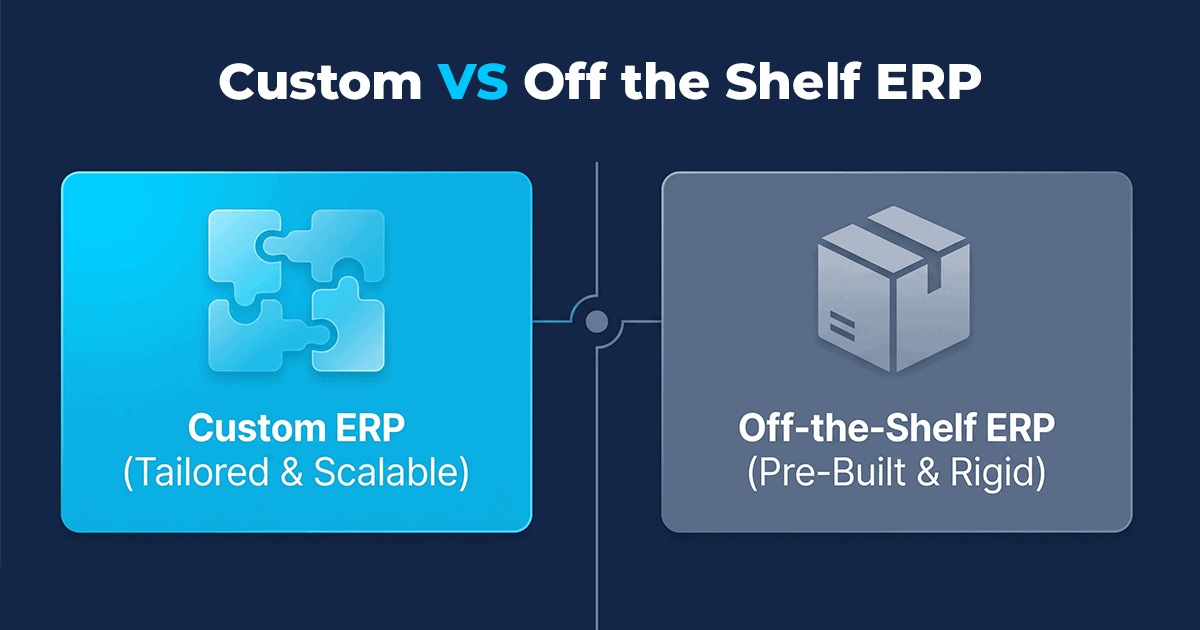
Choosing the right enterprise resource planning (ERP) system is one of the most critical technology decisions a growing business will make. With the global ERP market projected to reach $106.22 billion in 2026 and growing at a 13% annual rate, companies face an increasingly complex choice: build a custom ERP tailored to your exact processes, or implement an off-the-shelf solution from established vendors like SAP, Oracle, or Microsoft Dynamics?
The wrong choice can be costly. Between 55% and 75% of ERP implementations fail to meet their objectives, with the average project running 189% over budget. Nearly 45% of firms eventually switch ERP systems specifically because of off-the-shelf feature limitations. This guide breaks down the custom vs. off-the-shelf ERP debate with real cost comparisons, implementation timelines, and decision frameworks to help you choose the right path.
What Is Custom ERP?
Custom ERP is enterprise resource planning software built from the ground up based on your company’s specific workflow and business needs. Unlike packaged solutions, custom ERP systems are developed after analyzing your internal processes, pain points, and unique requirements. Developers examine how your business operates and build modules accordingly, resulting in a system that matches your processes exactly rather than forcing your team to adapt to pre-built workflows.
Custom ERP development typically involves working with a software development partner who conducts a discovery phase, documents your requirements, designs the architecture, and builds modules incrementally. The result is a proprietary system that can integrate with your existing tools, support your specific industry requirements, and scale with your business model.
What Is Off-the-Shelf ERP?
Off-the-shelf ERP is pre-built, commercially licensed software that provides industry-standard features out of the box. Popular platforms include SAP Business One, Oracle NetSuite, Microsoft Dynamics 365, Odoo, and Sage Intacct. These systems are designed to serve broad market segments with generalized functionality for accounting, inventory, manufacturing, CRM, and HR.
Off-the-shelf ERP vendors offer established best practices, regular updates, support services, and large user communities. While these systems require customization to fit specific business processes, the core functionality is already developed, tested, and proven across thousands of implementations. Deployment is typically faster than custom builds, with vendors offering pre-configured industry templates and implementation partners who specialize in specific platforms.
Custom vs. Off-the-Shelf ERP: Side-by-Side Comparison
| Criteria | Custom ERP | Off-the-Shelf ERP |
|---|---|---|
| Upfront Cost | $100,000–$400,000 (depending on complexity and team size) | $10,000–$100,000 initial licensing/setup (varies by users and modules) |
| Ongoing Costs | Maintenance, hosting, occasional enhancements ($10,000–$30,000/year) | Annual subscription fees ($5,000–$50,000+/year), customization charges, support costs |
| 5-Year Total Cost of Ownership | Often lower for companies with 30+ users once workaround costs and subscription fees are factored in | Can exceed custom ERP costs due to recurring fees, customization charges, and hidden integration costs |
| Implementation Timeline | 6–12 months for full systems; 3–6 months for simpler builds; 8–12 weeks with low-code platforms | 3–9 months depending on scope and customization; faster for standard implementations |
| Process Fit | 100% aligned to your workflows; no workarounds needed | Requires process adaptation; 33–48% of businesses request moderate to heavy customization |
| Flexibility & Scalability | Complete control; can add features, integrations, or modules at any time | Limited to vendor roadmap; major customizations may be locked out or expensive |
| Ownership | You own the code and IP; can modify or migrate freely | Vendor owns the platform; you’re locked into their ecosystem and license terms |
| Updates & Support | Managed by your dev team or partner; updates on your schedule | Regular vendor updates (sometimes forced); support packages available but can be costly |
| Integration Complexity | Built to integrate seamlessly with your existing systems and APIs | May require middleware or costly connectors for third-party integrations |
| Risk | Higher upfront investment; requires careful vendor selection and project management | Vendor dependency; platform may be discontinued, pricing may increase, or features may change |
Custom ERP: When It Makes Sense
Custom ERP is the right choice if your business meets one or more of these criteria:
1. You Have Unique or Complex Processes
If your industry has specialized workflows that off-the-shelf ERP systems don’t support well, custom ERP eliminates the need for workarounds. Industries like manufacturing with custom production processes, logistics companies with proprietary routing algorithms, or businesses with complex multi-entity consolidation often benefit from custom builds.
2. You’re Growing Beyond 30–40 Users
Custom ERP typically becomes cost-competitive once you reach 30–40 users. At this scale, annual subscription fees for off-the-shelf platforms start to exceed the total cost of building and maintaining a custom solution over a 5-year period. Many businesses find that custom ERP is cheaper over 5 years once user counts and customization costs are factored in.
3. You Need Deep Third-Party Integrations
If your business relies on multiple specialized tools (CRM, eCommerce platforms, warehouse management systems, BI tools) that must share real-time data with your ERP, custom development can build native integrations rather than relying on expensive middleware or limited API connectors.
4. You Want to Own Your IP and Data
Custom ERP gives you complete ownership of the codebase and your data. You’re not locked into a vendor’s pricing changes, platform deprecations, or license restrictions. If you ever need to switch development partners or bring development in-house, you own the code.
5. You Operate in a Regulated Industry
Industries with strict compliance, data sovereignty, or security requirements (healthcare, finance, government) often need granular control over how data is stored, processed, and audited. Custom ERP allows you to build compliance directly into the system architecture.
Off-the-Shelf ERP: When It Makes Sense
Off-the-shelf ERP is the better choice if your business fits these conditions:
1. You Need a Fast Deployment
If you need an ERP system running within 3–6 months and your processes align reasonably well with industry best practices, off-the-shelf platforms offer faster time-to-value. Vendors provide pre-configured templates, proven implementation methodologies, and large partner networks to accelerate deployment.
2. Your Processes Are Standard for Your Industry
If your business follows common workflows (standard retail point-of-sale, basic manufacturing, straightforward distribution), off-the-shelf ERP systems are designed for you. You benefit from industry best practices and avoid reinventing the wheel.
3. You Lack In-House IT Resources
Off-the-shelf ERP vendors provide ongoing support, regular updates, security patches, and user training. If you don’t have an internal IT team or development partner on retainer, vendor-managed support can be valuable.
4. You’re a Small Business Under 20 Users
For companies with fewer than 20 users, the upfront cost of custom ERP may not be justified. Off-the-shelf solutions like Odoo, Zoho Books, or SAP Business One offer affordable entry points with monthly subscription pricing.
5. You Want Proven, Battle-Tested Software
Off-the-shelf platforms have been deployed across thousands of companies. Bugs have been fixed, edge cases handled, and features refined over years of real-world use. This maturity reduces implementation risk.
Cost Breakdown: Custom vs. Off-the-Shelf ERP
Custom ERP Costs
Initial Development: $100,000–$400,000 depending on scope, team size, and complexity. A simpler system for a 50-person company might cost $120,000–$180,000. A complex multi-module system for a 200-person enterprise could reach $300,000–$500,000.
Annual Maintenance: $10,000–$30,000/year for hosting, bug fixes, minor enhancements, and support. This represents roughly 10–15% of the initial build cost annually.
5-Year TCO Example (100 users): $150,000 (initial) + $100,000 (5 years maintenance) = $250,000 total.
Off-the-Shelf ERP Costs
Initial Licensing & Setup: $10,000–$100,000 for licenses, implementation consulting, data migration, and configuration. A 100-user deployment might cost $40,000–$80,000 initially.
Annual Subscription: $5,000–$50,000+/year depending on users, modules, and vendor. SAP Business One might cost $50–$100/user/month. NetSuite averages $99–$199/user/month. For 100 users, this could be $60,000–$120,000/year.
Customization & Integration: $20,000–$100,000+ for custom reports, integrations, and workflow modifications not included in the base system.
5-Year TCO Example (100 users): $60,000 (initial) + $400,000 (5 years subscription at $80,000/year) + $50,000 (customizations) = $510,000 total.
In this scenario, custom ERP delivers a lower 5-year total cost of ownership despite higher upfront investment. However, costs vary significantly based on user count, required modules, and vendor pricing.
Implementation Timeline: What to Expect
Custom ERP Timeline
- Discovery & Planning: 4–8 weeks (requirements gathering, process mapping, technical architecture)
- Design & Prototyping: 4–8 weeks (UI/UX design, database schema, module specifications)
- Development: 12–32 weeks (core modules built incrementally, testing at each phase)
- Testing & Training: 4–8 weeks (user acceptance testing, training, data migration)
- Total: 6–12 months for a full system; 3–6 months for simpler builds; 8–12 weeks with modern low-code platforms
Off-the-Shelf ERP Timeline
- Vendor Selection: 4–8 weeks (demos, RFPs, contract negotiation)
- Configuration & Customization: 8–16 weeks (module setup, workflow configuration, custom reports)
- Data Migration: 4–8 weeks (clean legacy data, map to new schema, import and validate)
- Testing & Training: 4–6 weeks (UAT, end-user training, go-live preparation)
- Total: 3–9 months depending on complexity and customization scope
Both timelines assume proper project management, stakeholder availability, and clear requirements. Timeline overruns are common in both custom and off-the-shelf implementations.
2026 Trends: The Middle Ground Emerges
What’s changed in 2026 is the emergence of low-code and no-code ERP platforms that challenge the traditional binary choice. These platforms allow businesses to build custom ERP systems using visual development tools, pre-built modules, and drag-and-drop configuration, delivering the process fit of custom development at speeds and costs closer to off-the-shelf deployment.
Another major trend is white-label ERP partnerships. Companies like Global IT Vision offer pre-built ERP modules (accounting, CRM, HR, industry-specific tools) that can be customized, branded, and deployed as either SaaS or on-premise solutions. This “semi-custom” approach gives businesses the flexibility of custom ERP without starting from scratch, often at a fraction of the cost and timeline.
Finally, AI-assisted development is compressing custom ERP timelines significantly. Modern frameworks, code generation tools, and AI-powered testing reduce development cycles by 30–50%, making custom ERP more accessible to mid-sized businesses.
Decision Framework: 5 Questions to Ask
1. How unique are your business processes?
If your workflows are highly specialized or give you a competitive advantage, custom ERP protects that uniqueness. If you follow standard industry practices, off-the-shelf fits.
2. What’s your user count trajectory?
If you’re under 30 users and growing slowly, off-the-shelf is likely more cost-effective. If you’re at 40+ users or growing rapidly, custom ERP’s lower TCO becomes compelling.
3. How critical is integration?
If you rely on multiple third-party systems that must share real-time data with your ERP, custom development can build seamless integrations. Off-the-shelf platforms may require costly middleware.
4. Do you have technical resources?
Custom ERP requires either an in-house dev team or a long-term development partner. If you lack technical capacity, off-the-shelf vendors provide managed support.
5. What’s your risk tolerance?
Custom ERP carries higher upfront investment risk but gives you control. Off-the-shelf reduces upfront risk but locks you into vendor pricing and roadmaps.
Frequently Asked Questions
What is the main difference between custom ERP and off-the-shelf ERP?
Custom ERP is built specifically for your business processes and requirements, offering 100% alignment with your workflows but requiring higher upfront investment. Off-the-shelf ERP is pre-built software designed for broad market segments, offering faster deployment and lower initial costs but requiring your business to adapt to the software’s workflows.
Is custom ERP more expensive than off-the-shelf ERP?
Custom ERP has higher upfront costs ($100,000–$400,000) compared to off-the-shelf licensing ($10,000–$100,000 initially). However, when you factor in annual subscription fees, customization charges, and workaround costs, many businesses find custom ERP is cheaper over a 5-year period, especially for companies with 30+ users.
How long does it take to implement custom ERP vs. off-the-shelf ERP?
Custom ERP typically takes 6–12 months for full systems, though simpler builds can be completed in 3–6 months and low-code platforms can deliver in 8–12 weeks. Off-the-shelf ERP implementations range from 3–9 months depending on scope and customization. Both timelines vary significantly based on complexity and project management.
Can I switch from off-the-shelf ERP to custom ERP later?
Yes, though data migration and process redesign can be complex. Nearly 45% of firms switch ERP systems due to feature limitations. If you’re considering a future switch, document your business processes thoroughly and ensure your current ERP allows data export in standard formats.
What is the failure rate for ERP implementations?
Between 55% and 75% of ERP implementations fail to meet their objectives, according to industry research. The average project runs 189% over budget, and only 25% are completed on time and within original scope. Failure rates apply to both custom and off-the-shelf implementations and are often due to poor requirements definition, inadequate change management, and vendor selection mistakes.
How is AI changing custom ERP development in 2026?
AI-powered development tools are compressing custom ERP timelines by 30–50% compared to traditional methods. Modern frameworks use AI for code generation, automated testing, and intelligent debugging, making custom ERP more accessible to mid-sized businesses. Additionally, AI features like predictive analytics, intelligent workflow automation, and natural language reporting are becoming standard in both custom and off-the-shelf ERP systems, with custom builds offering the advantage of tailoring AI features specifically to your business data and processes.
What is white-label ERP and how does it compare to custom or off-the-shelf?
White-label ERP is a middle-ground approach where a vendor provides pre-built, tested ERP modules that can be customized, branded, and deployed under your company name. Unlike off-the-shelf ERP (which locks you into the vendor’s brand and roadmap), white-label solutions give you ownership of the branded product while avoiding the full cost and timeline of building from scratch. White-label ERP often delivers significantly lower costs than pure custom development while deploying faster and offering more flexibility than traditional off-the-shelf platforms — making it an attractive option for growing businesses, software resellers, and companies seeking a semi-custom solution without vendor lock-in.
Need help deciding between custom and off-the-shelf? Our ERP consulting services guide businesses through vendor selection and implementation planning.
Conclusion: There’s No One-Size-Fits-All Answer
The custom vs. off-the-shelf ERP decision depends entirely on your business context. Off-the-shelf ERP makes sense for companies with standard processes, limited budgets, and fast deployment needs. Custom ERP delivers long-term value for businesses with unique workflows, 30+ users, complex integrations, or IP ownership requirements.
For many growing businesses in 2026, the best answer isn’t purely custom or purely off-the-shelf — it’s a semi-custom approach using white-label ERP platforms that offer pre-built modules with customization flexibility. This middle ground delivers faster time-to-value than pure custom builds while avoiding the vendor lock-in and ongoing costs of traditional off-the-shelf platforms.
Ready to explore your ERP options? Get a free ERP consultation to discuss whether custom, off-the-shelf, or a white-label solution is right for your business.
Sources
- Custom vs. off-the-shelf ERP systems — BDC
- Custom ERP vs Off-the-Shelf ERP: Which Is Better for Growing Businesses? — Appeak Technologies
- Custom ERP vs Off-the-Shelf ERP: Guide for Growing Companies — Bitvea
- Custom ERP vs Off the Shelf: Cost & ROI Comparison Guide (2026) — Digittrix
- Global ERP Statistics 2026: Market Size And Adoption Trends — Quantumrun
- 60 Critical ERP Statistics: Market Trends, Data and Analysis — NetSuite
- ERP Software Statistics and Facts (2026) — Scoop Market