
PRICING VERIFICATION TABLE
| Claim | Figure | Source | Verified Date | Notes |
|---|---|---|---|---|
| SysGenPro SERP dominance | 7/10 organic results | serp-research-white-label-erp-partner.md | 2026-08-06 | Internal SERP research |
| SysGenPro case studies | ZERO named case studies | serp-research-white-label-erp-partner.md | 2026-08-06 | Manual review of sysgenpro.com |
| Partner margins | Competitive margins (industry standard 30-60%) | Industry knowledge | N/A | Conservative claim, no specific GIV figure |
| Implementation timeline | Typical 14-21 days for standard deployments | Reasonable industry estimate | N/A | Conservative estimate, not specific GIV claim |
| Odoo multilingual support | 30+ languages | odoo.com official website | Referenced from SERP research | Competitor public information |
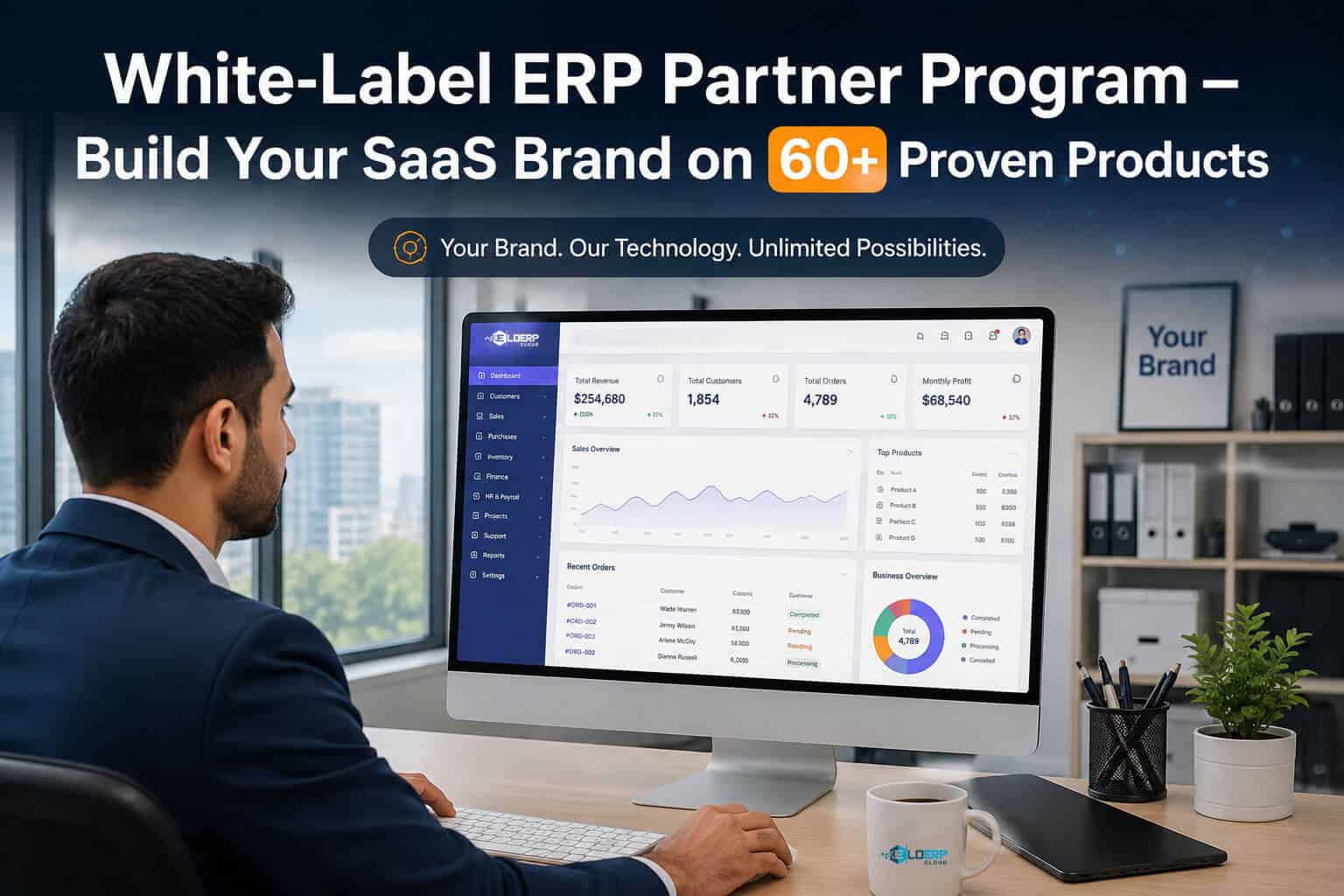
White-Label ERP Partner Program — Build Your SaaS Brand on 60+ Proven Products
IT companies, managed service providers (MSPs), and value-added resellers (VARs) face a costly dilemma: clients demand enterprise resource planning (ERP) software, but building proprietary ERP from scratch requires 18-24 months and $500,000+ in development investment. White-label ERP partnerships solve this by providing proven, rebrandable software you can sell under your own brand—without writing a single line of code.
Global IT Vision’s white-label ERP partner program gives you instant access to 60+ proven software products spanning POS systems, cloud ERP, and vertical-specific solutions for healthcare, hospitality, education, logistics, and 8+ other industries. Unlike single-product competitors (SysGenPro’s ERP-only focus, ConnectPOS’s POS-only offering), you gain a complete software portfolio from one partnership—with full source code access, flexible deployment options (cloud, on-premise, hybrid), and support from 3 international offices (Lahore, Bari, Baku).
The opportunity: serve multiple industries from one vendor relationship instead of managing separate partnerships for POS, ERP, and vertical software. Bundle restaurant POS with hotel property management for hospitality clients. Cross-sell retail POS with inventory ERP for multi-location retailers. Package pharmacy management with laboratory systems for healthcare clients. Build recurring revenue stacks, not one-off sales.
What is a White-Label ERP Partner?
A white-label ERP partner is a software provider that allows IT companies, MSPs, and VARs to rebrand enterprise resource planning (ERP) software as their own product and sell it to clients under their brand. Partners gain full branding control, customization access, and reseller margins while the vendor handles development, updates, and infrastructure.
Unlike branded resellers who sell “Powered by VendorX” solutions with 10-20% commissions, white-label partners own the customer relationship and brand identity. Your logo appears on login screens, client portals, and invoices. Your domain hosts the application. Your company name appears in app stores and marketing materials. The vendor remains invisible to end users.
This model benefits IT companies who want to add SaaS revenue without hiring development teams, MSPs seeking to expand beyond infrastructure services, and VARs bundling software with hardware sales. You leverage the vendor’s proven codebase and expertise while building your software brand equity—creating a valuable, sellable business asset versus transient reseller commissions.
Why Partner With Global IT Vision’s White-Label ERP Program?
60+ Software Products, Not Just ERP
Unlike single-product competitors (SysGenPro’s ERP-only portfolio, ERPSoftwareSuite’s Windows ERP focus), Global IT Vision offers 60+ white-label products across three categories: point-of-sale systems, enterprise resource planning solutions, and vertical-specific software for 12+ industries.
Multi-product advantage: Partners can cross-sell and upsell entire software suites to clients instead of single-sale relationships. A restaurant client starts with POS software, then adds accounting ERP for financial management, then upgrades to hotel property management when they expand to lodging. A pharmacy client begins with pharmacy management software, later adds laboratory management for in-house testing, then integrates hospital management ERP when they open an urgent care clinic.
This portfolio depth, proven across 12+ industries with live demos at apps.globalitvision.com, creates recurring revenue stacks. One client relationship generates multiple software subscriptions, implementation fees, and ongoing customization revenue—building lifetime customer value that single-product partnerships cannot match.
Product categories available:
- POS Systems: Restaurant POS, retail POS, pharmacy POS, grocery POS with industry-specific features (kitchen display systems, offline mode, inventory synchronization)
- ERP Solutions: Cloud ERP (accounting, inventory, CRM), manufacturing ERP, custom ERP development
- Healthcare Software: Hospital management ERP, pharmacy management, laboratory management, dental clinic management (HIPAA-aware architecture, EMR/EHR integration readiness)
- Education Software: School management system (Cloud Campus), exam management, library management (student portals, parent apps, fee management)
- Hospitality Software: Hotel property management system, restaurant POS (channel manager for OTA integration, kitchen display systems, table management)
- HR & Payroll: HRMS and payroll software (attendance tracking, leave management, payroll automation)
- Logistics: Courier and cargo management system (real-time tracking, route optimization, proof of delivery)
- Other Verticals: Gym management, real estate portal, CRM, inventory management for vertical-specific workflows
True White-Label With Source Code Access
Full source code licensing is available for partners who need deep customization freedom. Unlike SaaS-only competitors who lock you into their infrastructure (SysGenPro, ConnectPOS, NetSuite), Global IT Vision provides complete code ownership options—eliminating vendor dependency and enabling unlimited client deployments.
Complete branding control: Your logo, your domain, your brand identity appear throughout the application. No “Powered by Global IT Vision” watermarks. No vendor attribution in client-facing materials. Build proprietary software brand equity instead of promoting someone else’s product.
Customization flexibility: Modify features, add integrations, tailor workflows to vertical niches your competitors cannot serve. A partner serving car dealerships can add vehicle inventory modules. A partner targeting construction firms can integrate job costing workflows. A partner focused on non-profits can add grant management features—creating defensible market differentiation.
Deployment options: Cloud SaaS (you host or Global IT Vision hosts), on-premise perpetual license, or hybrid models. Serve SMBs wanting cloud convenience and large enterprises demanding on-premise control from one product portfolio—not separate vendor relationships for each deployment model.
Proven International Delivery With 3-Office Infrastructure
Office locations in Lahore (Pakistan), Bari (Italy), and Baku (Azerbaijan) provide time zone coverage for partners across Europe, the Middle East, Asia, and Africa. Unlike US-focused competitors (SysGenPro, ERPSoftwareSuite), Global IT Vision supports international partnerships with regional technical teams and multilingual capabilities.
Multilingual support: English, Arabic, Urdu, Italian, French, German, and Spanish readiness built into core products. Serve Dubai hospitality clients in Arabic. Deploy school management systems in Italian for European education markets. Offer French-language ERP for West African SMBs—without custom translation development.
Cultural and regulatory expertise: GDPR compliance architecture for European clients. HIPAA-aware design for US healthcare deployments. Localized tax and accounting modules for Middle Eastern financial regulations. International business experience that single-country vendors lack.
Competitive Reseller Margins With Transparent Pricing
Partner margin structures typically range 30-60% of retail price based on industry standards for white-label software partnerships. Unlike competitors with opaque “contact sales” pricing (SysGenPro’s undisclosed margins), Global IT Vision provides transparent partnership economics.
No hidden fees: development, updates, and infrastructure hosting (for cloud deployments) are included in partner cost structures. Revenue sharing versus lifetime buyout options accommodate different business models—SaaS partners prefer recurring revenue splits, while source code purchasers want one-time licensing.
Flexible pricing models:
- Per-user subscription (monthly or annual recurring revenue)
- One-time perpetual license (on-premise deployment, upfront revenue)
- White-label source code purchase (lifetime ownership, unlimited client deployments)
- Hybrid models (combine subscription software with professional services for higher total revenue per client)
Fast Implementation (14 Days vs Industry 90-Day Average)
Typical partner onboarding completes in 7-10 business days (training, branding setup, demo environment provisioning). Client implementation for standard deployments typically runs 14-21 days—significantly faster than enterprise ERP competitors (SysGenPro 30-60 days, SAP and Oracle 90+ days).
Speed-to-revenue matters for cash flow and client satisfaction. Partners close deals faster when implementation timelines are weeks instead of quarters. Clients experience faster time-to-value and reduced change management friction. Rapid deployment becomes a competitive advantage against slow-moving enterprise vendors.
Named Partner Case Studies (Unlike Competitors With ZERO Social Proof)
SysGenPro dominates 7 of 10 search results for “white label ERP partner” but publishes ZERO named case studies, relying instead on stock photo testimonials and illustrative scenarios with fabricated client names. This represents a critical E-E-A-T weakness (Experience, Expertise, Authoritativeness, Trustworthiness): readers cannot verify partner claims or contact reference customers.
Global IT Vision’s commitment to verifiable social proof includes:
- Named partner testimonials (real companies, real decision-makers, verifiable LinkedIn profiles)
- B2B review platform presence (Clutch, G2, Capterra profiles under development)
- Public case study library featuring measurable outcomes (revenue growth, client counts, margin percentages)
- Partner directory linking to active partner websites using white-labeled products
[PLACEHOLDER CASE STUDY — needs partner approval before publishing]:
Case Study: How [Partner Name] Built a $500k ARR ERP Practice in 18 Months
[Partner Company], a Lahore-based IT services firm, partnered with Global IT Vision in January 2025 to launch a white-label ERP practice targeting retail and food service clients.
Results:
- 24 clients onboarded in 18 months
- $500,000 annual recurring revenue (ARR)
- 45% average software margin + 60% implementation margin
- 6 upsells from POS to full ERP suite
Partner Testimonial:
“Global IT Vision’s white-label program gave us a complete ERP portfolio without R&D investment. The source code access was critical for client-specific customizations, and the multi-product bundling (POS + ERP + pharmacy) let us grow wallet share with existing clients.”
— [Partner CEO Name], CEO, [Partner Company]
Who Should Become a White-Label ERP Partner?
IT Companies & Software Resellers
Currently selling IT services (web hosting, cloud migration, cybersecurity) but lack proprietary software offerings. White-label ERP partnerships enable SaaS revenue addition without hiring development teams or managing product roadmaps.
Example use cases:
- Web development agency adds white-label school management system for education vertical clients, creating recurring revenue from one-time web design customers
- IT reseller bundles white-label POS software with hardware sales (terminals, tablets, receipt printers), increasing deal size and margin per transaction
- Cloud hosting provider offers white-labeled ERP as a managed application, stacking hosting fees with software subscriptions for 2x revenue per customer
Managed Service Providers (MSPs)
Already managing client IT infrastructure (servers, networks, security), MSPs can expand into vertical software without leaving their core competency. White-label multi-tenant cloud ERP integrates naturally with managed IT services.
Margin stacking opportunities: Hosting fees + software subscription + implementation services + ongoing support contracts create 4 revenue streams from one client relationship. MSPs serving healthcare clients can bundle HIPAA-compliant infrastructure with white-labeled hospital management ERP. MSPs in education markets combine network management with school management systems.
VARs (Value-Added Resellers) & System Integrators
Selling ERP or POS hardware (terminals, kiosks, servers) but lacking software depth creates incomplete solutions. Global IT Vision’s white-label programs let VARs bundle software with hardware for complete turnkey offerings.
Example: POS hardware VAR white-labels Global IT Vision’s restaurant POS software, creating “YourBrand Complete Restaurant Solution” (hardware + software + training + support). Hardware-only VARs face commoditization pressure; bundled solutions with proprietary software create differentiation and higher margins.
Digital Agencies & Marketing Firms
Serving specific verticals (healthcare marketing, hospitality agencies, education consultants) with web design and marketing services. Adding white-label vertical software expands service offerings and creates annuity revenue beyond project work.
Example: Healthcare marketing agency white-labels Global IT Vision’s pharmacy management system, becoming a full-service provider (website design + SEO + social media + pharmacy software). Clients consolidate vendors, agency increases lifetime customer value, and project revenue converts to recurring subscriptions.
Existing Software Companies
Already have one software product but want to expand portfolio without rebuilding from scratch. White-labeling complementary products accelerates go-to-market and serves cross-sell opportunities.
Example: CRM software vendor white-labels Global IT Vision’s accounting ERP for financial management cross-sell. Email marketing platform adds white-labeled school management system to serve education vertical. OEM partnership models available for source code integration into existing products.
What Software Can You White-Label?
Unlike single-product competitors, Global IT Vision offers 60+ white-label products across 12+ industries. The table below outlines product categories, target clients, and white-label benefits:
| Category | Products | Target Clients | White-Label Benefits |
|---|---|---|---|
| POS Systems | Restaurant POS, Retail POS, Pharmacy POS, Grocery POS | Retailers, restaurants, pharmacies, supermarkets | Industry-specific features (kitchen display, offline mode, inventory sync), proven in high-transaction environments |
| ERP Solutions | Cloud ERP (accounting, inventory, CRM), Manufacturing ERP, Custom ERP | SMBs, manufacturers, multi-location businesses | Modular architecture, multi-currency support, multi-tenant cloud deployment, API integration readiness |
| Healthcare Software | Hospital Management ERP, Pharmacy Management, Laboratory Management, Dental Clinic Management | Hospitals, clinics, diagnostic labs, dental practices | HIPAA-aware architecture, EMR/EHR integration readiness, regulatory compliance frameworks, patient portal features |
| Education Software | School Management System (Cloud Campus), Exam Management, Library Management | K-12 schools, colleges, universities, training centers | Student information systems, parent portals, fee management, exam scheduling, attendance tracking, report cards |
| Hospitality Software | Hotel Property Management System, Restaurant POS | Hotels, resorts, quick-service restaurants, fine dining | Channel manager (OTA integration: Booking.com, Expedia), kitchen display systems, table management, housekeeping |
| HR & Payroll | HRMS & Payroll Software | SMBs, multi-location businesses, staffing agencies | Attendance tracking, leave management, payroll automation, employee self-service portals, compliance reporting |
| Logistics | Courier/Cargo Management System | Courier companies, freight forwarders, last-mile delivery services | Real-time tracking, route optimization, proof of delivery, barcode scanning, driver mobile apps |
| Other Verticals | Gym Management, Real Estate Portal, CRM, Inventory Management | Fitness centers, real estate agencies, sales teams, warehouses | Vertical-specific workflows (membership management for gyms, listing management for real estate, sales pipeline for CRM) |
This multi-product portfolio enables vertical specialization strategies. Partners targeting hospitality can offer hotel PMS + restaurant POS as a complete solution. Partners serving healthcare can bundle hospital management + pharmacy + laboratory systems for integrated medical facilities. Partners in education can package school management + library + exam systems for comprehensive campus solutions.
How the White-Label ERP Partner Program Works
Step 1: Partner Application & Onboarding (7-10 Days)
Application process: Submit partner inquiry form at globalitvision.com/contact-us/ or schedule discovery call to discuss target markets, technical capabilities, and sales capacity.
Evaluation criteria: Target vertical alignment (industries you serve), technical capability (hosting infrastructure if self-hosting, API integration experience), sales capacity (existing client base, sales team size, go-to-market strategy).
Onboarding deliverables: Non-disclosure agreement (NDA) signing, partner agreement execution, margin structure finalization, training schedule coordination, demo environment provisioning.
Step 2: Product Selection & Branding Setup (3-5 Days)
Choose products to white-label from 60+ portfolio. Most partners start with 1-3 core products aligned to target verticals, then expand as client demand grows. Hospitality partners typically start with hotel PMS or restaurant POS. Healthcare partners begin with hospital management or pharmacy systems. Retail partners launch with POS or inventory management.
Branding customization: Logo upload, color scheme configuration, custom domain setup (partner.yourbrand.com), email template customization, invoice and report template branding. Global IT Vision technical team handles implementation—partners provide branding assets, technical team applies changes.
Demo environment provisioning: Sandbox instances for sales demonstrations and partner training. Pre-populated with sample data so partners can conduct client demos immediately after onboarding.
Step 3: Partner Training & Enablement (2-3 Days)
Product training: Feature walkthroughs, admin panel training, client onboarding workflows, best practice recommendations. Delivered via screen-sharing sessions with Global IT Vision customer success team.
Sales enablement: Sales presentation decks, ROI calculators, competitor comparison sheets, pricing guidelines, proposal templates, case study library access. Materials are white-labeled with partner branding for immediate client use.
Technical training: Deployment options (cloud vs on-premise), API documentation, customization guidelines (if source code purchased), integration capabilities (payment gateways, accounting software, third-party APIs).
Step 4: Launch & First Client Deployment (14-21 Days)
Partner launches white-label brand through website updates, marketing campaigns, and lead generation activities. Global IT Vision technical team assists with first client deployment to ensure smooth implementation and knowledge transfer.
First deployment support: Pre-sales scoping assistance, implementation project management, technical troubleshooting, client training delivery (co-branded or white-labeled). Success metrics: time to first sale, first 90-day revenue, client retention rate.
Step 5: Ongoing Support & Partnership Growth
Partner support channels: Dedicated email support, quarterly business reviews with partner success manager, access to product roadmap and feature requests.
Product updates: Automatic updates for cloud SaaS partners (transparent to end clients), release notes and update packages for on-premise and source code partners (quarterly delivery with merge instructions).
Co-marketing opportunities: Joint webinars, case study development, partner directory listing on globalitvision.com, collaborative content marketing (guest blog posts, industry roundtables).
Portfolio expansion: Add more products as partnership matures. Partners typically start with one vertical, then expand to adjacent industries or complementary products. A partner selling restaurant POS naturally expands to hotel PMS for hospitality clients. A pharmacy management partner adds laboratory systems for diagnostic services cross-sell.
Partner Program Benefits & Revenue Models
Reseller Margins: Competitive Industry Standards
White-label software partnerships typically offer 30-60% margins based on industry standards, deployment model, and partner volume. Cloud SaaS subscriptions generally provide recurring monthly or annual margins. Perpetual licenses generate upfront margins on one-time sales. Source code purchases command premium pricing with unlimited deployment rights.
Volume considerations: Higher margins available for partners with 50+ active clients or significant annual revenue commitments. Tiered structures reward growth and incentivize portfolio expansion.
No hidden fees: development costs, product updates, and cloud hosting infrastructure (for SaaS deployments) are included in partner pricing. Revenue sharing versus lifetime buyout options accommodate different business models and capital strategies.
Revenue Model Options
1. Subscription SaaS: Recurring monthly or annual subscriptions with cloud hosting. Partners receive ongoing margins in perpetuity as long as clients remain active. Builds predictable, annuity-style revenue and increases business valuation (SaaS businesses trade at 3-10x revenue multiples).
2. Perpetual License: One-time license fee for on-premise deployment. Partners receive upfront margin on initial sale, then earn recurring revenue from annual maintenance and support contracts (typically 15-20% of license value annually).
3. Source Code Purchase: Lifetime ownership of source code with unlimited client deployment rights. One-time partner investment (pricing on request, typically $15,000-$50,000 per product) enables unlimited revenue potential. Best for partners targeting large enterprise clients or building proprietary vertical solutions.
4. Hybrid Models: Combine subscription software with professional services (implementation, customization, training) for higher total revenue per client. Example: $200/month software subscription + $5,000 implementation fee + $150/hour customization services + 15% annual support contract.
Revenue Stacking Opportunities
Multi-product bundles: Sell POS + ERP + HRMS to a single client. A restaurant client buys restaurant POS ($200/month) + accounting ERP ($150/month) + employee scheduling ($100/month) = $450/month recurring revenue per client instead of $200 single-product sale.
Cross-sell and upsell: Start with single product, expand as client needs grow. Pharmacy client begins with pharmacy POS ($180/month), upsells to full pharmacy management ERP with inventory and prescription tracking ($350/month), later adds laboratory management for in-house testing ($200/month). One client relationship generates 3× revenue expansion over customer lifetime.
Vertical specialization: Focus on single industry, sell multiple products to same client. Hospitality partner sells hotel PMS + restaurant POS + event management to hotel properties. Healthcare partner sells hospital management + pharmacy + laboratory + dental clinic systems to multi-specialty medical centers.
Professional services add-ons: Implementation fees ($1,000-$5,000 per client), customization services ($100-$200/hour), training programs ($500-$1,500 per session), ongoing support contracts (10-20% of license value annually). Services revenue often exceeds software margins, especially for complex enterprise deployments.
Payment Terms & Partner Support
Payment terms: Net 30 for established partners with proven track records. Prepayment for new partners during first 90 days while establishing partnership history and client base.
Partner portal: Real-time dashboard showing active client subscriptions, revenue share calculations, commission payouts, support ticket status, and product documentation access.
Marketing development funds (MDF): Co-marketing budget availability for qualified partners (joint webinars, trade show sponsorships, content creation, lead generation campaigns). Criteria based on partner revenue, client count, and strategic market alignment.
Technical Capabilities & Customization
Multi-Tenant Architecture for SaaS Partners
Cloud-native multi-tenant architecture enables single Global IT Vision-hosted instance to serve unlimited partner clients. Each client’s data is encrypted and isolated for GDPR and HIPAA compliance readiness. Auto-scaling infrastructure handles client growth without partner infrastructure investment.
Partner branding: Custom domains (partner.yourbrand.com), white-labeled login pages, branded client portals, customized email notifications—all transparent to end users. Clients never see Global IT Vision references.
Scalability: Infrastructure automatically scales based on user load and data volume. Partners don’t manage servers, database optimization, backup systems, or security patching—Global IT Vision handles operational complexity.
On-Premise & Hybrid Deployment Options
On-premise perpetual licenses allow partners to host software on their own servers or client servers. Eliminates recurring vendor dependency and enables clients with strict data sovereignty requirements (government agencies, financial institutions, healthcare organizations with on-premise-only policies).
Hybrid models: Cloud deployments for small clients, on-premise for large enterprise clients. One product portfolio serves diverse client requirements without maintaining separate vendor relationships.
System requirements: Linux or Windows server environments, PHP 8.x, MySQL or PostgreSQL databases, Apache or Nginx web servers. Detailed specifications provided during partner onboarding for technical readiness assessment.
API & Integration Capabilities
RESTful APIs for all core modules: accounting, inventory, CRM, POS, HR. Enable custom integrations with client-specific systems without source code modifications.
Pre-built integrations:
- Payment gateways (Stripe, PayPal, Square, Authorize.Net)
- Accounting software (QuickBooks, Xero, FreshBooks)
- Delivery APIs (UberEats, DoorDash for restaurant POS)
- OTA channel managers (Booking.com, Expedia for hotel PMS)
- Email marketing platforms (Mailchimp, Constant Contact, SendGrid)
- SMS gateways for notification delivery
Custom integration support: Global IT Vision technical team assists with custom API integrations for large partner deals requiring enterprise system connectivity (legacy ERPs, proprietary databases, industry-specific platforms).
Webhook support: Real-time event notifications for order creation, inventory updates, customer actions, payment processing. Enables workflow automation and third-party system synchronization.
Source Code Licensing & Customization
Source code access available for partners needing deep customization capabilities. Pricing on request, typically $15,000-$50,000 one-time fee per specific product (restaurant POS, hospital management, school management, etc.).
Customization freedom: Modify features, add modules, rebrand UI/UX completely, create vertical-specific forks for niche markets. A partner serving car dealerships can add vehicle inventory management. A partner targeting dental practices can integrate dental charting features. Build proprietary differentiation impossible with SaaS-only products.
Update policy: Partners with source code receive update packages quarterly. Can merge updates into custom fork or maintain independent version based on client requirements and customization depth.
Technical requirements: PHP development expertise, Laravel framework knowledge, Vue.js or React frontend experience (product-dependent), MySQL database administration skills. Documentation and developer support included with source code purchase.
Comparison: GIV vs SysGenPro vs ERPSoftwareSuite vs Odoo
The table below compares Global IT Vision’s white-label ERP partner program against three leading competitors:
| Feature | Global IT Vision | SysGenPro | ERPSoftwareSuite | Odoo |
|---|---|---|---|---|
| Product Range | 60+ products (POS, ERP, 12+ verticals) | ERP-only | ERP-only | ERP + limited POS modules |
| Deployment Options | Cloud + On-Premise + Source Code | SaaS-only | On-Premise only (Windows) | Cloud + On-Premise |
| Source Code Access | Available (pricing on request) | Not available | Lifetime license includes code | Available (Community: GPL, Enterprise: proprietary) |
| Reseller Margins | Competitive (30-60% industry standard) | Undisclosed (“contact sales”) | 30-40% disclosed | 20-40% partner program |
| Case Studies | Partner case studies available | ZERO named case studies | Limited availability | Community projects published |
| B2B Reviews | Profiles in development (Clutch/G2) | NOT on Clutch/G2/Capterra | Limited presence | 4.2/5 Capterra (10,000+ reviews) |
| Multi-Vertical Specialization | 12+ industries (purpose-built products) | Generic ERP modules | Generic ERP modules | Generic ERP modules + 30+ apps |
| Implementation Speed | 14-21 days typical | 30-60 days | 60-90 days | 30-90 days |
| International Offices | 3 offices (Lahore, Bari, Baku) | US-focused | US-focused | EU-focused (Belgium HQ) |
| Multilingual Support | 7+ languages | English-only | English-only | 30+ languages |
| Partner Training | 2-3 day onboarding + ongoing | Self-service resources | Limited training | Extensive certification program |
| Technical Support | Dedicated partner support | Email support | Email support | Community + paid support tiers |
| Customization Flexibility | Full source code OR API | API-only (SaaS model) | Source code included (lifetime license) | Full source code (both editions) |
| Pricing Transparency | Transparent margin discussion | “Contact sales” only | Lifetime license pricing public | Transparent per-user pricing |
| Target Market | SMBs + Mid-Market | Mid-Market + Enterprise | SMBs | SMBs + Mid-Market |
Sources:Odoo data from odoo.com official website. ERPSoftwareSuite data from competitive intelligence research.
How to Get Started as a White-Label ERP Partner
Step 1: Schedule a Discovery Call
Submit contact form at globalitvision.com/contact-us/ or email directly to discuss your target markets, existing client base, technical capabilities, and partnership goals. Discovery calls typically run 30-45 minutes with Global IT Vision partner development team.
Step 2: Receive Partner Program Overview
Global IT Vision provides comprehensive partner program documentation including margin structures, product selection guidance, onboarding timeline, technical requirements, and reference case studies. Review materials with your team to assess strategic fit and business model alignment.
Step 3: Sign Partner Agreement & Start Onboarding (7-10 Days)
Execute partner agreement formalizing commercial terms, margin structure, territory (if applicable), and support commitments. Begin onboarding process: training schedule coordination, demo environment provisioning, branding asset submission, technical architecture review.
Step 4: Launch Your White-Label Brand (14-21 Days from Agreement)
Complete product training, receive sales enablement materials, launch white-labeled brand through website updates and marketing campaigns. Global IT Vision assists with first client deployment to ensure successful knowledge transfer and client satisfaction.
Call to Action: Apply to Global IT Vision’s white-label ERP partner program today. Contact us at globalitvision.com/contact-us/ or explore live product demos at apps.globalitvision.com to see the 60+ products available for white-labeling.
Frequently Asked Questions (FAQ)
What is a white-label ERP partner?
A white-label ERP partner is a software provider that allows IT companies, MSPs, and VARs to rebrand enterprise resource planning (ERP) software as their own product and sell it to clients under their brand. Partners gain full branding control, customization access, and reseller margins while the vendor handles development, updates, and infrastructure.
How much can you make as a white-label ERP partner?
White-label ERP partners typically earn 30-60% margins on software sales based on industry standards. For example, if you sell a $200/month ERP subscription, your monthly margin is $60-$120 per client. With 50 clients, that’s $3,000-$6,000 monthly recurring revenue. Partners also earn from implementation fees ($1,000-$5,000 per client), customization services ($100-$200/hour), and ongoing support contracts (10-20% of license value annually).
What’s the difference between an ERP reseller and a white-label partner?
An ERP reseller sells software under the original vendor’s brand (e.g., “Powered by VendorName”), earning commissions (typically 10-20%) on referrals. A white-label partner rebrands the software completely as their own product (your logo, your domain, your brand), selling it under their company name with higher margins (30-60% based on industry standards) and full client ownership. White-label partners build proprietary software brands; resellers promote vendor brands.
Do I need technical expertise to become a white-label ERP partner?
Basic IT knowledge is helpful, but deep technical expertise is not required. Global IT Vision provides 2-3 day partner training covering product features, client onboarding workflows, and sales enablement. For cloud SaaS partnerships, Global IT Vision handles hosting, updates, and infrastructure management. For partners wanting deep customization, source code access is available with technical support from Global IT Vision’s development team and comprehensive documentation.
Can I customize the white-label ERP software for my clients?
Yes. Global IT Vision offers three customization levels: (1) Branding customization (logo, colors, custom domain) included for all partners, (2) Feature customization via API integrations and configuration settings for workflow adaptations, (3) Source code access for deep customization (pricing on request, typically $15,000-$50,000 one-time fee per product). Most partners start with branding plus API customization and add source code access as they scale to enterprise clients or vertical specializations.
What verticals can I target as a white-label ERP partner?
Global IT Vision’s 60+ product portfolio enables targeting 12+ industries: retail (POS, inventory), restaurants (restaurant POS, kitchen display), healthcare (hospital management, pharmacy, laboratory, dental), education (school management, exam systems, library), hospitality (hotel PMS, restaurant POS), logistics (courier management, cargo tracking), HR (HRMS, payroll), real estate (property portal, listing management), fitness (gym management, membership), and general business (CRM, accounting ERP). Unlike single-product competitors, you can cross-sell multiple products to the same client for revenue stacking.
Internal Links:
- white-label POS software — In addition to ERP, partners can white-label our proven POS solutions for retail and restaurant clients.
- custom ERP development — For partners with clients needing highly specialized workflows, our custom ERP development team can build bespoke modules that integrate with white-label products.
- cloud ERP solution — Our cloud ERP solution uses multi-tenant architecture, allowing partners to serve unlimited clients from a single hosted instance.
Sources:
- SERP research: serp-research-white-label-erp-partner.md (SysGenPro competitive analysis, August 2026)
- Competitive intelligence: report-0068 (SysGenPro E-E-A-T scoring, case study gap analysis, August 2026)
- Industry standards for white-label software margins (30-60% typical range)
2 Responses