
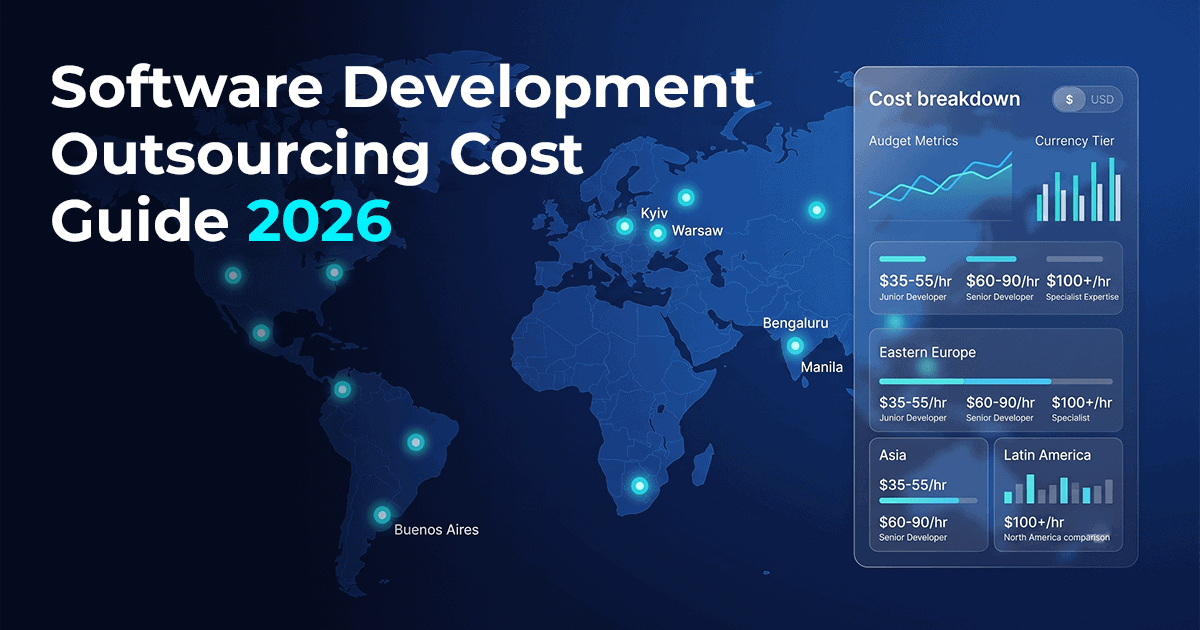
Software development outsourcing has become a strategic necessity for startups, SMBs, and enterprises looking to build custom applications, ERP systems, mobile apps, and web platforms without the overhead of full in-house teams. The global software development outsourcing market reached $618 billion in 2026, up from $564 billion in 2025, and is projected to hit $977 billion by 2031 with a 9.6% compound annual growth rate.
Companies that outsource software development report saving 40–70% on total development costs versus equivalent in-house teams. However, outsourcing costs vary dramatically by region, skill level, project complexity, and engagement model. Rates range from $15/hour in South Asia to $200/hour in North America, with total project costs spanning from $10,000 for simple apps to $500,000+ for enterprise platforms.
This guide breaks down the true cost of outsourcing software development in 2026, covering regional hourly rates, project type costs, team size pricing, and hidden expenses to help you budget accurately and choose the right outsourcing partner.
How Much Does Software Development Outsourcing Cost in 2026?
Software development outsourcing costs depend on three primary variables: where you outsource (region/country), who you hire (skill level and role), and what you’re building (project complexity and timeline).
Average Hourly Rates by Region (2026)
Software development outsourcing rates vary significantly by geography due to differences in cost of living, local salaries, and talent supply.
| Region | Hourly Rate Range | Best For |
|---|---|---|
| North America (US, Canada) | $95–$200/hour | High-complexity projects, regulated industries, real-time collaboration |
| Western Europe (UK, Germany, France) | $90–$150/hour | Enterprise systems, GDPR compliance, EU market focus |
| Eastern Europe (Ukraine, Poland, Romania) | $25–$55/hour | Quality + value balance, nearshore for EU clients, strong technical talent |
| Latin America (Mexico, Brazil, Argentina) | $25–$55/hour | Nearshore for US clients, timezone alignment, English proficiency |
| South Asia (India, Pakistan, Bangladesh) | $15–$45/hour | Cost-sensitive projects, large-scale development, mature outsourcing ecosystem |
| Southeast Asia (Philippines, Vietnam) | $10–$49/hour | Budget-friendly option, growing talent pool |
| Middle East & Africa | $30–$80/hour | Fastest-growing outsourcing region, 13.2% CAGR through 2031 |
These rates reflect 2026 market conditions and represent the average cost per developer hour. Actual costs may vary based on vendor reputation, project complexity, and contract terms.
Monthly Team Costs (2026)
Many outsourcing partnerships use monthly retainers rather than hourly billing. Here’s what you can expect to pay per developer per month:
- Offshore (South Asia, Southeast Asia): $3,500–$5,500/month per developer
- Nearshore (Eastern Europe, Latin America): $4,000–$7,000/month per developer
- Onshore (North America, Western Europe): $10,000–$20,000+/month per developer
A small outsourced team (3–5 developers) typically costs $20,000–$60,000/month depending on region and seniority. A mid-sized team (6–10 developers) ranges from $50,000–$130,000/month.
Software Development Outsourcing Costs by Skill Level
Not all developers cost the same. Rates vary by experience, technical expertise, and role.
Junior Developers
Hourly Rates: $15–$35/hour (offshore); $50–$80/hour (onshore)
Junior developers have 0–2 years of experience. They can handle routine coding tasks, bug fixes, and simple features under supervision. Best for low-risk projects or tasks that don’t require deep architectural knowledge.
Mid-Level Developers
Hourly Rates: $30–$60/hour (offshore); $80–$120/hour (onshore)
Mid-level developers have 3–5 years of experience and can work independently on most features. They understand design patterns, can integrate APIs, and contribute to architecture discussions. This is the sweet spot for most outsourcing projects.
Senior Developers
Hourly Rates: $40–$80/hour (offshore); $100–$150/hour (onshore)
Senior developers have 6+ years of experience and can lead technical design, make architecture decisions, and mentor junior team members. Essential for complex projects, system integrations, and mission-critical applications.
Specialized Roles
Certain roles command premium rates due to high demand and specialized skills:
- DevOps Engineers: $50–$100/hour (offshore); $120–$180/hour (onshore)
- Security Engineers: $60–$110/hour (offshore); $130–$200/hour (onshore)
- AI/ML Engineers: $60–$120/hour (offshore); $140–$220/hour (onshore)
- Blockchain Developers: $70–$130/hour (offshore); $150–$250/hour (onshore)
- Enterprise Architects: $70–$140/hour (offshore); $150–$250/hour (onshore)
Software Development Outsourcing Costs by Project Type
Total project costs depend on complexity, scope, and timeline. Here’s what different types of projects typically cost when outsourced.
| Project Type | Complexity | Estimated Cost (Outsourced) | Timeline |
|---|---|---|---|
| Simple Mobile App | Basic UI, limited features, single platform | $10,000–$50,000 | 2–4 months |
| Mid-Complexity Web Application | Multiple user roles, integrations, custom logic, admin dashboard | $50,000–$150,000 | 4–8 months |
| Enterprise ERP System | Multi-module, custom workflows, integrations, reporting | $100,000–$500,000+ | 8–18 months |
| E-Commerce Platform | Product catalog, payment gateway, inventory, order management | $30,000–$120,000 | 3–6 months |
| SaaS Platform | Multi-tenant, subscription billing, role-based access, APIs | $80,000–$300,000 | 6–12 months |
| CRM System | Contact management, pipeline tracking, reporting, integrations | $40,000–$150,000 | 4–8 months |
| MVP (Minimum Viable Product) | Core features only, basic UI, limited integrations | $15,000–$60,000 | 2–4 months |
| Custom API Development | RESTful API, authentication, endpoints, documentation | $10,000–$40,000 | 1–3 months |
| Legacy System Migration | Data migration, re-architecture, cloud migration | $50,000–$300,000+ | 6–12 months |
These estimates assume outsourcing to mid-cost regions (Eastern Europe, Latin America, South Asia) with mid-level to senior developers. Costs can increase 50–100% if you choose onshore partners in North America or Western Europe.
What’s Included in Software Development Outsourcing Costs?
Understanding what’s included (and what’s not) in outsourcing quotes is critical to budgeting accurately.
Typically Included
- Development Labor: Developer hours, code reviews, testing
- Project Management: Dedicated PM to coordinate timelines, sprints, and communication
- UI/UX Design: Wireframes, mockups, prototypes (sometimes charged separately)
- Quality Assurance: Unit testing, integration testing, UAT
- Version Control & Collaboration Tools: GitHub, Jira, Slack access
- Basic Documentation: Code comments, README files, API documentation
Often NOT Included (Potential Hidden Costs)
- Infrastructure & Hosting: AWS, Azure, or Google Cloud costs (typically billed separately)
- Third-Party Licenses: API fees, software licenses, premium frameworks
- Post-Launch Maintenance: Bug fixes, updates, feature enhancements after go-live
- Staff Training: Onboarding your team on the new system
- Data Migration: Moving data from legacy systems to new platforms
- Compliance & Security Audits: HIPAA, PCI-DSS, GDPR compliance certifications
- Extended Support: 24/7 support, SLA guarantees, disaster recovery
Always clarify scope upfront and request itemized quotes to avoid surprises.
Offshore vs. Nearshore vs. Onshore Outsourcing Costs
The proximity of your outsourcing partner impacts costs, communication, and collaboration.
Offshore Outsourcing (Asia, Eastern Europe)
Average Cost: $15–$60/hour
Pros: Lowest hourly rates, large talent pools, mature outsourcing ecosystems
Cons: Timezone differences (8–12 hours), potential language barriers, limited real-time collaboration
Best For: Cost-sensitive projects, large-scale development, non-urgent timelines
Nearshore Outsourcing (Latin America for US; Eastern Europe for EU)
Average Cost: $25–$70/hour
Pros: Overlapping timezones (1–3 hours difference), cultural alignment, easier travel for onsite visits
Cons: Higher rates than offshore, smaller talent pools than Asia
Best For: Agile projects requiring real-time collaboration, US/EU companies prioritizing timezone alignment
Onshore Outsourcing (Same Country)
Average Cost: $90–$200/hour
Pros: Same timezone, no language barriers, cultural fit, easier legal/IP protection
Cons: Highest costs, often comparable to hiring in-house
Best For: Highly regulated industries (finance, healthcare), projects requiring frequent in-person meetings
Total Cost of Ownership: Beyond Hourly Rates
The cheapest hourly rate doesn’t always mean the lowest total cost. Consider these factors:
Communication Overhead
Offshore teams with significant timezone gaps may require more documentation, async communication, and rework due to misunderstandings. This can add 15–25% to project timelines.
Code Quality and Technical Debt
Low-cost developers may produce functional code that’s poorly documented, hard to maintain, or not scalable. Refactoring technical debt later can cost 2–3x the original savings.
Project Management Costs
Managing a remote team requires strong project management. If your vendor doesn’t provide a dedicated PM, you’ll need to allocate internal resources or hire one (typical cost: $5,000–$15,000/month).
Turnover and Knowledge Transfer
High turnover at low-cost vendors can result in knowledge loss and rework. Always ask about team stability and knowledge transfer processes.
Post-Launch Maintenance
Budget 15–25% of initial development cost annually for ongoing maintenance, bug fixes, and minor enhancements.
How to Reduce Software Development Outsourcing Costs (Without Sacrificing Quality)
1. Start with an MVP (Minimum Viable Product)
Build only core features initially. Validate the concept, gather user feedback, and iterate. This can reduce initial costs by 40–60%.
2. Choose the Right Outsourcing Model
- Project-Based: Fixed scope, fixed price. Best for well-defined projects.
- Time & Materials: Pay for hours worked. Best for evolving requirements.
- Dedicated Team: Monthly retainer for a dedicated team. Best for long-term partnerships.
Time & Materials offers flexibility but requires active management. Fixed-price reduces risk but limits scope changes.
3. Leverage Pre-Built Solutions and Frameworks
Don’t reinvent the wheel. Use established frameworks (React, Laravel, Django), pre-built admin panels, authentication libraries, and third-party integrations to cut development time by 30–50%.
4. Provide Clear Requirements Upfront
Ambiguous requirements lead to scope creep, rework, and budget overruns. Invest time in detailed wireframes, user stories, and acceptance criteria before development starts.
5. Optimize Team Composition
You don’t need all senior developers. A balanced team (1 senior, 2 mid-level, 1 junior) costs 20–30% less than an all-senior team while maintaining quality.
6. Consider Hybrid Onshore/Offshore Models
Keep strategic roles (product management, architecture) onshore and execution roles (coding, QA) offshore to balance cost and control.
Software Development Outsourcing Cost Calculator (Example)
Let’s estimate the cost of outsourcing a mid-complexity web application (CRM system) to an Eastern European team.
Project Scope:
- Custom CRM with contact management, pipeline tracking, reporting, and integrations
- Estimated timeline: 6 months
- Team composition: 1 senior developer, 2 mid-level developers, 1 QA engineer, 1 project manager
Monthly Costs (Eastern Europe Rates):
- Senior Developer: $6,000/month
- Mid-Level Developer (x2): $5,000/month each = $10,000/month
- QA Engineer: $4,000/month
- Project Manager: $5,000/month
- Total Monthly Cost: $25,000/month
6-Month Project Total: $25,000 x 6 = $150,000
Additional Costs:
- UI/UX Design (upfront): $8,000
- Cloud Hosting (6 months): $3,000
- Third-Party API Licenses: $2,000
- Total Project Cost: $163,000
Post-Launch (Annual):
- Maintenance & Support: $25,000/year (15% of development cost)
- Cloud Hosting: $6,000/year
Compare this to hiring an equivalent in-house team in the US, which would cost approximately $400,000–$500,000 for the same 6-month project (salaries, benefits, overhead).
Frequently Asked Questions
How much does it cost to outsource software development in 2026?
Software development outsourcing costs range from $15–$200 per hour depending on region and skill level. Offshore rates (South Asia, Eastern Europe) average $25–$55/hour. Nearshore rates (Latin America, Eastern Europe for US/EU) run $30–$70/hour. Onshore rates (North America, Western Europe) reach $95–$200/hour. Total project costs range from $10,000 for simple apps to $500,000+ for enterprise systems.
What is the cheapest country to outsource software development?
In 2026, the cheapest countries for software development outsourcing are India ($15–$40/hour), the Philippines ($10–$35/hour), Bangladesh ($12–$30/hour), and Vietnam ($15–$40/hour). However, the cheapest rate doesn’t always mean the best value. Consider factors like English proficiency, timezone overlap, code quality, and vendor reputation when selecting a partner.
Is offshore or nearshore outsourcing more cost-effective?
Offshore outsourcing (Asia, Eastern Europe) offers lower hourly rates ($15–$55/hour) but may incur higher communication overhead, longer timelines, and potential quality issues. Nearshore outsourcing (Latin America for US; Eastern Europe for EU) costs more per hour ($30–$70/hour) but delivers better timezone alignment, real-time collaboration, and cultural fit. For Agile projects requiring frequent communication, nearshore often delivers lower total cost despite higher hourly rates.
What are hidden costs in software development outsourcing?
Common hidden costs include infrastructure and cloud hosting ($200–$5,000+/month), third-party API licenses and software subscriptions, post-launch maintenance and support (15–25% of development cost annually), data migration from legacy systems, compliance and security audits (HIPAA, PCI-DSS), scope creep and change requests, and knowledge transfer and documentation. Always request itemized quotes and clarify what’s included before signing contracts.
How can I reduce software development outsourcing costs?
To reduce outsourcing costs without sacrificing quality, start with an MVP (40–60% cost reduction), choose the right engagement model (project-based vs. time & materials), leverage pre-built frameworks and third-party integrations, provide clear requirements upfront to minimize rework, optimize team composition (balance senior, mid-level, and junior roles), and consider hybrid onshore/offshore models. Additionally, negotiate volume discounts for long-term partnerships.
What is the average cost of building a custom ERP system?
Custom ERP systems cost $100,000–$500,000+ when outsourced, depending on the number of modules, integrations, and users. A basic ERP for a 50-person company might cost $120,000–$180,000 outsourced to an Eastern European or South Asian partner. A complex multi-module system for a 200+ person enterprise could reach $300,000–$600,000. Implementation timelines range from 6–18 months. Compare this to off-the-shelf ERP systems that may have lower upfront costs but higher long-term subscription fees.
How do I choose the right software development outsourcing partner?
Evaluate partners based on technical expertise in your required stack (React, Laravel, AWS, etc.), proven experience in your industry or project type, transparent pricing and clear contract terms, strong communication (English proficiency, timezone overlap, project management), code quality and development processes (code reviews, testing, CI/CD), client references and portfolio of similar projects, and post-launch support and maintenance offerings. Request proposals from 3–5 vendors and conduct technical interviews before committing.
Conclusion: Plan for Total Cost, Not Just Hourly Rates
Software development outsourcing can deliver 40–70% cost savings compared to in-house teams, but only if you plan comprehensively. The cheapest hourly rate often comes with hidden costs — communication overhead, technical debt, turnover, and rework — that erode savings.
In 2026, the smartest outsourcing strategy balances cost, quality, and collaboration. Offshore partners in South Asia and Eastern Europe offer strong value for well-defined projects. Nearshore partners in Latin America and Eastern Europe excel for Agile projects requiring real-time collaboration. Onshore partners are best for highly regulated industries or projects needing frequent in-person interaction.
Start by defining your project scope clearly, request itemized quotes from multiple vendors, evaluate total cost of ownership (not just hourly rates), and build a long-term partnership with a vendor who aligns with your quality standards and communication needs.
Ready to outsource your next project? Get a free project estimate to discuss your requirements and receive a detailed cost breakdown tailored to your needs.
Sources
- Cost of outsourced software development by country (2026) — Geniusee
- Software Development Outsourcing Rates 2026: Costs and Trends — CodeBridge
- IT Outsourcing Costs in 2026: Full Pricing Breakdown — Qubit Labs
- Software Development Outsourcing Rates by Country (2026) — VA Masters
- Outsourcing Software Development 2026: Costs, Types & Tips — Vetted Outsource
- Cost of Outsourcing Software Development in 2026: Average Rates by Region, Team Size and Technology — Python Blogs
- Software Development Outsourcing Statistics and Trends (2026) — FreshCode