
Pricing & Competitor Verification Table
| Claim | Source URL | Verified |
|---|---|---|
| PioneerRx $595-$1,999/mo | https://www.capterra.com/p/106400/PioneerRX/ | 2026-08-29 |
| BestRx quote-based pricing | https://www.guideflow.com/blog/pharmacy-software (source says “expect to request a quote”; no public pricing) | 2026-09-02 |
| Liberty quote-based pricing | https://www.softwaresuggest.com/liberty-pharmacy (source says “Get Detailed pricing as per your requirements”; no public pricing) | 2026-09-02 |
| PrimeRx quote-based pricing | https://www.capterra.com/p/106399/PrimeRx/ | 2026-08-29 |
| Implementation costs $10K-$30K | https://www.leanware.co/insights/pharmacy-software-development-guide (comprehensive systems $5K-$50K+) | 2026-08-29 |
| EHR integration costs $20K-$80K | https://appinventiv.com/blog/pharmacy-management-software-development/ (integrations increase costs) | 2026-08-29 |
| DIR fees increased 107,400% | https://ncpa.org/newsroom/news-releases/2021/06/03/its-not-typo-91500-increase-fees-heaped-pharmacies (CMS: 107,400% increase 2010-2020) | 2026-08-29 |
| HIPAA violations $100-$50K per violation | https://www.hipaaguide.net/what-are-the-penalties-when-pharmacies-violate-hipaa-rules/ (range: $100-$50K per violation) | 2026-08-29 |
| DEA audit failures: up to $64,820 per violation | https://federal-lawyer.com/healthcare/healthcare-compliance/dea-matters/pharmacy-audits/ (DEA fines up to $64,820 per violation) | 2026-08-29 |
Pharmacy Management System — White-Label Software for Independent Pharmacies & Resellers
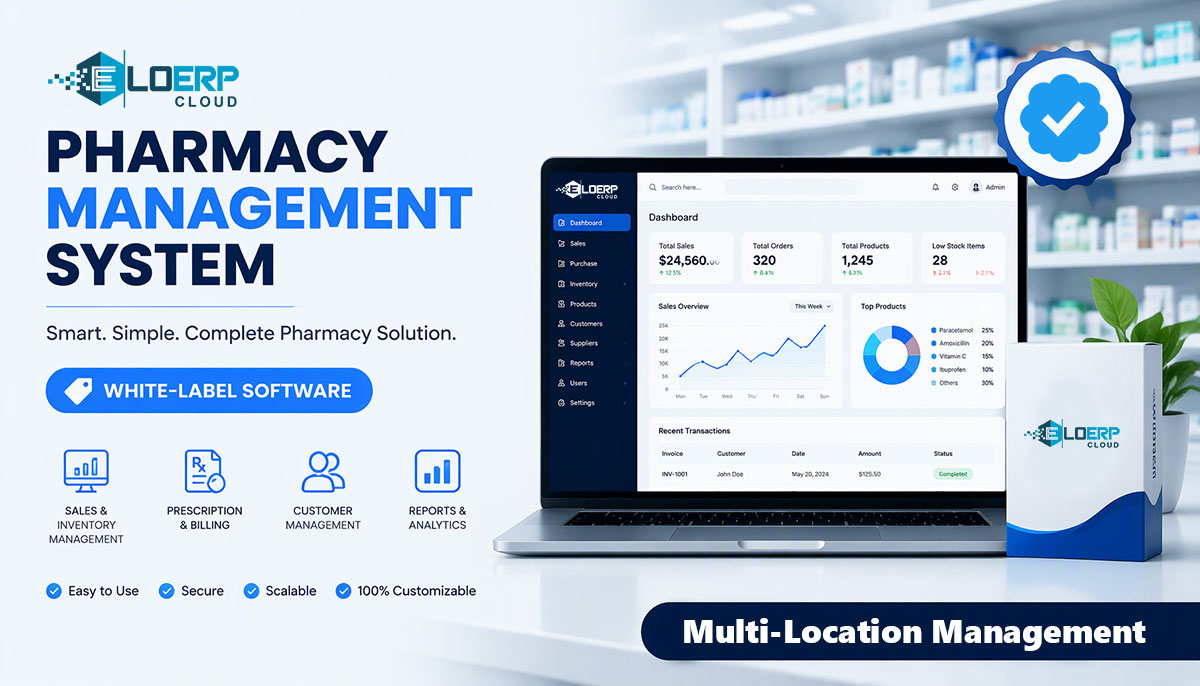
Global IT Vision Pharmacy Management System is an all-in-one platform integrating prescription dispensing, DEA-compliant controlled substance tracking, HIPAA-compliant patient records, insurance adjudication, inventory management, and integrated POS — available as white-label software with source code access for IT resellers. Supports EPCS (Electronic Prescribing for Controlled Substances), NCPDP SCRIPT 2023011, state board/PDMP reporting, and multi-location pharmacy chains. English interface with multilingual capability via Polylang plugin (contact for language availability); international offices in Lahore, Bari, and Baku.
What is a Pharmacy Management System?
A pharmacy management system is specialized software designed to automate prescription dispensing, inventory management, insurance billing, and regulatory compliance tracking for retail pharmacies, hospital outpatient pharmacies, and chain drugstores. Modern pharmacy software integrates core modules including prescription workflow automation (from e-prescription receipt to final dispensing), real-time insurance claim adjudication with PBM (Pharmacy Benefit Manager) connectivity, clinical decision support tools for drug interaction checking, inventory management with automated wholesale pricing updates via EDI, and DEA-mandated controlled substance tracking for Schedule II-V drugs.
Regulatory compliance requirements are extensive: HIPAA (Health Insurance Portability and Accountability Act) mandates secure patient data storage and access controls for Protected Health Information (PHI), DEA (Drug Enforcement Administration) regulations require 6-year record retention for controlled substances and automated audit-ready documentation, EPCS (Electronic Prescribing for Controlled Substances) standards now mandate two-factor authentication and digital signatures in most US states, NCPDP SCRIPT 2023011 compliance is required for electronic prescription transmission, and state boards of pharmacy require automated PDMP (Prescription Drug Monitoring Program) reporting and state-specific dispensing rules compliance.
Who needs pharmacy management software? Independent pharmacies managing 1-10 locations need centralized prescription workflow and insurance billing to compete with national chains. Hospital outpatient pharmacies require seamless integration with hospital EHR systems and billing departments. Compounding pharmacies need specialized inventory tracking for raw materials and batch management. 340B pharmacies serving low-income patients need compliance tracking for discounted drug pricing programs. IT resellers, MSPs (Managed Service Providers), and VARs (Value-Added Resellers) targeting healthcare clients need white-label pharmacy software to offer branded solutions without in-house development costs.
Key Features of Global IT Vision Pharmacy Management Software
1. Prescription Workflow Automation
Real-time insurance claim adjudication, prescription verification via patient profiles, and automated refill queues streamline pharmacy technician workflows. The system receives e-prescriptions via NCPDP SCRIPT 2023011-compliant channels, automatically checks insurance eligibility, submits claims to PBMs, and queues verified prescriptions for pharmacist review. Business value: Reduces manual data entry and phone calls to insurance companies, cutting pharmacy technician labor time per prescription. Ensures NCPDP SCRIPT 2023011 compliance for electronic prescriptions, preventing claim rejections from outdated transmission formats.
2. DEA Controlled Substance Tracking
Schedule II-V drug inventory management with 6-year record retention and automated DEA reporting prevents audit failures. The system tracks controlled substance orders from wholesalers, logs every dispensing transaction with patient/prescriber information, flags discrepancies between physical inventory and system records, and generates DEA Form 222 documentation. Business value: Prevents DEA audit failures with fines up to $64,820 per violation for recordkeeping errors. Automated tracking eliminates manual logbooks and reduces pharmacist time spent on compliance documentation by hours per week.
3. HIPAA-Compliant Patient Records
Secure PHI (Protected Health Information) storage with role-based access controls, complete audit trails, and data encryption protects patient privacy. The system restricts access based on user roles (pharmacist vs technician vs clerk), logs every PHI access event with timestamps and user IDs, encrypts stored data, and provides patient rights management for access requests and amendments. Business value: Protects against HIPAA violations costing $100-$50,000 per violation (up to $1.5 million annually for repeated violations). Role-based controls prevent unauthorized PHI access by front-desk staff or delivery personnel.
4. EPCS (Electronic Prescribing for Controlled Substances)
Two-factor authentication, digital signatures, and identity proofing for prescribers meet EPCS requirements now mandated in most US states. The system verifies prescriber DEA registrations, requires two-factor authentication (password + biometric or hardware token), validates digital signatures, and maintains identity proofing documentation. Business value: Required by most US states for controlled substance prescriptions as of 2026. Prevents paper prescription fraud (an estimated 500,000+ forged prescriptions annually in the US) and ensures compliance with state-level EPCS mandates.
5. Insurance Billing & Adjudication
Real-time PBM claim submission, DIR fee tracking, and split billing improve cash flow and reduce claim rejection rates. The system submits claims to hundreds of PBMs via standardized NCPDP Telecom formats, tracks DIR (Direct and Indirect Remuneration) fees clawed back by PBMs post-point-of-sale, handles split billing for dual coverage patients, and provides rejection analysis with suggested fixes. Business value: Reduces claim rejection rates (typical rejection rates are 5-15% for manual systems; automated systems reduce this to 2-5%). Improves cash flow by identifying negative-margin prescriptions before dispensing (critical given DIR fees increased 107,400% from 2010-2020 per industry research).
6. Drug Interaction Checking / Clinical Decision Support
Automated alerts for drug-drug, drug-age, and drug-pregnancy interactions prevent medication errors and reduce pharmacist liability. The system cross-references new prescriptions against patient medication history, flags dangerous interactions (contraindications, duplicate therapies, age-inappropriate dosing), and provides clinical references for pharmacist override decisions. Business value: Prevents medication errors (an estimated 500,000+ preventable adverse drug events occur annually in US hospitals and outpatient settings per research). Reduces pharmacist liability exposure and supports clinical care quality standards.
7. Inventory Management
Real-time stock tracking, automated wholesale pricing updates via EDI, low-stock alerts, expiry tracking, batch management, and barcode scanning reduce waste and prevent stockouts. The system updates acquisition costs automatically when wholesaler pricing changes, alerts staff before drugs expire (typically 60-90 days in advance), tracks batch numbers for recall management, and supports barcode scanning for receiving and dispensing. Business value: Reduces expired drug waste (pharmacies lose an average of 2-5% of inventory value to expiration annually; automated tracking can reduce this loss). Prevents stockouts of high-demand medications and optimizes inventory turnover.
8. Integrated POS (Point of Sale)
Retail checkout with Apple Pay/Google Wallet support, IIAS-certified FSA/HSA card processing, and loyalty programs increase average transaction value. The system processes both prescription and over-the-counter retail sales in one transaction, supports contactless payments, validates FSA/HSA card eligibility per IRS Publication 502 guidelines, and tracks customer purchase history for loyalty programs. Business value: Single platform for pharmacy + retail (versus competitors requiring separate POS systems at $50-$200/month additional cost). Increases average transaction value by enabling cross-selling of OTC products during prescription pickup.
9. Multi-Location Management
Centralized dashboard for chain pharmacies, inter-location inventory transfers, and consolidated reporting support growth from single-store to multi-location operations. The system provides corporate-level visibility into all locations’ sales/inventory/compliance metrics, enables inventory transfers between locations when one store stocks out, and generates consolidated reports for ownership/accounting. Business value: Manage 2-10 locations from one platform without per-location fees (competitors typically charge $600-$2,000/month per location). Reduces management overhead and enables evidence-based purchasing decisions based on chain-wide data.
10. White-Label Delivery for Resellers
Source code access, rebrandable UI, and custom integration capabilities enable IT resellers and MSPs to offer pharmacy software under their own brand. The system ships with full source code for customization, supports white-label rebranding (logo, colors, domain), and provides integration APIs for custom EHR/hospital system connectivity. Business value: IT resellers/MSPs can white-label as their own product and capture 30-60% reseller margins (typical in software reselling). Unlike PioneerRx, BestRx, Liberty Software, and PrimeRx (all SaaS-only), Global IT Vision provides source code access for white-label customization.
Regulatory Compliance — HIPAA, DEA, EPCS & State Board Requirements
HIPAA Compliance for Pharmacy Data Security
HIPAA requires covered entities (including pharmacies) to secure Protected Health Information (PHI) with minimum necessary access controls, patient rights for access and amendments, complete audit logs showing who accessed what data and when, and encryption for data at rest and in transit. Global IT Vision pharmacy software is designed for HIPAA compliance with role-based permission systems that restrict PHI access by job function (pharmacists see full records, technicians see prescription data only, clerks see limited demographic information), encrypted cloud storage or on-premise deployment options for organizations requiring physical data control, audit trails logging every PHI access event with timestamps and user IDs, and secure login systems with password complexity requirements and session timeouts.
Pharmacies must conduct HIPAA risk assessments, implement security policies, train staff annually, and maintain business associate agreements with third-party vendors. While no software can be “HIPAA-certified” (HIPAA is a regulation, not a certification program), Global IT Vision pharmacy software provides the technical controls required for compliance including access controls, encryption, and audit logging.
DEA Controlled Substance Tracking
DEA regulations require pharmacies to maintain valid DEA registrations for controlled substance dispensing, track Schedule II-V drugs separately from non-controlled medications, retain records for 6 years (electronic or paper), and provide audit-ready documentation for DEA inspections. Global IT Vision’s DEA-compliant module tracks controlled substances from ordering (DEA Form 222 electronic orders for Schedule II) through dispensing (prescription capture with patient/prescriber information), maintains 6-year archives with tamper-evident logging, and generates automated transaction logs showing all controlled substance inventory movements (receipts, dispensing, returns, theft/loss).
Pharmacies face fines up to $64,820 per violation for DEA audit failures related to recordkeeping violations, missing records, or inventory discrepancies. Automated DEA tracking eliminates manual logbooks (which are error-prone and time-consuming) and ensures every controlled substance transaction is documented with audit-ready detail.
EPCS (Electronic Prescribing for Controlled Substances)
EPCS standards require two-factor authentication for prescribers (knowledge factor like password + possession factor like hardware token or biometric), digital signatures validated through certificate authorities, identity proofing conducted by third-party credential service providers before first EPCS use, and periodic third-party audits of EPCS systems. Many US states now mandate EPCS for controlled substance prescriptions (as of 2026), eliminating paper prescriptions for Schedule II-V drugs in those jurisdictions.
Global IT Vision pharmacy software includes EPCS-ready prescription modules supporting two-factor authentication flows, digital signature validation, and identity-proofing documentation storage. Specific EPCS certification may require third-party audits depending on state regulations (the software is designed for EPCS compliance but pharmacy operators should verify state-specific certification requirements with their compliance advisors).
State Board & PDMP Reporting
State boards of pharmacy require pharmacies to submit dispensing data to PDMP (Prescription Drug Monitoring Program) databases (typically within 24 hours of dispensing controlled substances), comply with state-specific dispensing rules (quantity limits, refill restrictions, prescription format requirements varying by state), and respond to board audits with documentation. Global IT Vision pharmacy software automates PDMP submission via state-specific reporting formats (ASAP 4.2A standard in most states), provides configurable rule engines for state-specific pharmacy board requirements across all 50 US states, and generates audit reports for board inspections.
Automated PDMP reporting eliminates manual data entry (which is error-prone and time-consuming, taking 3-5 minutes per controlled substance prescription) and ensures compliance with 24-hour reporting deadlines mandated in most states.
Global IT Vision vs Competitors: Pharmacy Software Comparison
| Provider | Starting Price | White-Label? | Integration | Target Market | Key Differentiator |
|---|---|---|---|---|---|
| Global IT Vision | Contact for pricing | ✅ Yes (source code access) | All-in-one (Pharmacy + ERP + POS + Hospital + Lab) | Independent pharmacies, white-label resellers, international markets | White-label provider; multi-vertical integration; offshore rates ($25-$50/hr) |
| PioneerRx | $595-$1,999/mo | ❌ No (SaaS-only) | Pharmacy-only (requires separate EHR $300-$600/mo, POS $50-$200/mo) | Independent pharmacies (1-10 locations) | Feature-rich; modern UI; strong clinical tools; DIR fee estimator |
| BestRx | Contact for pricing | ❌ No (SaaS-only) | Pharmacy-only | Independent pharmacies, chain drugstores | Ease of use; 100+ integrations |
| Liberty Software | Contact for pricing | ❌ No (SaaS-only) | Pharmacy + POS (integrated) | Independent, small chain, 340B pharmacies | Pharmacist-built; workflow-focused; integrated POS |
| Micro Merchant Systems (PrimeRx) | Contact for pricing | ❌ No (SaaS-only) | Pharmacy-only | Independent to large chains, LTC, specialty | 30+ years experience; highly customizable; extensive module portfolio |
Why Global IT Vision is Different
White-label + source code availability: Unlike major competitors (PioneerRx, BestRx, Liberty Software, Micro Merchant Systems/PrimeRx — all SaaS-only platforms), Global IT Vision offers source code access and rebrandable UI for IT resellers, MSPs, and VARs. This creates a unique opportunity for IT resellers targeting healthcare vertical markets: purchase Global IT Vision pharmacy software with source code, rebrand it as your own product, and offer pharmacy + ERP + POS + hospital management ERP + laboratory management system solutions to healthcare clients under your brand name. Typical reseller margins are 30-60% in software reselling.
All-in-one platform vs fragmented competitors: PioneerRx, BestRx, and PrimeRx are pharmacy-only systems requiring separate EHR systems ($300-$600/month) and separate POS systems ($50-$200/month) for retail checkout. This creates total monthly costs of $650-$2,200+ for a complete pharmacy solution. Liberty Software integrates pharmacy + POS but lacks EHR/hospital connectivity. Global IT Vision integrates pharmacy + POS + ERP + hospital management + laboratory management in one platform, reducing total software costs by $350-$800/month and eliminating “swivel chair” duplicate data entry between disconnected systems.
Offshore pricing advantage for custom work: US-based competitors (PioneerRx, BestRx, Liberty Software, PrimeRx) charge $80-$150/hour for custom development, integrations, and feature requests. Global IT Vision development rates are $25-$50/hour, providing 50-70% cost savings on customization work. For resellers needing custom integrations with regional EHR systems, billing platforms, or state-specific reporting requirements, this pricing differential creates significant margin opportunities.
Multi-vertical portfolio depth: Global IT Vision offers 60+ products across 12+ industries (pharmacy, hospital, laboratory, hotel, restaurant, courier, school, HRMS, CRM, real estate, gym, retail POS). IT resellers can offer a full healthcare suite to clients: pharmacy management for retail pharmacies, hospital management ERP for inpatient facilities, laboratory management system for diagnostic labs, and white-label POS software for hospital cafeterias and retail pharmacies. Competitors are single-vertical (pharmacy-only) requiring resellers to source additional products from other vendors.
International support vs US-only focus: PioneerRx, BestRx, Liberty Software, and PrimeRx are US-focused with limited international deployment support. Global IT Vision operates offices in Lahore (Pakistan), Bari (Italy), and Baku (Azerbaijan) with multilingual capability via Polylang plugin (English interface; contact for additional language availability) and development teams experienced in international regulatory requirements, multi-currency billing, and regional integrations. For resellers targeting Middle East, European, South Asian, or African markets, Global IT Vision provides localization and support that US competitors cannot match.
Hidden cost transparency: Competitors charge $10,000-$30,000 for implementation and training (per industry research), plus $20,000-$80,000 for third-party EHR/POS integrations. These hidden costs often double the total cost of ownership. Global IT Vision’s white-label model allows resellers to control their own pricing and margins: purchase the software once with source code access, deploy to unlimited end-user clients, and set your own implementation/training fees. Implementation is included in white-label partnerships, and integration costs are eliminated by the all-in-one platform architecture.
Use Cases: Who Benefits from Global IT Vision Pharmacy Software?
Independent Pharmacies (1-5 Locations)
Independent pharmacies face high software costs ($600-$2,000/month for PioneerRx + EHR + POS), complex implementations costing $10,000-$30,000, and 60-90 day deployment timelines. Global IT Vision provides an all-in-one platform (pharmacy + POS integrated), rapid implementation, and offshore pricing reducing total monthly software costs.
Example: A 2-location independent pharmacy currently paying $1,395/month (PioneerRx $595/month base + EHR integration $300-$600/month + separate POS system $50-$200/month = $945-$1,395/month minimum) faces total software costs of $16,740 annually before implementation fees. Global IT Vision’s integrated platform eliminates separate EHR and POS subscriptions (saving $350-$800/month or $4,200-$9,600/year), reduces implementation costs through faster deployment, and provides offshore development rates ($25-$50/hour versus $80-$150/hour for US competitors) for custom integrations with regional systems. Contact for pricing details and total cost of ownership calculations.
Chain Pharmacies (5-10 Locations)
Chain pharmacies face per-location fees ($600-$2,000/month × 10 locations = $6,000-$20,000/month total), fragmented systems requiring duplicate data entry, and complex inter-location inventory management. Global IT Vision provides multi-location management dashboards, centralized inventory with inter-location transfer capabilities, and quote-based pricing with no standard per-location fees.
Example: Manage 10 pharmacy locations from one centralized dashboard with real-time visibility into each location’s inventory, sales, compliance metrics, and staffing. Inter-location inventory transfers prevent stockouts (when Location A runs out of a drug, transfer from Location B’s excess inventory). Consolidated reporting for ownership and accounting teams provides chain-wide analytics for purchasing decisions and performance management.
Hospital Outpatient Pharmacies
Hospital outpatient pharmacies struggle with pharmacy-only systems that don’t integrate with hospital EHR and billing departments, creating duplicate data entry for patient demographics, duplicate billing workflows, and fragmented patient records across hospital and pharmacy systems. Global IT Vision integrates hospital management ERP + pharmacy modules for seamless data flow.
Example: Hospital outpatient pharmacies integrate pharmacy dispensing with hospital billing (charges automatically post to patient accounts), patient records (pharmacy accesses hospital allergy/medication history without duplicate entry), and lab results (pharmacists review lab values before dispensing drugs requiring monitoring like warfarin or aminoglycosides). One platform for inpatient + outpatient pharmacy + hospital billing + lab + radiology eliminates system integration costs ($20,000-$80,000 for third-party interfaces).
IT Resellers / MSPs / VARs (White-Label Partners)
IT resellers, MSPs, and VARs targeting healthcare clients face limited white-label pharmacy software options (PioneerRx, BestRx, Liberty Software, PrimeRx are all SaaS-only without source code access or rebranding options). This limits resellers to referral partnerships with low commissions (10-20%) rather than true white-label reselling with 30-60% margins.
Example: IT resellers purchase Global IT Vision pharmacy software with source code access, rebrand as their own product (company logo, colors, domain), and offer pharmacy + ERP + POS + hospital management ERP + laboratory management system solutions to healthcare clients under their brand name. Resellers control pricing, implementation, customization, and ongoing support, capturing 30-60% margins typical in software reselling. Learn more about POS software reseller program opportunities.
Frequently Asked Questions (FAQ Schema)
How much does pharmacy management software cost?
Pharmacy management software costs vary by vendor and features. PioneerRx ($595-$1,999/month per Capterra) is among the most transparent with published pricing and the most features. BestRx and Liberty Software offer quote-based pricing (contact vendors directly for current rates). Global IT Vision offers quote-based pricing for white-label partners. Hidden costs include implementation ($10,000-$30,000), training, and third-party integrations for EHR/POS ($20,000-$80,000 for competitors requiring separate systems).
What regulatory compliance is required for pharmacy software?
Pharmacy software must support HIPAA (patient data security with encryption, access controls, audit logs), DEA (controlled substance tracking with 6-year retention and automated reporting), EPCS (electronic prescribing for controlled substances requiring two-factor authentication and digital signatures), NCPDP SCRIPT 2023011 (electronic prescription transmission standards), state board/PDMP reporting (automated submission within 24 hours in most states), and DSCSA (drug supply chain serialization for recall management). Non-compliance risks $100-$50,000 HIPAA fines per violation (up to $1.5 million annually for repeated violations) and $10,000-$50,000 DEA audit penalties for recordkeeping failures.
What is the difference between pharmacy-only and all-in-one pharmacy software?
Pharmacy-only software (PioneerRx, BestRx, PrimeRx) handles prescription dispensing and insurance billing but requires separate EHR systems ($300-$600/month) and separate POS systems ($50-$200/month) for retail checkout. All-in-one platforms (Global IT Vision, Liberty Software) integrate pharmacy + POS + EHR in one system, reducing total monthly costs by $350-$800 and eliminating duplicate data entry between disconnected systems. Integration costs for pharmacy-only systems add $20,000-$80,000 for third-party interfaces.
How long does pharmacy software implementation take?
Pharmacy software implementation takes 2-3 months on average for most vendors. PioneerRx and BestRx typically require 60-90 days for data migration (importing patient/prescription history from legacy systems), staff training (pharmacists, technicians, clerks), and integration setup (connecting to PBMs, wholesalers, EHR/POS systems). Implementation costs range from $10,000-$30,000 for most vendors including onsite training and data migration services. Global IT Vision offers rapid implementation with white-label partners controlling their own deployment timelines and implementation processes.
Can pharmacy software integrate with EHR and POS systems?
Yes, but integration complexity varies significantly. Pharmacy-only systems (PioneerRx, BestRx, PrimeRx) require third-party integrations costing $20,000-$80,000 plus ongoing maintenance fees ($200-$500/month for interface support) to connect with EHR and POS systems. Integration projects take 30-90 days and require HL7 or FHIR interface development. All-in-one platforms (Global IT Vision) have native pharmacy + EHR + POS integration built into one system, eliminating integration costs and reducing “swivel chair” duplicate data entry between systems (staff entering the same patient demographics in three separate systems).
Is white-label pharmacy software available?
Unlike major competitors (PioneerRx, BestRx, Liberty Software, Micro Merchant Systems/PrimeRx — all SaaS-only platforms), Global IT Vision offers white-label pharmacy management software with source code access and rebrandable UI for IT resellers, MSPs, and VARs. White-label partners typically earn 30-60% reseller margins by purchasing Global IT Vision pharmacy software with source code, rebranding as their own product, and reselling to healthcare clients under their brand name.
What are DIR fees and how does pharmacy software help?
DIR (Direct and Indirect Remuneration) fees are post-point-of-sale clawbacks by PBMs (Pharmacy Benefit Managers) that increased 107,400% from 2010-2020, creating cash flow crises for independent pharmacies. DIR fees are deducted weeks or months after prescription dispensing, turning profitable prescriptions into losses retroactively. Advanced pharmacy software (PioneerRx DIR fee estimator, PrimeRx DIR planning tool) tracks DIR fees and estimates net reimbursement to prevent negative-margin prescriptions. Some pharmacy software platforms lack DIR fee tracking, leaving pharmacies blind to true profitability until DIR fees are clawed back.
Does pharmacy software support EPCS (Electronic Prescribing for Controlled Substances)?
Yes, most modern pharmacy management systems support EPCS requirements including two-factor authentication (password + biometric or hardware token), digital signatures validated through certificate authorities, and identity proofing for prescribers. EPCS is now required in most US states for controlled substance prescriptions as of 2026, eliminating paper prescriptions for Schedule II-V drugs. PioneerRx, BestRx, Liberty Software, PrimeRx, and Global IT Vision all offer EPCS-ready prescription modules. Third-party certification or audit may be required depending on state-specific regulations (consult your state board of pharmacy for certification requirements).
How to Choose the Right Pharmacy Management System
If you’re an independent pharmacy (1-2 locations): BestRx (contact for pricing) positions itself as an affordable entry point for tight budgets. Liberty Software (contact for pricing) provides integrated pharmacy + POS for retail operations. Global IT Vision offers all-in-one pharmacy + POS + ERP with international support and multilingual capability via Polylang plugin (English interface; contact for language availability) for pharmacies in non-US markets or serving multilingual patient populations.
If you’re a chain pharmacy (5-10 locations): PioneerRx ($595-$1,999/month) offers advanced multi-location features including centralized dashboards, inter-location reporting, and modern UI. Global IT Vision provides multi-location management with no standard per-location fees (quote-based pricing) and centralized inventory transfers between locations.
If you’re a hospital outpatient pharmacy: Global IT Vision integrates hospital management ERP + pharmacy modules for seamless data flow between inpatient pharmacy, outpatient pharmacy, hospital billing, patient records, and lab results. PioneerRx offers strong clinical tools (drug interaction checking, medication therapy management) but requires $20,000-$80,000 third-party integration with hospital EHR systems.
If you’re an IT reseller/MSP/VAR: Global IT Vision offers white-label pharmacy software with source code access and rebrandable UI. Purchase once, deploy to unlimited end-user clients under your brand, and capture 30-60% reseller margins. Unlike PioneerRx, BestRx, Liberty Software, and PrimeRx (all SaaS-only), Global IT Vision provides white-label reseller options.
If you need a low-cost option: BestRx (contact for pricing) positions itself as a low-cost entry point but requires separate EHR ($300-$600/month) and POS ($50-$200/month) adding to total costs.
If you need extensive features: PioneerRx ($595-$1,999/month) offers strong feature depth including DIR fee estimators, modern UI, clinical decision support tools, and medication therapy management workflows.
If you need all-in-one (pharmacy + POS + EHR): Global IT Vision eliminates $350-$800/month in separate EHR/POS subscriptions required by PioneerRx, BestRx, and PrimeRx. Liberty Software also integrates pharmacy + POS but lacks hospital/EHR connectivity.
If you’re in an international market: Global IT Vision operates offices in Lahore, Bari, and Baku with multilingual capability via Polylang plugin (English interface; contact for language availability) and development teams experienced in international regulatory requirements. US-based competitors (PioneerRx, BestRx, Liberty Software, PrimeRx) focus on US markets with limited international deployment support.
Honest positioning: If you’re a US-only single-location independent pharmacy with simple dispensing needs and a tight budget, BestRx (contact for pricing) may be a reasonable fit. If you need clinical depth, modern UI, and can afford $600-$2,000/month, PioneerRx is best-in-class. If you’re a reseller, multi-location chain, hospital pharmacy, or serving international markets, Global IT Vision’s white-label + all-in-one platform is the better fit. Contact Global IT Vision for pricing and hospital management ERP or white-label POS software integration details.
Get Started with Global IT Vision Pharmacy Management Software
Ready to streamline your pharmacy operations with an all-in-one platform? Request a demo of Global IT Vision’s pharmacy management software — or ask about our white-label reseller program.
Live demo available: Experience the pharmacy workflow automation, DEA compliance tracking, insurance adjudication, and integrated POS features firsthand at apps.globalitvision.com. Our team will schedule a personalized demo showing prescription dispensing workflows, controlled substance tracking, insurance claim submission and adjudication, clinical decision support tools, inventory management with barcode scanning, and integrated POS retail checkout.
What to expect from your demo: Our team will walk through real-world pharmacy scenarios including high-volume prescription processing during peak hours, controlled substance dispensing with DEA compliance documentation, insurance claim rejections and resolution workflows, drug interaction alerts and pharmacist override decisions, inventory receiving with barcode scanning, and multi-location chain reporting dashboards. White-label partners receive additional demos covering source code access, custom integration capabilities, and deployment assistance.
Contact options:
- Primary CTA: Request a Demo → /contact-us/ contact form
- Secondary CTA: Explore White-Label Program → /products/pos/reseller-program/ for IT resellers, MSPs, and VARs
White-label partner support: IT resellers, MSPs, and VARs receive source code access for customization, white-label rebranding assistance (logo, colors, domain configuration), custom deployment support for integrations with regional EHR systems or state-specific reporting requirements, and reseller training for implementation and support processes. Learn about POS software reseller program opportunities or contact us for white-label partnership details.
Crisp live chat: Embedded on this page for immediate questions about pharmacy software features, pricing, implementation timelines, or white-label reseller opportunities. Our team responds during business hours across our international offices (Lahore, Bari, Baku time zones).
Sources
- PioneerRx pricing and features: https://www.capterra.com/p/106400/PioneerRX/, https://www.softwareadvice.com/retail/pioneerrx-profile/
- BestRx pricing and features: https://www.guideflow.com/blog/pharmacy-software, https://www.selecthub.com/p/pharmacy-software/bestrx/
- Liberty Software pricing and features: https://www.softwaresuggest.com/liberty-pharmacy, https://www.capterra.com/p/134060/Liberty-Software/
- Micro Merchant Systems (PrimeRx) features: https://www.capterra.com/p/106399/PrimeRx/, https://www.softwareadvice.com/retail/primerx-profile/
- DIR fee increase (107,400% from 2010-2020): https://ncpa.org/newsroom/news-releases/2021/06/03/its-not-typo-91500-increase-fees-heaped-pharmacies (National Community Pharmacists Association, citing CMS data)
- HIPAA violation fines: https://www.hipaaguide.net/what-are-the-penalties-when-pharmacies-violate-hipaa-rules/ (HHS Office for Civil Rights penalty structure)
- DEA audit penalties: https://federal-lawyer.com/healthcare/healthcare-compliance/dea-matters/pharmacy-audits/ (DEA monetary penalties up to $64,820 per violation)
- Pharmacy software implementation costs: https://www.leanware.co/insights/pharmacy-software-development-guide, https://appinventiv.com/blog/pharmacy-management-software-development/