
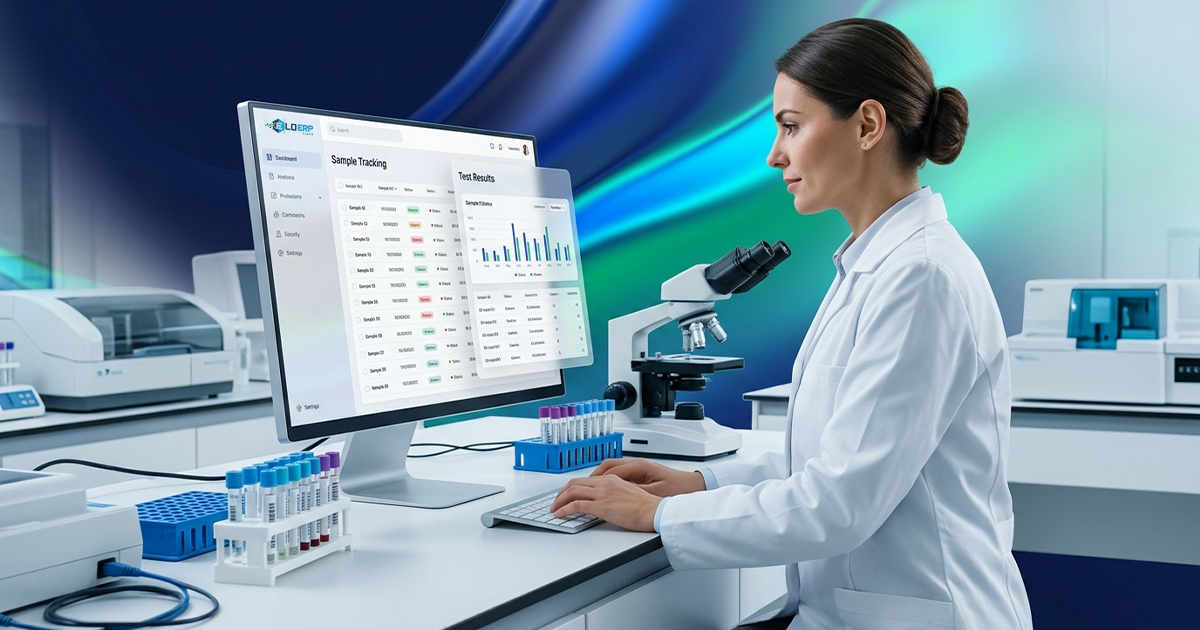
A laboratory management system (LIMS) is software that manages lab workflows including sample tracking, test orders, inventory management, quality control, result reporting, billing, and regulatory compliance. Comprehensive LIMS platforms support clinical labs, research labs, pathology labs, and specialized facilities (veterinary, IVF, cannabis testing) with configurable workflows, equipment integration, and multi-location support.
Clinical labs, research facilities, hospital pathology departments, and specialized testing centers face complex operational challenges: sample chain-of-custody tracking (barcode scanning, aliquot management), equipment integration (analyzers, centrifuges, PCR machines), quality control workflows (QC protocols, proficiency testing, CLIA compliance), inventory management (reagents, consumables, expiration tracking), result delivery (patient portals, EHR integration, physician notifications), and billing (insurance claims, CPT codes, pricing lists).
Generic lab management systems offer basic sample tracking but lack clinical-grade features (HIPAA compliance, HL7 integration, regulatory reporting). Enterprise LIMS platforms (ThermoFisher, LabWare, Illumina) provide comprehensive features but require $50K-$500K budgets and long implementation timelines (6-12 months). SMB labs and multi-location lab networks need affordable, fast-deployment LIMS with white-label options for lab chains building their own branded platforms.
This guide covers laboratory management system capabilities, deployment models, integration requirements, and platform comparison (Global IT Vision versus LabWorks, ThermoFisher, Illumina, Autoscribe, Labguru), helping lab managers and LIMS resellers choose the right platform based on lab type, budget, and customization needs.
What is a Laboratory Management System (LIMS)?
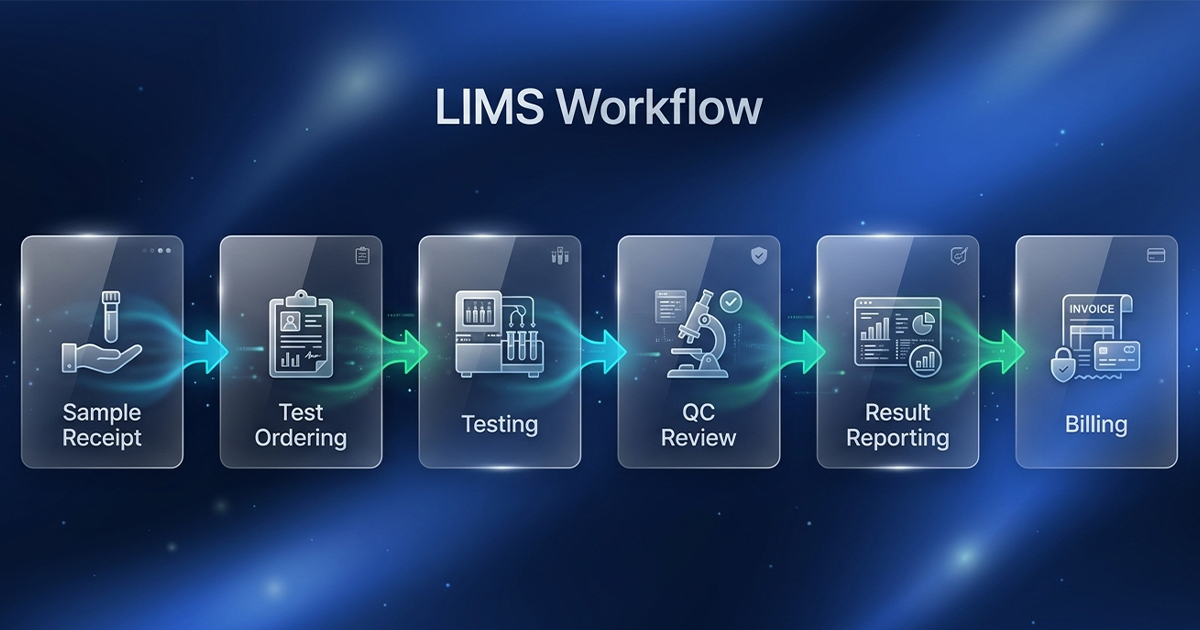
A laboratory management system is software that manages laboratory operations from sample receipt to result delivery. LIMS automates and streamlines workflows that would otherwise require manual documentation, spreadsheets, and paper records—reducing errors, improving turnaround times, and ensuring regulatory compliance.
Core modules in a comprehensive LIMS include sample tracking (barcode/RFID accessioning, aliquot management, storage location tracking), test order management (configurable test catalogs, panel ordering, priority handling), inventory management (reagent tracking, expiration alerts, vendor management), quality control (QC protocols, proficiency testing, compliance monitoring), result reporting (automated report generation, patient portals, EHR integration), and billing (CPT coding, insurance claims, pricing lists).
LIMS users span diverse laboratory types: clinical labs (hospital pathology departments, reference labs like Quest and LabCorp, diagnostic centers), research labs (academic institutions, pharmaceutical R&D, biotech companies, contract research organizations), and specialized labs (veterinary diagnostic labs, IVF embryology labs, forensic labs, cannabis testing facilities, environmental testing centers).
LIMS vs LIS: Understanding the Distinction
Laboratory Information System (LIS) typically refers to clinical/diagnostic lab software emphasizing patient billing, insurance claims, and regulatory compliance. LIMS (Laboratory Information Management System) is broader, covering research lab workflows, quality control testing, extensive inventory management, and instrument integration. In practice, many clinical LIMS include LIS features (billing, CPT coding), so vendors use the terms interchangeably. Global IT Vision’s LIMS covers both clinical and research workflows.
Business Benefits of LIMS
Modern LIMS delivers measurable operational improvements. According to The Business Research Company’s 2026 LIMS market report, laboratories implementing LIMS reduce manual documentation errors and maximize productivity, driven by automated workflows and real-time data access. LabWorks, a leading LIMS provider, reports 50-70% productivity increases with typical ROI achieved in 1-3 years.
Key benefits include faster turnaround times (automated workflows eliminate manual data entry steps), error reduction (barcode scanning prevents sample mislabeling, auto-validation catches out-of-range results before reporting), compliance automation (audit trails document every action for inspections, automated QC tracking ensures CLIA/CAP compliance), inventory cost control (expiration tracking prevents reagent waste, usage analytics identify cost-saving opportunities), and revenue capture (automated billing ensures all performed tests are invoiced, reducing unbilled test leakage).
Key Features of Laboratory Management Systems
Sample Tracking & Chain of Custody
Sample tracking forms the foundation of any LIMS. At sample receipt (accessioning), the system assigns unique barcode or RFID identifiers, linking the physical specimen to the patient order and test requisition. Aliquot management tracks parent/child relationships when samples are divided into multiple tubes for different tests.
Real-time location tracking shows where samples are throughout their lifecycle: freezer storage (specific shelf, box, position), processing stations (chemistry bench, hematology area), analyzer queues, and archival storage. Chain-of-custody audit trails record every person who handled the sample, when, and where—critical for forensic labs, clinical trials, and regulated testing environments.
The sample lifecycle flows from receipt → testing → storage → disposal/archival. LIMS automates retention policies, flagging samples for disposal after regulatory retention periods expire (typically 2-7 years depending on test type and jurisdiction).
Test Order Management
LIMS maintains configurable test catalogs defining test names, CPT codes, turnaround times, specimen requirements, and pricing. Multi-test profiles (panels) allow ordering groups of related tests with a single click—for example, a “Metabolic Panel” automatically orders glucose, electrolytes, BUN, creatinine, and calcium.
Priority handling ensures STAT (urgent) orders skip normal queues, with visual indicators alerting technicians to critical specimens. Physician/client order portals enable referring physicians to submit test orders electronically, reducing phone calls and fax-based ordering.
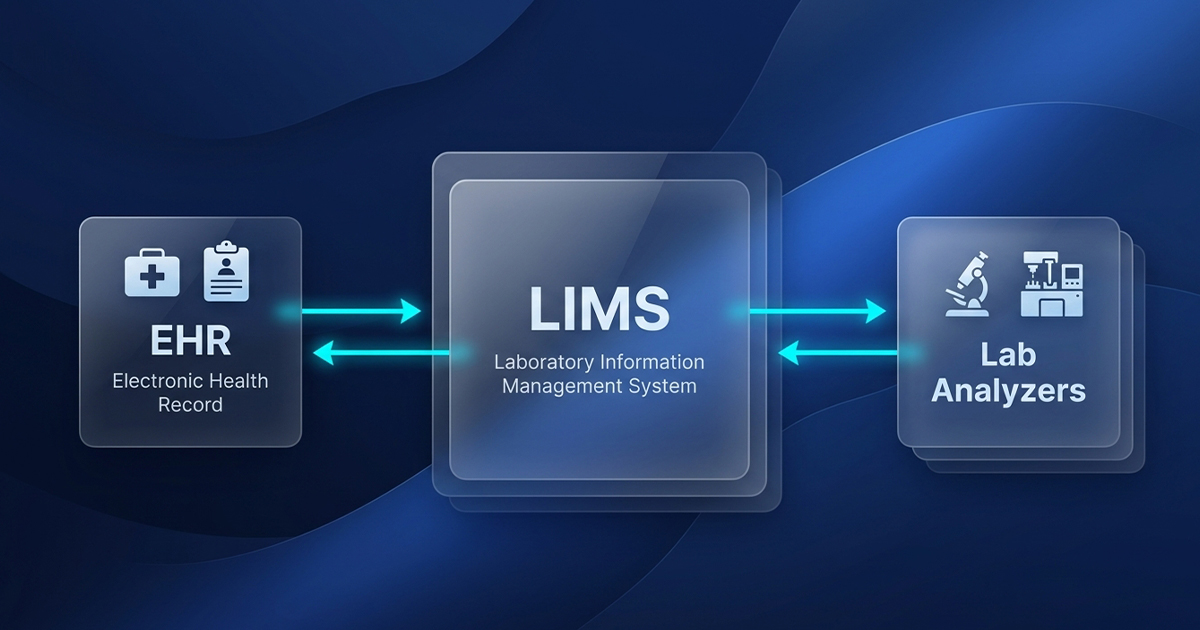
Integration with EHR/EMR systems allows hospitals to send orders directly from patient charts via HL7 ORM messages, eliminating duplicate data entry and reducing order errors.
Instrument & Equipment Integration
Bi-directional interfaces connect LIMS to laboratory analyzers, automating result import and worklist management. The LIMS sends worklists to analyzers (which samples to run, which tests), and analyzers automatically upload results, QC values, and instrument flags back to the LIMS.
Supported integration protocols include HL7 (health care data exchange standard), ASTM E1394 (lab instrument communication protocol), and LIS2-A2 (lab automation messaging). Common integrations span chemistry analyzers (Abbott, Roche, Beckman Coulter), hematology analyzers (Sysmex, Horiba), microbiology systems (BD Kiestra), and PCR/molecular platforms (Roche, Cepheid).
For analyzers without native interfaces, middleware software bridges communication between legacy equipment and the LIMS. Result auto-verification applies rule-based validation (range checks, delta checks, duplicate detection) before flagging results for technologist review, accelerating result release for normal findings.
Quality Control & Compliance
Clinical labs operating under CLIA (Clinical Laboratory Improvement Amendments) must run quality control samples at two concentration levels per day of patient testing, according to CMS CLIA regulations. LIMS automates QC workflow, tracking control lot numbers, target ranges, and recording results. Westgard rules and Levy-Jennings charts provide statistical QC analysis, automatically flagging out-of-control runs.
Proficiency testing tracking manages CAP (College of American Pathologists) and CLIA PT enrollment, result submission deadlines, and grading—critical for maintaining laboratory accreditation. Personnel competency records document training, validations, and continuing education per regulatory requirements.
Comprehensive audit trails log every action: who accessed what data, when, what changes were made—meeting FDA 21 CFR Part 11 requirements for electronic records in pharmaceutical and clinical research labs. Document management stores SOPs (standard operating procedures), validation protocols, and training records in centralized, version-controlled repositories.
Inventory & Supply Chain Management
Reagent tracking monitors lot numbers, expiration dates, storage temperatures, and usage rates. Low-stock alerts trigger automatic reorder notifications when inventory falls below defined thresholds. Vendor management maintains supplier catalogs, purchase orders, and receiving documentation.
Equipment calibration tracking ensures analyzers, pipettes, centrifuges, and other equipment receive timely maintenance and calibration per manufacturer specifications and regulatory standards. Service history logs document repairs, preventive maintenance, and qualification testing.
Cost-per-test analysis calculates reagent consumption by test type, enabling labs to identify high-cost tests, negotiate better vendor pricing, and optimize test menus.
Result Reporting & Delivery
Configurable report templates allow labs to customize letterhead, logos, disclaimers, and result formatting for different clients. Critical value alerts automatically notify ordering physicians via SMS, email, or phone for dangerously abnormal results (life-threatening high potassium, critical low hemoglobin) requiring immediate clinical action.
Patient portals provide secure online result access, reducing phone inquiries and improving patient satisfaction. EHR result delivery via HL7 ORU (observation result) messages pushes results directly into hospital electronic medical records, updating patient charts in real-time.
Modern LIMS support multiple result formats: PDF reports (for email/portal delivery), HL7 messages (for EHR integration), FHIR (Fast Healthcare Interoperability Resources—newer interoperability standard), and custom APIs for specialty integrations.
Billing & Revenue Cycle Management
CPT (Current Procedural Terminology) and LOINC (Logical Observation Identifiers Names and Codes) mapping links each test to billable codes for insurance claims. Insurance claim generation produces CMS-1500 forms (professional claims) and UB-04 forms (institutional claims) with proper diagnosis codes, test codes, and pricing.
Pricing lists manage client-specific pricing contracts, insurance reimbursement schedules, and Medicare fee schedules. Outstanding billing reports identify unbilled tests, track aging receivables, and flag claims requiring follow-up.
Integration with accounting systems (QuickBooks, Xero, NetSuite) synchronizes invoices, payments, and financial reporting, closing the loop between laboratory operations and business management.
Types of Laboratory Management Systems (By Lab Type)
Clinical LIMS (Hospital & Diagnostic Labs)
Clinical LIMS focuses on patient testing, regulatory compliance, and insurance billing. Key requirements include HIPAA compliance (encrypted patient data, access controls, Business Associate Agreements), HL7/EHR integration (receiving orders from and sending results to hospital EMRs), CPT coding and insurance billing workflows, and critical value alert protocols.
Clinical LIMS users include hospital pathology departments (hospital management ERP integrated labs), reference laboratories (high-volume regional/national labs), and outpatient diagnostic centers. Regulatory requirements span CLIA certification (CMS oversight of clinical testing), CAP accreditation (peer-based lab quality standards), and state laboratory licenses.
Research LIMS (Academic & Pharma R&D)
Research LIMS emphasizes experiment tracking, protocol management, and data analysis over billing workflows. Key features include electronic lab notebooks (ELN integration for experiment documentation), experiment templates (standardized protocols for reproducibility), data visualization (charts, graphs, statistical analysis), and extensive instrument integration.
Research LIMS users include university research labs, pharmaceutical R&D departments, biotech companies, and contract research organizations (CROs). Use cases span drug discovery screening, genomics research, proteomics workflows, and cell culture/bioreactor tracking.
Specialty LIMS (Vertical-Specific Labs)
Veterinary LIMS manages animal patient records, species-specific reference ranges (normal values differ by species), and veterinary CPT codes for billing animal hospitals and clinics.
IVF LIMS handles embryology workflows including egg retrieval documentation, fertilization tracking (IVF, ICSI methods), embryo grading and development monitoring, and cryopreservation inventory (tracking frozen embryos, sperm, eggs by patient and storage location). Critical patient matching ensures correct sperm/egg/embryo assignment to prevent mix-ups.
Forensics LIMS maintains evidence chain-of-custody documentation, legal hold protocols (preserving evidence integrity for court), court-ready reports with detailed audit trails, and DNA profiling workflows.
Cannabis Testing LIMS performs potency testing (THC, CBD, terpene percentages), contaminant screening (pesticides, heavy metals, microbial testing), and state compliance reporting. Many states require integration with seed-to-sale tracking systems like Metrc.
Environmental LIMS manages water, soil, and air sample testing with EPA compliance features, chain-of-custody forms specific to environmental monitoring, and regulatory reporting to environmental agencies.
LIMS Deployment Options (Cloud vs On-Premise vs Hybrid)
Cloud LIMS (SaaS Multi-Tenant)
Cloud LIMS runs on vendor-hosted infrastructure accessed via web browsers. Subscription pricing typically ranges $200-$800 per user per month, varying by feature set and sample volume.
Advantages: Fast deployment (2-6 weeks from contract to go-live), automatic updates (vendor manages software patches and feature releases), lower upfront cost ($5K-$50K implementation fees versus $50K+ for on-premise), no IT infrastructure investment (no servers to purchase/maintain), and remote access (lab staff, pathologists, and administrators access the system from any internet-connected device).
Disadvantages: Recurring costs yield higher total cost of ownership over 5+ years, data stored on vendor servers (privacy considerations for sensitive research or proprietary data), and limited customization (multi-tenant architecture constrains deep workflow modifications).
Best for: SMB labs lacking dedicated IT staff, multi-location lab chains requiring centralized data access, startups with limited capital budgets, and labs prioritizing fast deployment over deep customization.
On-Premise LIMS (Self-Hosted Single-Tenant)
On-premise LIMS installs on the laboratory’s own servers with perpetual software licenses. Licensing typically costs $10K-$100K one-time fee, varying by lab size and module selection.
Advantages: Complete data control (sensitive data remains on-site), deep customization capability (especially with source code access), one-time licensing cost (no perpetual subscriptions), and no internet dependency (system operates during internet outages).
Disadvantages: Higher upfront costs (software license + server hardware + implementation: $50K-$200K total), longer deployment timelines (3-6 months for installation, configuration, validation, training), IT staff requirements (system administrators for backups, updates, troubleshooting), and limited remote access (requires VPN setup for off-site users).
Best for: Large hospital systems with existing IT infrastructure, regulated industries with data sovereignty requirements (FDA-regulated pharma labs, DoD/military labs with classified data), and labs requiring extensive customization beyond SaaS platform capabilities.
Hybrid LIMS (Cloud + On-Premise)
Hybrid deployments maintain core data and workflows on-premise while hosting specific modules in the cloud. Common hybrid configurations include on-premise core system with cloud-based patient portals (external result access without VPN), mobile apps (field sample collection for environmental/veterinary labs), and disaster recovery backups (cloud-based off-site backup for business continuity).
Advantages: Balance control and flexibility (on-premise data security with cloud convenience), compliance with modern features (meet data residency requirements while offering patient-facing cloud portals).
Disadvantages: Infrastructure complexity (managing both on-premise and cloud environments), integration overhead (ensuring seamless data sync between environments).
Best for: Enterprise labs with compliance mandates plus remote workforce needs, labs transitioning from on-premise to cloud (hybrid as migration path).
Laboratory Management System Integrations
EHR/EMR Integration (HL7, FHIR)
Hospital-based labs require bidirectional integration with electronic medical records. Inbound integration receives test orders from hospital EMR to LIMS via HL7 ORM (order) messages containing patient demographics, ordering provider, and requested tests. Outbound integration sends results from LIMS to EMR via HL7 ORU (observation result) messages, automatically updating patient charts.
Benefits include eliminating duplicate data entry (orders flow electronically, no manual transcription), faster result delivery to physicians (results appear in EMR within minutes of LIMS approval), and patient chart completeness (all lab results centralized in medical record).
Common EHR integration partners include Epic (dominant in U.S. academic medical centers), Cerner (large hospital systems), Meditech (community hospitals), Allscripts (ambulatory practices), and eClinicalWorks (primary care networks).
FHIR (Fast Healthcare Interoperability Resources) represents the newer API-based integration standard, offering more flexible data exchange than HL7 v2.x, though HL7 v2 remains more prevalent in 2026 laboratory implementations.
Analyzer/Instrument Middleware
Bi-directional analyzer interfaces automate specimen management and result capture. LIMS → analyzer communication sends worklists (which samples to run, which tests per sample), reducing manual barcode scanning at analyzers. Analyzer → LIMS communication auto-imports test results, QC values, instrument flags (hemolyzed specimen, repeat analysis), and calibration data.
Interface protocols include HL7 (healthcare standard), ASTM E1394 (automated clinical lab workstations), and LIS2-A2 (point-of-care connectivity).
Common analyzer manufacturers providing LIMS interfaces: Abbott (chemistry, immunoassay), Roche (chemistry, molecular diagnostics), Beckman Coulter (chemistry, hematology), Sysmex (hematology), Horiba (hematology), BD Kiestra (microbiology automation), and Cepheid (rapid PCR testing).
Billing & Accounting Systems
Labs export invoices and claims to accounting platforms for financial management. QuickBooks, Xero, and NetSuite integrations sync customer invoices, payment records, and accounts receivable aging.
Insurance eligibility verification APIs perform real-time checks of patient coverage before testing, reducing claim denials. Payment processing integration (Stripe, Square, Authorize.net) enables patient self-pay billing for direct-to-consumer lab testing.
Compliance & Regulatory Systems
CAP proficiency testing portals integrate for automated PT enrollment and result submission. Cannabis labs integrate with Metrc (state seed-to-sale tracking in legalized states). FDA-regulated labs submit eCTD (electronic Common Technical Document) packages for clinical trial data.
ISO 17025-accredited environmental labs generate certificates of analysis with digitally signed results meeting accreditation body requirements.
How to Choose a Laboratory Management System (Selection Criteria)
Lab managers and LIMS resellers should evaluate platforms using these criteria:
- Lab type fit: Ensure clinical features (HIPAA, billing, CLIA compliance) for patient testing labs versus research features (ELN, protocol management) for R&D labs versus specialty workflows (veterinary, IVF, forensics)
- Deployment preference: Cloud for fast deployment and remote access versus on-premise for data control and customization versus hybrid for compliance with modern features
- Budget: Cloud $200-$800/user/month ($15K-$50K implementation) versus on-premise $10K-$100K license + $10K-$100K implementation + $2K-$20K/year maintenance
- Integration requirements: Must connect to existing EHR (which one—Epic, Cerner, Meditech?), laboratory analyzers (which brands?), billing systems?
- Customization needs: Will configurable workflows suffice, or do you need source code access for proprietary logic and deep modifications?
- Multi-location support: Single lab versus lab network requiring centralized data, branch-specific pricing/menus, regional compliance rules
- White-label requirements: Lab chains building branded patient portals, resellers launching LIMS businesses under their own brand
- Compliance requirements: CLIA and CAP (clinical), HIPAA (patient data), FDA 21 CFR Part 11 (pharmaceutical research), ISO 17025 (environmental/testing labs)
- Scalability: Current volume (tests/day, samples/month) and growth projections—will you outgrow the system in 2 years?
- Vendor support: Implementation timeline expectations (2 weeks versus 6 months), training included in pricing, ongoing tech support response times
- Total cost of ownership (TCO): 5-year comparison (cloud: subscription × 60 months + implementation; on-premise: license + hardware + IT staff + maintenance)
Top Laboratory Management Systems Compared (2026)
| Platform | Lab Type Focus | Deployment | Starting Price | White-Label | Source Code | Reseller Program |
|---|---|---|---|---|---|---|
| Global IT Vision LIMS | Clinical, research, veterinary, IVF, specialized | Cloud + on-premise + hybrid | Quote-based | Yes | Available on request | Yes |
| LabWorks | Clinical, research, environmental, food/beverage | Cloud + on-premise | Quote-based | No | No | Not disclosed |
| ThermoFisher SampleManager | Clinical, research, pharma, manufacturing | Cloud + on-premise | Enterprise (quote-based) | No | No | Partner program (large integrators only) |
| Illumina Clarity LIMS | Genomics, NGS sequencing only | Cloud + on-premise | Bundled with sequencers | No | No | No |
| Autoscribe Matrix LIMS | Clinical, research, QC labs | Cloud + on-premise | Quote-based | Limited | No | Yes (OEM partnerships) |
| Labguru | Research, biotech, academia | Cloud only | Quote-based | No | No | No |
Global IT Vision LIMS
Global IT Vision provides laboratory management systems supporting clinical diagnostics, pathology, research, veterinary, IVF, and specialized testing facilities. Deployment flexibility includes cloud SaaS (fast 2-4 week deployment), on-premise (full data control, 6-8 week deployment), and hybrid (on-premise core with cloud patient portals).
White-label capability enables complete rebranding (your logo, domain, branded patient/physician portals) for lab chains and resellers. Source code availability (on request) permits deep customization and proprietary integration development. Reseller program offers flexible business models: lifetime licensing (buy wholesale, sell retail) or SaaS commission structures (20-40% recurring revenue).
Key differentiators include multi-vertical coverage (12+ industries with specialized workflows), part of 60+ product portfolio (bundle with hospital management ERP, pharmacy management, dental clinic software—single vendor for complete healthcare facility), international support (offices in Lahore, Bari, Baku covering South Asia, Middle East, Europe time zones), and fast deployment (2-4 weeks cloud, 6-8 weeks on-premise versus 6-12 months for enterprise LIMS).
Best for: Multi-location lab chains requiring branded platforms, LIMS resellers building their own businesses, labs needing white-label patient/physician portals, international markets (Asia, Middle East, Europe), labs requiring bundled healthcare software solutions.
LabWorks
LabWorks serves laboratories across agriculture, environmental, food/beverage, chemical, manufacturing, and mining sectors. The platform offers cloud and on-premise deployment options with mobile app support for field sample collection.
LabWorks reports 50-70% productivity increases with 1-3 year ROI timelines. Core strengths include user-friendly interfaces (minimal training required), comprehensive sample tracking with barcode management, and strong analytics/dashboards for operational visibility.
Limitations include SaaS branding requirements (no white-label option for resellers), quote-based pricing without public pricing transparency, and no disclosed reseller program.
Best for: SMB environmental and food testing labs, labs prioritizing ease of use over deep customization, facilities without dedicated IT staff requiring turnkey cloud deployment.
ThermoFisher SampleManager LIMS
ThermoFisher’s SampleManager LIMS targets enterprise laboratories in pharmaceutical, food/beverage, oil/gas, petrochemical, water/environmental, manufacturing, and contract testing sectors. The platform supports GLP, ISO 17025, and other regulatory compliance frameworks.
Deployment options include cloud (Thermo Fisher managed infrastructure with servers, OS, database, backup, disaster recovery) and on-premise installations. Deep instrument integration leverages ThermoFisher’s ownership of analyzer brands (ThermoScientific instruments have native connectivity).
Pricing follows enterprise models (quote-based, likely $50K-$500K depending on lab size and modules). Implementation timelines typically span 6-12 months for full validation and deployment.
Best for: Large pharmaceutical R&D departments, hospital systems with substantial budgets, FDA-regulated labs requiring validated systems, enterprise labs with complex compliance needs and long-term vendor relationship expectations.
Illumina Clarity LIMS
Illumina’s BaseSpace Clarity LIMS focuses exclusively on genomics and next-generation sequencing workflows. The platform automates sample management, workflow optimization, sample sheet generation, and quality checking for NGS libraries.
Clarity LIMS provides audit trails, sample tracking, and workflow management specifically designed for Illumina sequencing platforms (NextSeq, NovaSeq, MiSeq). Deployment options include on-premise and cloud environments.
Pricing typically bundles with Illumina sequencer purchases rather than standalone LIMS licensing. The narrow genomics focus means limited applicability for general clinical or research labs not performing NGS.
Best for: Genomics labs and sequencing centers already using Illumina sequencing platforms, core facilities specializing in NGS services, research labs requiring tight sequencer integration.
Autoscribe Matrix LIMS
Autoscribe Matrix Gemini LIMS serves medical laboratories, clinical diagnostics, and quality control labs with configurable workflows (no custom coding required). The platform features regulatory compliance support for CLIA, HIPAA, FDA 21 CFR Part 11, and ISO 17025.
Matrix Configuration Tools provide flexibility without programming, enabling fast implementation relative to coded customizations. The company leverages 30+ years of LIMS experience with focus on automated data capture and real-time reporting.
Autoscribe offers OEM partnerships for resellers, though specific white-label and pricing details require direct inquiry. Complex configuration capability may present steeper learning curves versus simpler cloud-native LIMS.
Best for: Large labs with complex workflows requiring extensive configuration, facilities needing strong FDA/ISO compliance features, labs with technical staff capable of leveraging configuration tools.
Labguru
Labguru targets research labs, biotech companies, and academic institutions with cloud-based LIMS emphasizing electronic lab notebooks (ELN), inventory management, and protocol documentation. The modern interface prioritizes ease of use for research scientists.
Pricing operates on quote-based models without public per-user pricing disclosure. The research focus means limited clinical features (no billing workflows, insurance claims, or clinical compliance modules).
Cloud-only deployment limits options for labs requiring on-premise data storage. No white-label capability or reseller program restricts applicability for lab chains and LIMS resellers.
Best for: Academic research labs and core facilities, small biotech startups emphasizing R&D workflows, university departments needing ELN integration, research environments prioritizing modern user experience over clinical/billing features.
Comparison Summary
Among the platforms compared, Global IT Vision is the only provider offering white-label deployment, source code access, multi-vertical coverage (clinical + research + specialty labs), and flexible business models (lifetime licensing, SaaS, reseller partnerships). LabWorks and Labguru provide turnkey cloud LIMS for SMBs but lack white-label options. ThermoFisher and Autoscribe serve enterprise labs with complex compliance needs but require large budgets and extended implementations. Illumina focuses exclusively on genomics labs. Labs and resellers seeking customizable, multi-vertical LIMS with international support choose Global IT Vision.
Laboratory Management System Implementation (What to Expect)
Implementation Timeline
Cloud LIMS: 2-6 weeks from contract signing to go-live, including system configuration (test catalog setup, user roles, report templates), user training (role-based sessions for techs, pathologists, billing staff), and data migration (importing historical patient/test data from legacy systems).
On-premise LIMS: 3-6 months covering server infrastructure setup (hardware installation, database configuration), software installation and licensing, customization and integration development (EHR interfaces, analyzer connections, custom workflows), validation (IQ/OQ/PQ protocols for regulated labs), and comprehensive training programs.
Factors affecting timeline: Number of integrations (each EHR and analyzer interface adds 2-6 weeks), data migration volume (migrating 5+ years of historical data versus fresh start), customization complexity (standard configuration versus custom workflow logic requiring code), and validation requirements (FDA-regulated labs need Installation Qualification, Operational Qualification, Performance Qualification protocols adding 4-8 weeks).
Data Migration
Legacy system export produces CSV files, HL7 message archives, or database dumps containing patient records, test results, QC data, and billing history. Data mapping aligns old field names/formats to new LIMS structure (e.g., mapping legacy “PT_NAME” field to new “Patient_FullName” field).
Historical data import decisions balance completeness versus performance—importing 10 years of detailed test results may create database bloat, while 2-3 years of recent data plus summarized older records balances access needs and system performance.
Validation spot-checks migrated data accuracy, comparing random samples between legacy and new systems to ensure data integrity.
User Training
Role-based training delivers targeted instruction: laboratory technicians (sample accessioning, running worklists, result entry, QC procedures), pathologists and medical directors (result review, approval workflows, critical value handling), billing staff (insurance claims, pricing, receivables), and administrators (system configuration, user management, report customization).
Training formats vary by organizational needs: on-site workshops (instructor-led, hands-on practice in test environment), webinars (remote training for multi-location labs), video tutorials (on-demand reference materials), and user manuals (detailed documentation for complex procedures).
Typical training duration spans 2-5 days for core users (techs, pathologists who use the system daily) and 1 day for occasional users (administrators, billing staff with limited system interaction).
Validation & Go-Live
Regulated labs require system validation following IQ/OQ/PQ (Installation Qualification, Operational Qualification, Performance Qualification) protocols documenting that the system was installed correctly, operates according to specifications, and performs accurately under normal operating conditions.
Parallel testing runs old and new LIMS simultaneously for 1-2 weeks, comparing results to verify accuracy before full cutover. Go-live cutover executes final data migration, transitions all operations to new LIMS, and decommissions old system after validation period.
Post-go-live support provides 30-90 day hypercare periods with vendor support on standby for immediate issue resolution, ensuring smooth transition to steady-state operations.
LIMS Pricing Models (Cloud Subscription vs Perpetual License)
Cloud SaaS Pricing (Monthly Subscription)
Typical range: $200-$800 per user per month, varying by feature set (basic sample tracking versus full clinical/billing suite) and sample volume (high-volume labs may negotiate custom pricing).
Included services: software license, cloud hosting (servers, database, backups), automatic updates (feature releases, security patches), and technical support (help desk, phone/email support).
Additional implementation costs: initial setup fees ($5K-$50K for configuration, training, data migration), ongoing integration fees ($3K-$20K per analyzer/EHR interface depending on complexity), and data migration services ($5K-$30K for large historical datasets).
5-year TCO example: 10 users × $400/month × 60 months = $240K subscription + $50K implementation = $290K total cost of ownership.
On-Premise Perpetual License
Typical range: $10K-$100K one-time license fee, varying by lab size (number of users, sample volume) and modules purchased (core LIMS versus full suite with billing, inventory, QC modules).
Included in license: perpetual software usage rights, installation support.
Additional costs: server hardware ($5K-$30K for application/database servers), implementation services ($10K-$100K for installation, configuration, training, validation), annual maintenance (15-20% of license fee annually: $2K-$20K/year for updates, patches, technical support), and IT staff (system administrator salary for backups, updates, troubleshooting—$60K-$120K annually depending on location).
5-year TCO example: $50K license + $20K hardware + $50K implementation + ($10K maintenance × 5 years) = $170K total (excluding IT staff costs).
Hybrid Pricing (Lifetime + Optional SaaS Modules)
Base system: perpetual license for on-premise core LIMS (sample management, testing workflows, reporting).
Add-on modules: SaaS subscription for cloud-based components (patient portal $50-$100/month, mobile app $100-$200/month, cloud backup/disaster recovery $100-$300/month).
Best for: Labs wanting cost control (no indefinite subscription commitment) while accessing modern cloud features (external-facing portals, mobile apps) without fully cloud-based architecture.
Pricing Comparison Summary
Cloud LIMS offers lower upfront cost ($5K-$50K to start) and predictable monthly expenses, ideal for SMBs and labs without IT infrastructure. On-premise LIMS has higher upfront investment ($50K-$100K+ to start) but lower total cost over 5+ years, ideal for large labs with existing IT capabilities. Global IT Vision offers flexible pricing across all models (cloud, on-premise, hybrid) to match lab budgets and business requirements.
Why Choose Global IT Vision Laboratory Management System?
White-Label LIMS for Lab Chains & Resellers
Complete rebrand capability allows lab chains to build unified branded platforms: your logo, your domain name (e.g., mylabnetwork.com), branded patient portals, and physician ordering portals—no Global IT Vision branding visible to end users.
Multi-tenant architecture enables managing multiple client labs from single admin panel—ideal for reference lab networks serving hospital clients, outpatient facilities, and physician offices under centralized management.
Reseller business models include lifetime licensing (purchase wholesale, implement for clients, sell at retail pricing—you control margins) and SaaS commissions (20-40% recurring revenue from client subscriptions). Build your own LIMS brand versus reselling vendor-branded software with limited differentiation.
Source Code Access for Deep Customization
Full source code availability (on request) eliminates vendor lock-in—your development team can modify any workflow, add proprietary features, or customize interfaces beyond configuration options.
Custom workflow development enables implementing unique laboratory processes: specialized sample accessioning protocols, proprietary quality control algorithms, industry-specific compliance reporting not available in standard LIMS packages.
Proprietary integrations allow building custom interfaces to in-house systems, legacy equipment lacking standard protocols, or unique laboratory automation not supported by commercial interface engines.
Long-term independence: maintain and update software internally if vendor relationship ends—you own ability to support your laboratory system indefinitely.
Multi-Vertical Lab Support (12+ Industries)
Single LIMS platform covers clinical labs (hospital pathology, diagnostic centers, reference labs), research labs (academic, pharmaceutical R&D, biotech), veterinary diagnostic labs, IVF embryology labs, forensic labs, cannabis testing facilities, environmental testing centers, food safety labs, and more.
Specialized workflows per vertical: veterinary reference ranges by species, IVF embryo grading and cryopreservation tracking, forensic chain-of-custody protocols, cannabis potency/contaminant testing with state compliance.
Single vendor for all lab types versus purchasing separate LIMS for each vertical—reduces vendor management overhead, standardizes processes across lab portfolio.
Flexible Deployment (Cloud, On-Premise, Hybrid)
Cloud SaaS: Fast deployment (2-4 weeks), remote access from any device, automatic updates, minimal IT requirements—ideal for multi-location lab chains, startup labs, facilities prioritizing speed over customization.
On-premise: Complete data sovereignty (sensitive research data, proprietary testing methods stay on-site), offline operation (no internet dependency during outages), deep customization with source code access—ideal for hospital systems, FDA-regulated labs, facilities with existing IT infrastructure.
Hybrid: On-premise core for sample management, testing, billing (data control) plus cloud-based patient portals and mobile apps (modern external access)—balances security/control with convenience/accessibility.
Match deployment to compliance requirements (HIPAA, data residency laws), budget constraints (subscription versus capital expenditure), and IT capability (managed cloud versus self-hosted).
Complete Lab Software Portfolio (LIMS + ERP + Billing)
Bundle LIMS with complementary healthcare software from Global IT Vision’s 60+ product portfolio: Hospital Management ERP (unified patient records across hospital departments—pathology LIMS data flows to main hospital EMR), Pharmacy Management System (integrated medication dispensing with lab results—pharmacists see lab values when verifying medication orders), Dental Clinic Management (dental lab integration for prosthetics, crown/bridge fabrication tracking).
Unified patient records across facility departments eliminate data silos—pathology LIMS results, radiology images, pharmacy medications, billing all reference single patient record.
Single vendor relationship simplifies support, licensing, and upgrades versus integrating five different vendors’ systems with separate contracts, support contacts, and update schedules.
Multi-product upsell opportunities for resellers—offer comprehensive healthcare software suites to hospital clients, increasing contract value and client stickiness.
International Support & Fast Implementation
Global IT Vision maintains offices in Lahore, Pakistan (headquarters), Bari, Italy (European operations), and Baku, Azerbaijan (Central Asia, Caucasus region), providing regional support across South Asia, Middle East, Europe, and CIS markets.
Multilingual support and regional business hours—European clients receive support during European business hours, Middle East clients during MENA working hours—no relying on offshore support with 12-hour time differences.
Fast deployment timelines: 2-4 weeks for cloud LIMS (versus 8-12 weeks typical for North American SaaS vendors), 6-8 weeks for on-premise (versus 6-12 months for enterprise LIMS validation and deployment).
Implementation services included: data migration from legacy LIMS, user training (on-site or remote), integration development (EHR, analyzers, billing systems), go-live support, and post-implementation hypercare.
Frequently Asked Questions (FAQ)
What is the difference between LIMS and LIS?
LIS (Laboratory Information System) focuses on clinical/diagnostic labs with patient billing, insurance claims, and regulatory compliance (CLIA, CAP). LIMS (Laboratory Information Management System) is broader, covering research labs, QC testing, inventory management, and instrument integration. Many clinical LIMS include LIS features (billing, CPT coding), so vendors use the terms interchangeably. Global IT Vision’s LIMS covers both clinical and research workflows, supporting hospitals, reference labs, research institutions, and specialized testing facilities.
How much does a laboratory management system cost?
Cloud LIMS costs $200-$800 per user per month with $5K-$50K implementation fees. On-premise LIMS costs $10K-$100K perpetual license plus $10K-$100K implementation and $2K-$20K annually for maintenance. Total 5-year cost ranges from $170K-$500K depending on lab size, deployment choice, and feature requirements. Global IT Vision offers flexible pricing (cloud, on-premise, lifetime licensing, or SaaS) matching lab budgets and business models—contact for customized quote based on your laboratory’s specific needs.
Can LIMS integrate with our existing EHR/EMR system?
Yes. Most modern LIMS support HL7 and FHIR integration with EHR systems including Epic, Cerner, Meditech, Allscripts, and eClinicalWorks. HL7 ORM messages send test orders from EMR to LIMS; HL7 ORU messages send results from LIMS back to EMR, updating patient charts automatically. Integration typically costs $3K-$20K per interface depending on complexity (bidirectional versus unidirectional, standard HL7 versus custom mapping). Global IT Vision LIMS includes HL7/FHIR support with implementation assistance for hospital integrations.
How long does LIMS implementation take?
Cloud LIMS implementation takes 2-6 weeks including configuration (test catalog, user roles, report templates), training (role-based for techs, pathologists, billing staff), and data migration from legacy systems. On-premise LIMS takes 3-6 months including server setup, software installation, integrations (EHR, analyzers), validation (IQ/OQ/PQ for regulated labs), and comprehensive training. Timeline depends on integration count (each EHR/analyzer adds 2-6 weeks), data migration volume, and validation requirements (FDA-regulated labs add 4-8 weeks). Global IT Vision cloud LIMS deploys in 2-4 weeks; on-premise in 6-8 weeks.
What is white-label LIMS and who needs it?
White-label LIMS allows lab chains and resellers to rebrand the software completely—your logo, your domain name, branded patient/physician portals—without vendor branding visible to end users. Lab chains use white-label LIMS to build unified branded platforms across multiple clinic locations (e.g., “ABC Diagnostics” portal serving 10 lab sites). LIMS resellers use white-label to launch their own branded businesses (purchase wholesale, implement for clients, sell at retail pricing or earn SaaS commissions). Global IT Vision offers complete white-label capability with source code access for maximum customization freedom.
Does LIMS support multiple lab locations?
Yes. Enterprise LIMS platforms support multi-location lab networks with centralized data (corporate dashboard showing all locations), branch-specific configurations (local test catalogs, pricing lists, compliance rules for state/regional requirements), inter-lab transfers (sample routing between locations with chain-of-custody tracking), and consolidated billing (corporate invoicing for entire network or location-specific billing). Multi-location features are essential for reference lab networks, hospital systems with multiple campuses, and lab franchises. Global IT Vision LIMS supports unlimited locations with centralized admin controls and branch customization.
Is LIMS HIPAA compliant for clinical labs?
Clinical LIMS must be HIPAA compliant, including encrypted data storage (AES-256 encryption at rest and in transit), access controls (role-based permissions limiting who can view/modify patient data), audit trails (logging every access/modification with user/timestamp), and BAA agreements (Business Associate Agreement between lab and vendor). Cloud LIMS vendors must host data in HIPAA-compliant data centers (AWS, Azure, Google Cloud with HIPAA certifications). On-premise LIMS requires labs to implement HIPAA safeguards (encryption, user permissions, audit logging, workstation security). Global IT Vision LIMS includes HIPAA compliance features for clinical deployments (both cloud and on-premise configurations).
Ready to deploy a customizable laboratory management system for your lab or LIMS reseller business? Contact Global IT Vision for a consultation and demo. Get pricing for cloud, on-premise, or white-label LIMS deployment tailored to your lab workflows, compliance requirements, and business model.
Sources
- The Business Research Company – Laboratory Information Management System Market Report 2026-2030 (Market size: $2.67B in 2026, 10.2% CAGR)
- LabWorks LIMS (Productivity improvements, deployment options)
- Illumina Clarity LIMS (Genomics-focused features)
- ThermoFisher SampleManager LIMS (Enterprise features, compliance)
- Autoscribe Matrix Gemini LIMS (Configurable workflows, compliance)
- CMS CLIA Regulations (CLIA compliance requirements)
- CLIA LIMS Software: Verification, Quality Control, and Reporting (QC requirements)
One Response