
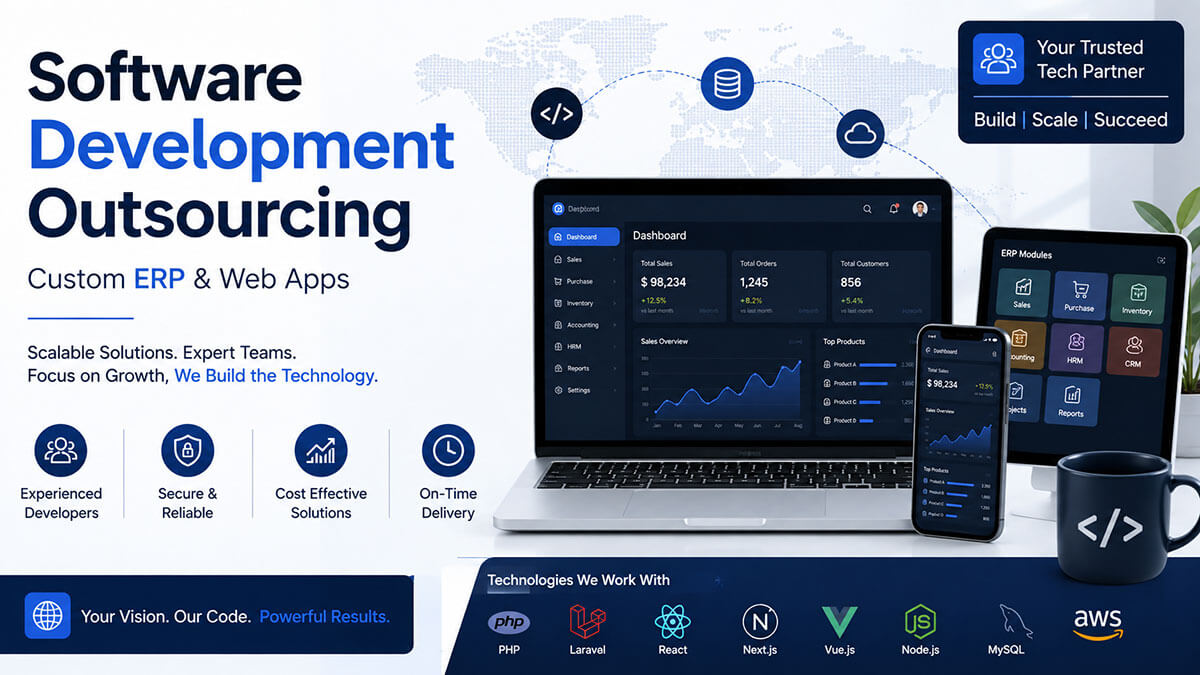
Access enterprise-grade custom software development at offshore rates. Global IT Vision delivers custom ERP systems, web applications, and mobile apps with proven expertise across 12+ industry verticals. Competitive offshore rates provide 50-70% cost savings versus US-based development firms.
Quick facts: 60+ products built, 700+ projects delivered, offices in Lahore (Pakistan), Bari (Italy), and Baku (Azerbaijan). Rapid project onboarding, month-to-month contracts available for ongoing development needs.
What is Software Development Outsourcing?
Software development outsourcing transfers all or part of your software development work to an external team. Unlike staff augmentation where contractors join your team, outsourced projects are vendor-managed: the development company owns project planning, resource allocation, quality assurance, and delivery timelines.
Outsourcing works best for defined deliverables with clear scope, budget, and timeline. Common use cases include MVP builds (3-6 month fixed-scope projects), system migrations (legacy-to-cloud transitions), feature additions (specific functionality for existing products), and maintenance contracts (ongoing bug fixes, security updates, minor enhancements).
The outsourcing model shifts accountability to the vendor. You provide requirements, approve milestones, and receive finished software. The vendor handles hiring, team management, infrastructure, and technical execution. This frees your internal team to focus on core business activities while external specialists handle complex technical work.
When to Choose Outsourcing
Choose software development outsourcing when:
- Fixed deliverable — you need a specific outcome (build an MVP, migrate to cloud, add payment gateway integration) with defined acceptance criteria
- Limited technical capacity — your in-house team lacks bandwidth or specialized skills (mobile app development, DevOps, ERP customization) to execute the project
- Faster time-to-market — offshore teams can start quickly versus lengthy permanent hiring cycles
- Cost predictability — fixed-price contracts provide upfront cost certainty (versus hourly staff augmentation where scope creep increases costs)
Choose staff augmentation instead when you have existing technical leadership, need long-term capacity expansion, or want full control over daily task prioritization. For a detailed comparison, see staff augmentation vs. outsourcing.
Why Choose Global IT Vision for Software Development Outsourcing?
60+ Products, 700+ Projects Delivered
Proven track record across ERP, POS, healthcare, education, hospitality, and logistics verticals. Global IT Vision (part of IT Vision Private Limited, Lahore) has developed 60+ software products deployed across 12+ industry verticals.
Portfolio breadth demonstrates technical range. Our development teams have built:
- ERP systems: Financial accounting modules (chart of accounts, general ledger, AP/AR, financial statements), manufacturing ERP (bill of materials, production planning, shop floor control), multi-location inventory management
- Point-of-Sale software: Restaurant POS with kitchen display systems, retail POS with barcode scanning, pharmacy POS with prescription tracking
- Healthcare platforms: Hospital management ERP (patient records, billing, pharmacy, lab integration), clinic management systems, dental practice management
- Education software: School management systems (student records, attendance, grading, parent portals), exam management, library management
- Logistics applications: Courier management systems (package tracking, delivery routing, customer portals)
This depth means our developers understand business workflows, not just code syntax. ERP developers know double-entry accounting principles. Healthcare developers understand HIPAA compliance requirements. Logistics developers know real-time GPS tracking integration.
White-Label Software Expertise
One of few software development outsourcing providers with white-label platform experience. Global IT Vision builds rebrandable software for channel partners and resellers through our white-label POS software and white-label ERP solutions programs.
White-label development requires modular, configurable architecture. Systems must support multi-tenant deployments, client-specific branding, and feature toggles for different partner tiers. These architectural patterns—abstraction layers, configuration-driven behavior, API-first design—are transferable skills for any complex enterprise application.
Offshore Cost Savings (50-70% versus US Firms)
Pakistan-based offshore development delivers substantial cost savings:
- Global IT Vision offshore rates: Contact for custom quote based on project scope
- US-based development firms: $70-$150/hr (Clutch 2026 averages for mid-tier custom software companies)
Example cost comparison for a 6-month custom ERP project (1,000 development hours, hypothetical rates):
- Offshore Pakistan rate (example: $40/hr): $40,000 total project cost
- US mid-tier rate ($100/hr per Clutch 2026): $100,000 total project cost
- Potential savings: $60,000 (60% cost reduction)
Offshore rates reflect lower cost-of-living in Pakistan versus the US, not lower quality. Our developers use the same tech stacks (React, Node.js, Laravel, Flutter), follow the same methodologies (Agile, Scrum), and deliver to the same quality standards (code review, QA testing, documentation).
International Presence (Lahore, Bari, Baku)
Three office locations provide timezone coverage and regional expertise:
- Lahore, Pakistan (UTC+5): Primary development center, dedicated technical team
- Bari, Italy (UTC+1): European client support, EU timezone alignment
- Baku, Azerbaijan (UTC+4): Central Asia and Middle East market access
Timezone advantages:
- Europe/Middle East clients: 4-6 hours daily overlap for real-time collaboration (Lahore 2 PM = Bari 9 AM)
- Asia clients: Full day overlap (Singapore, India, UAE)
- US clients: Async-friendly workflow (submit requests end-of-day EST, receive progress updates next morning as Pakistan team works overnight)
Multilingual Capability
English, Arabic, Urdu support. All developers are English-fluent (required for Global IT Vision hiring). Arabic-speaking developers and project managers available for Middle East clients. Project communication (status reports, sprint planning, code documentation) conducted in English.
Our Development Process (6-Phase Agile Framework)
Phase 1: Discovery & Requirements (Week 1)
Requirements gathering, technical feasibility assessment, project scope definition. Discovery activities include:
- Stakeholder interviews: Understand business goals, user personas, success metrics
- Workflow mapping: Document current processes, identify pain points, design future-state workflows
- Technical assessment: Review existing systems, integration points, data migration needs
- Feasibility analysis: Validate technical approach, identify risks, propose architecture options
Deliverables: Requirements document (functional specs, user stories, acceptance criteria), technical architecture proposal, project timeline, cost estimate.
Phase 2: Planning & Design (Week 2-3)
Detailed project plan, wireframes, database schema, technical specifications. Planning activities include:
- Sprint planning: Break requirements into 2-week sprint cycles with deliverable milestones
- UI/UX design: Create wireframes, mockups, user flow diagrams (tools: Figma, Adobe XD)
- Database design: Define schema, relationships, indexes, data migration strategy
- API design: Document endpoints, request/response formats, authentication flow
- QA strategy: Define test plan, acceptance criteria, regression testing approach
Deliverables: Sprint backlog, UI mockups, database schema diagrams, API documentation, test plan.
Phase 3: Agile Development (Week 4+)
Iterative development in 2-week sprints with continuous client feedback. Development approach:
- Sprint structure: 2-week cycles, each sprint delivers working features deployable to staging
- Daily standups: 15-minute team sync (async-friendly for clients in different timezones via Slack/email summaries)
- Code standards: Follow language-specific best practices (ESLint for JavaScript, PSR-12 for PHP, PEP 8 for Python)
- Version control: Git workflow with feature branches, pull requests, mandatory code review before merge
- Staging deployments: Each sprint ends with deployment to staging environment for client review
Technology stack decisions made during planning phase based on project requirements (see Technology Expertise section below).
Phase 4: Quality Assurance (Ongoing, Throughout Development)
Concurrent QA testing during each sprint, not a separate post-development phase. QA activities include:
- Unit testing: Developers write tests for individual functions/components (Jest for JavaScript, PHPUnit for PHP, PyTest for Python)
- Integration testing: Validate interactions between modules (API tests, database transaction tests)
- Manual QA: Dedicated QA engineer tests each sprint’s features against acceptance criteria
- Regression testing: Automated test suite runs on each commit to catch breaking changes
- Performance testing: Load testing for multi-user scenarios, database query optimization
Bug tracking via Jira/Linear. Critical bugs (app crashes, data loss) fixed same sprint. Minor issues (UI polish, edge cases) prioritized for future sprints.
Phase 5: Deployment & Launch (Week N)
Production deployment, data migration, user training, go-live support. Deployment activities include:
- Production setup: Configure hosting (AWS, DigitalOcean, client infrastructure), SSL certificates, domain DNS
- Data migration: Import existing data from legacy systems, validate data integrity
- User training: 2-4 hour training sessions for admin users (recorded for future reference)
- Go-live monitoring: Development team on standby during first 48 hours post-launch for rapid bug fixes
- Handoff documentation: Admin guides, user manuals, API documentation, deployment runbooks
Phase 6: Support & Maintenance (Post-Launch)
Ongoing bug fixes, minor enhancements, security updates. Support options:
- 30-day warranty: Free bug fixes for issues present at launch (does not cover new feature requests or changes to original requirements)
- Monthly retainer: $500-$2,000/month for ongoing support (8-40 hours/month for minor updates, bug fixes, security patches)
- Ad-hoc hourly: $40-$60/hr for one-off changes outside retainer hours
Support communication via email, Slack, or Jira. Response times: critical bugs (system down) within 4 hours, medium priority (feature broken) within 24 hours, low priority (minor UI issues) within 72 hours.
Technology Expertise
Web Development Frameworks
Frontend: React, Next.js, Vue.js, Angular, Tailwind CSS. Modern JavaScript frameworks with responsive design, component-based architecture, and API integration. Next.js for SEO-critical applications (server-side rendering), React for complex single-page applications, Vue.js for rapid prototyping, Tailwind CSS for utility-first styling (replacing legacy jQuery/Bootstrap where applicable).
Backend: Node.js (Express.js), PHP (Laravel), Python (Django, Flask), .NET Core. RESTful API design, authentication (JWT, OAuth), database ORM integration, background job processing. Laravel for rapid PHP development, Django for data-heavy applications, Node.js for real-time features (WebSocket, Server-Sent Events).
Legacy support: jQuery, Bootstrap 3/4 maintenance for brownfield projects. Where legacy stacks must be maintained, our teams can support existing jQuery/Bootstrap codebases while planning incremental migration to modern frameworks (React/Next.js/Tailwind).
Mobile Development
React Native, Flutter, Swift (iOS native), Kotlin (Android native). Cross-platform frameworks (React Native, Flutter) recommended for 70%+ code reuse between iOS and Android. Native development (SwiftUI, Jetpack Compose) for performance-critical apps or platform-specific features (Apple HealthKit, Android ML Kit).
Example mobile projects: Restaurant POS mobile app (React Native + offline mode + Bluetooth printer integration), courier delivery app (Flutter + real-time GPS tracking + push notifications).
Database & Cloud
Databases: PostgreSQL, MySQL, MongoDB, SQL Server. Relational databases (PostgreSQL, MySQL) for transactional systems (ERP, e-commerce), NoSQL (MongoDB) for flexible schemas (CMS, analytics), SQL Server for .NET stack integration.
Cloud platforms: AWS, DigitalOcean, Microsoft Azure. AWS for enterprise clients (EC2, RDS, S3, Lambda), DigitalOcean for cost-conscious SMBs (Droplets, Managed Databases), Azure for .NET/Microsoft-centric organizations.
DevOps: Docker, CI/CD pipelines (GitHub Actions, GitLab CI), server management. Containerized deployments for consistent environments, automated testing and deployment pipelines, managed hosting or client infrastructure support.
ERP & Business Systems
Custom ERP development, financial accounting modules, inventory management, multi-location support. Portfolio includes:
- Financial ERP: Chart of accounts, general ledger, accounts payable/receivable, financial statements (balance sheet, profit & loss, cash flow)
- Manufacturing ERP: Bill of materials (BOM), production planning, work order tracking, shop floor control
- Inventory management: Multi-location stock tracking, reorder points, warehouse transfers, barcode/RFID integration
- HRMS & payroll: Employee records, attendance, leave management, payroll calculation, tax compliance
For cloud-based SaaS ERP solutions, explore our cloud ERP platform. For ERP-specific consulting and implementation services, see ERP consulting services.
Project Examples (Anonymized Case Studies)
Case Study 1: Healthcare Clinic Management System
Client type: Multi-specialty clinic network (5 locations, 20+ doctors)
Challenge: Paper-based patient records, no centralized appointment scheduling, manual billing prone to errors. Needed cloud-based system accessible from all clinic locations.
Solution: Custom healthcare management ERP built on Laravel (backend) + Vue.js (frontend) + PostgreSQL (database). Features included patient registration, appointment scheduling with SMS reminders, electronic medical records (EMR), lab test integration, billing and insurance claims, and pharmacy inventory management.
Team: 3 developers (2 full-stack, 1 QA engineer), 1 project manager
Timeline: 4 months (discovery 2 weeks, design 2 weeks, development 12 weeks, deployment 2 weeks)
Outcome: Reduced appointment booking time from 10 minutes (phone-based) to 2 minutes (online portal). Eliminated billing errors (automated insurance claim validation). Centralized patient records accessible from all locations. For pre-built healthcare software, see our hospital management ERP.
Case Study 2: School Administration Platform
Client type: Private school (K-12, 1,200 students, 80 staff)
Challenge: Multiple disconnected systems (student records in Excel, attendance on paper, fee collection manual, parent communication via email). Needed unified platform for administration, teachers, and parents.
Solution: Cloud-based school management system built on Node.js (backend) + React (frontend) + MongoDB (database). Features included student registration, attendance tracking, grade management, fee collection (payment gateway integration), parent portal (view grades, attendance, communicate with teachers), and timetable management.
Team: 4 developers (2 backend, 1 frontend, 1 mobile for parent app), 1 UI/UX designer, 1 QA engineer
Timeline: 5 months (discovery 3 weeks, design 3 weeks, development 14 weeks, deployment 2 weeks)
Outcome: Automated fee collection (60% of payments now online, reduced cash handling). Real-time attendance updates visible to parents within 1 hour. Reduced administrative workload by 30% (less manual data entry). For off-the-shelf school software, explore our school management system.
Case Study 3: E-Commerce Platform Migration
Client type: Retail business (online + 3 physical stores, $2M annual revenue)
Challenge: Legacy e-commerce platform (OsCommerce) slow, difficult to customize, no mobile-responsive design. Frequent downtime during traffic spikes. Needed modern platform with better performance and mobile experience.
Solution: Migration from OsCommerce to WooCommerce (WordPress) with custom theme (Tailwind CSS for responsive design), payment gateway integration (Stripe, PayPal), inventory sync with physical stores (API integration), and AWS hosting for scalability.
Team: 2 developers (1 WordPress/WooCommerce specialist, 1 frontend developer), 1 DevOps engineer
Timeline: 3 months (design 3 weeks, development 8 weeks, data migration 1 week, deployment 1 week)
Outcome: 70% increase in mobile conversions (improved mobile UX). 40% faster page load times (AWS hosting + caching). Zero downtime during Black Friday traffic spike (previous platform crashed 3 times during peak sales).
Pricing & Engagement Models
Global IT Vision offers three pricing structures based on project type:
Fixed-Price Projects
Best for: Defined scope projects (MVP builds, specific feature additions, migrations) where requirements are stable and unlikely to change.
How it works: You provide detailed requirements, we deliver a fixed quote. Price includes discovery, design, development, QA, and deployment. Changes to scope trigger change-order process (documented approval, revised timeline and cost).
Typical range: $15,000-$500,000 depending on project complexity. Small projects (simple CRM, landing page builds, WordPress site) start at $15,000. Complex ERP systems (multi-module, multi-location, custom workflows) range $100,000-$500,000.
Example: 3-month MVP build (web app with user authentication, dashboard, basic reporting) typically $25,000-$50,000 fixed price.
Time & Materials (Hourly)
Best for: Evolving scope projects where requirements will emerge during development, or ongoing maintenance contracts.
How it works: You pay hourly rates for actual development time. Provides flexibility to adjust priorities mid-project. Monthly invoices with detailed timesheets showing hours worked per task.
Hourly rates: Contact for custom quote based on project scope and team composition.
Example: 6-month ongoing development retainer structured as a monthly engagement with flexible scope adjustments.
Monthly Retainer
Best for: Ongoing support, incremental feature additions, or long-term partnership where you need dedicated capacity but flexible scope.
How it works: Fixed monthly fee covers a set number of hours (typically 40-160 hours/month). Unused hours roll over to next month (up to 1 month accumulation). Ideal for post-launch maintenance and iterative enhancements.
Typical retainers: Contact for custom quote based on required hours and support level.
Example: Post-launch support retainers typically cover bug fixes, minor UI updates, security patches, and small feature additions.
Contact for custom quote based on project scope. All quotes include discovery phase (requirements gathering + technical feasibility assessment) at no additional cost.
Software Development Outsourcing vs. Staff Augmentation vs. ERP Consulting
| Software Outsourcing | Staff Augmentation | ERP Consulting | |
|---|---|---|---|
| Control | Vendor-managed (we own timeline, team, deliverables) | Client-managed (you assign tasks, review code daily) | Advisory-only (consultant provides recommendations, you execute) |
| Best For | Fixed deliverables (MVP, migration, feature build) | Ongoing capacity needs (long-term projects, maintenance) | Strategic guidance (ERP selection, process optimization, implementation planning) |
| Pricing | Fixed-price or hourly ($15k-$500k projects) | Hourly contractor rate (contact for quote) | Hourly consulting rate (contact for quote) |
| Timeline | Short-to-medium term (1-6 months typical) | Long-term (3-12+ months typical) | Short-term engagements (1-3 months advisory) |
| Knowledge Retention | Medium (vendor provides handoff docs at project end) | High (your team controls IP, documentation, domain knowledge) | Low (consultant delivers recommendations, no implementation) |
Choose software outsourcing when you have a defined deliverable, want vendor accountability for delivery, and don’t have internal capacity to manage a contractor team.
Choose staff augmentation when you have existing technical leadership, need long-term team expansion, and want daily control over priorities.
Choose ERP consulting when you need strategic ERP advice (vendor selection, process analysis, implementation roadmap) but will handle execution internally or with a separate implementation partner.
Frequently Asked Questions
What is software development outsourcing?
Software development outsourcing transfers software development work to an external company. The outsourcing vendor manages project execution (hiring developers, timeline, quality assurance, delivery) while you provide requirements and approve milestones. Common for MVP builds, system migrations, and defined-scope projects where vendor accountability reduces client management overhead.
How much does software development outsourcing cost?
Offshore software development outsourcing from Pakistan provides 50-70% cost savings versus US-based firms ($70-$150/hr per Clutch 2026 data). Fixed-price projects range $15,000-$500,000 depending on complexity. A typical 3-month MVP project costs $25,000-$50,000. Monthly retainers for ongoing development available. Contact for custom quote based on project scope, technology stack, and team size.
How long does a custom software project take?
Custom software projects typically take 3-6 months from discovery to deployment. Simple projects (basic CRM, WordPress site, landing pages) complete in 6-10 weeks. Complex ERP systems (multi-module, integrations, data migrations) require 4-9 months. Timeline depends on requirements complexity, integrations needed, and client approval speed. Discovery and planning phases (2-4 weeks) establish realistic timeline before development starts.
What industries does Global IT Vision serve?
Global IT Vision serves 12+ industry verticals including healthcare (hospital management systems, clinic software), education (school management platforms), hospitality (hotel PMS, restaurant POS), retail (POS systems, e-commerce), logistics (courier management), and financial services (ERP accounting modules). 60+ products delivered across these verticals demonstrate domain expertise beyond generic software development.
Do you provide ongoing support after launch?
Yes. All projects include 30-day warranty (free bug fixes for issues present at launch). Ongoing support available via monthly retainers or ad-hoc hourly arrangements. Support covers bug fixes, security updates, minor enhancements, and performance optimization. Response times: critical issues within 4 hours, medium priority within 24 hours. Contact for custom support quote.
What is the difference between outsourcing and staff augmentation?
Software outsourcing is vendor-managed (we handle project execution, timeline, team) while staff augmentation is client-managed (contractors join your team, you assign daily tasks). Choose outsourcing for defined deliverables with fixed scope. Choose staff augmentation when you have technical leadership and need long-term capacity expansion. Detailed comparison at staff augmentation vs. outsourcing.
Can you work with our existing tech stack?
Yes. Global IT Vision supports legacy and modern tech stacks. Modern frameworks include React, Next.js, Vue.js, Laravel, Node.js, Flutter. Legacy support includes jQuery, Bootstrap 3/4, older PHP frameworks (CodeIgniter, CakePHP), and .NET Framework. For brownfield projects (existing codebase maintenance), our teams assess current architecture and recommend incremental modernization where applicable.
How do you handle timezone differences?
Pakistan timezone (UTC+5) provides 4-6 hour overlap with Europe and Middle East for real-time collaboration. For US clients, async workflow maximizes productivity: submit requests end-of-day EST, receive progress updates next morning as Pakistan team works overnight. Weekly video calls (scheduled at mutually convenient times) for sprint planning and milestone reviews. Daily progress updates via Slack/email for async status tracking.
Start Your Next Software Project
Contact Global IT Vision for a free project assessment. We’ll review your requirements, propose technical approach, and deliver a detailed quote within 5-7 business days.
Contact options:
- Email: [Contact form on website]
- Live chat: Available on all pages (Crisp widget, bottom-right)
- Office locations: Lahore (Pakistan), Bari (Italy), Baku (Azerbaijan)
Next steps:
- Submit project requirements via contact form (include: project goals, must-have features, timeline, budget range)
- Schedule discovery call (30-60 minutes, review requirements, discuss technical approach)
- Receive detailed proposal (project timeline, team structure, cost estimate, sample deliverables)
- Kickoff (sign contract, onboard team, start discovery phase)
Sources
- Custom Software Development Cost: 2026 Pricing & Timeline Benchmarks : Source: Keyhole Software
- 2026 Software Development Price Guide: Hourly Rates & Nearshore Costs : Source: FullStack Labs