
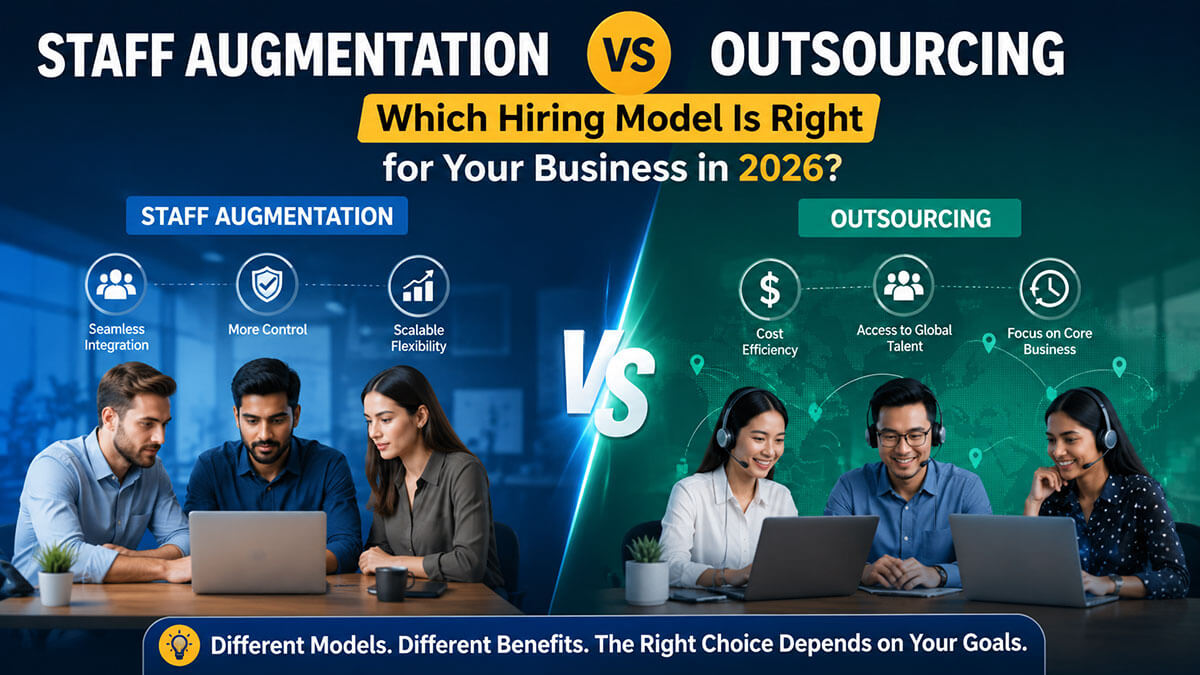
When engineering teams face talent shortages or project backlogs, they typically weigh two hiring models: staff augmentation vs outsourcing. Both solve the same fundamental problem—filling critical skill gaps—but they operate on entirely different principles. Staff augmentation brings contractors into your internal team where you control tasks, workflows, and daily management. Outsourcing delegates entire projects or functions to an external vendor who manages execution while you review deliverables at milestones. The choice between these models determines who controls priorities, how knowledge is retained, what your cost structure looks like, and how quickly you can adapt to changing requirements. This article provides a side-by-side comparison of control, cost, timeline, knowledge retention, and a decision framework to help CTOs and engineering managers choose the right hiring model in 2026.
If you already know you need extra engineers inside your own team, see our development staff augmentation services.
Quick definition: Staff augmentation hires contractors who join your internal team (you manage daily work), while outsourcing delegates entire projects to a vendor (vendor manages execution). Staff augmentation suits ongoing team capacity needs and knowledge retention; outsourcing suits fixed-scope projects requiring specialized expertise or fast delivery timelines.
Quick Comparison Table — Staff Augmentation vs Outsourcing
| Factor | Staff Augmentation | Outsourcing |
|---|---|---|
| Definition | Contractors join your team, you manage daily work | Vendor delivers entire project, manages execution |
| Control | High (you control tasks, priorities, workflows) | Low (vendor controls delivery, you review milestones) |
| Management | Your team manages contractors (daily standups, sprint planning) | Vendor manages team (you interact with PM only) |
| Best For | Ongoing needs, team scaling, knowledge retention | Fixed projects, specialized expertise, fast delivery |
| Contract Length | Flexible (monthly, quarterly) | Project-based (3-12+ months) |
| Knowledge Retention | High (contractors integrate into your processes) | Low (vendor keeps IP unless contractually transferred) |
| Cost Structure | Hourly/monthly rate per contractor | Fixed bid or milestone-based pricing |
| Typical Cost Range | $25-$150/hour depending on location/skill | $50K-$500K+ per project depending on scope |
| Timeline | 7-14 days to start (faster ramp-up) | 2-6 weeks for vendor selection + kickoff |
| Communication | Direct (Slack, standups, daily interaction) | Structured (weekly status calls, milestone reviews) |
| Scalability | Easy (add/remove contractors monthly) | Hard (scope changes require contract amendments) |
| Risk | Performance risk (replace non-performers monthly) | Delivery risk (vendor misses milestones, quality issues) |
Not sure which model fits your needs? Contact our team for a free consultation on staff augmentation vs. outsourcing for your project.
What Is Staff Augmentation?
How Staff Augmentation Works
Staff augmentation hires contractors—developers, designers, QA engineers, DevOps specialists—who join your existing team. These contractors use your tools (Jira, Slack, GitHub), attend your daily standups, follow your processes, and integrate into your development workflow. You control task assignment, set priorities, conduct code reviews, and manage deployment workflows just as you would with full-time employees. Contracts are typically flexible, ranging from 30-day to 90-day terms, allowing you to replace non-performing contractors quickly without lengthy termination procedures.
Typical use cases include scaling teams for product launches, backfilling attrition during hiring freezes, and adding specialized skills (machine learning engineers, DevOps experts) without committing to full-time hires. For example, a SaaS company preparing for a major feature release might augment its core team with three senior developers for a six-month sprint, then reduce the team once the launch stabilizes.
Staff Augmentation Pricing Model
Staff augmentation pricing follows an hourly or monthly rate per contractor. According to Clutch’s 2026 software development pricing data, offshore contractors from Pakistan, India, and the Philippines charge $25–$49 per hour, while US-based contractors charge $100–$149 per hour. Senior engineers through offshore providers bill around $30 to $40 per hour, compared to $80 to $150 per hour for comparable US-based senior developers (FullScale offshore staff augmentation guide, 2026).
For a senior offshore developer at $40/hour working 160 hours per month, the monthly cost is $6,400. A US-based contractor at $120/hour would cost $19,200 per month—a 60-70% savings with offshore augmentation. Importantly, these rates are transparent with no hidden fees or scope creep. Most providers offer month-to-month contracts with no minimum commitment, giving you the flexibility to scale up or down based on workload.
Cost comparison: A senior developer through offshore staff augmentation costs $4,000–$8,000 per month versus a US full-time hire at $10,000–$15,000 per month plus benefits (health insurance, retirement, paid time off).
When to Choose Staff Augmentation
Staff augmentation is the right choice when you have ongoing capacity needs rather than a one-time project. Knowledge retention is critical in staff augmentation because contractors learn your codebase, understand your architectural decisions, and adopt your team’s development practices. This model works best when you have strong internal management—a project manager or tech lead who can direct contractors daily and integrate them into sprint planning.
Choose staff augmentation if:
- Ongoing capacity needs: You need extra hands for continuous product development, not a single deliverable
- Knowledge retention critical: Contractors must understand your systems deeply for long-term maintenance
- Strong internal management: You have a PM or tech lead available to direct contractors
- Flexible timeline: No hard deadline; development is iterative with changing priorities
- Examples: SaaS product development, maintenance and support team scaling, backfilling for parental leave or attrition
Staff Augmentation Pros & Cons
Pros:
- High control: You manage daily work, set priorities, and direct development tasks
- Knowledge retention: Contractors integrate into your team and retain institutional knowledge
- Flexibility: Scale up or down monthly with no long-term lock-in
- Cost efficiency: Offshore rates deliver 50–70% savings compared to US contractors
Cons:
- Management overhead: You must direct contractors daily, conduct code reviews, manage performance
- Onboarding time: 1–2 weeks for contractors to learn your codebase and processes
- Performance risk: You are responsible for vetting and managing contractors; non-performers require replacement
What Is Project-Based Outsourcing?
How Outsourcing Works
Project-based outsourcing delegates an entire project or function to an external vendor. The vendor delivers a defined scope—such as a mobile app, CRM integration, or DevOps migration—with fixed timelines and deliverables outlined in a Statement of Work (SOW). The vendor manages the team, assigns tasks, handles quality assurance, and delivers work at milestones. Your role is to review milestone demos, provide feedback, and approve final handoff.
Communication in outsourcing is structured: weekly status calls, milestone reviews, and final delivery presentations. You interact primarily with the vendor’s project manager rather than individual developers. Typical use cases include MVP development for startups, legacy system migrations (moving from on-premise to cloud), and specialized integrations requiring niche expertise (Salesforce implementations, SAP integrations, blockchain solutions).
Outsourcing Pricing Model
Outsourcing projects are priced as either fixed bids (total project cost) or milestone-based payments (pay per phase). According to IdeaSoft’s 2026 outsourcing cost guide, a simple build costs $20,000–$90,000, mid-complexity products run $90,000–$250,000, and complex platforms start at $250,000 or more.
For a six-month project with a five-person team, outsourcing costs typically range from $150,000 to $300,000. This cost includes project management, QA testing, and documentation—the vendor handles the full software development life cycle (SDLC). Compare this to hiring US-based contractors for the same project at $300,000–$600,000 in labor costs alone, not including your internal PM and QA overhead.
The trade-off is scope change friction. Any modification to the original SOW requires a contract amendment and additional fees. If requirements evolve mid-project, expect renegotiation and cost overruns.
When to Choose Outsourcing
Outsourcing works best for defined project scopes with clear requirements, deliverables, and timelines. If you need specialized expertise your team lacks—such as blockchain development, AI/ML model training, or IoT device integration—outsourcing gives you access to niche skills without hiring full-time specialists. Outsourcing also delivers faster time-to-market; a dedicated vendor team can complete a project in 3–6 months versus 12+ months if you had to build and train an internal team first.
Choose outsourcing if:
- Defined project scope: Requirements, deliverables, and timeline are fixed
- Specialized expertise needed: Skills you lack in-house (blockchain, AI/ML, compliance certifications)
- Fast time-to-market: Vendor delivers in 3–6 months with a dedicated team
- Limited internal management capacity: No PM or tech lead available to direct contractors daily
- Examples: Mobile app launch, ERP implementation, data warehouse migration, SOC 2 or HIPAA compliance certification
Outsourcing Pros & Cons
Pros:
- Low management overhead: Vendor handles PM, QA, and delivery—you review milestones only
- Specialized expertise: Access niche skills (blockchain, AI/ML) without hiring full-time
- Faster delivery: Dedicated team with no distractions from other projects
- Predictable cost: Fixed bid or milestone payments eliminate hourly rate uncertainty
Cons:
- Low control: Vendor manages execution; you review milestones but don’t direct daily work
- Knowledge loss: Vendor retains codebase knowledge unless contractual handoff includes documentation and training
- Scope change friction: Contract amendments and additional fees for mid-project changes
- Vendor dependency: Lock-in risk if vendor controls critical intellectual property or infrastructure
Staff Augmentation vs Outsourcing — Decision Framework
Use this framework to determine which model fits your business situation:
| Your Situation | Recommended Model | Why |
|---|---|---|
| Ongoing product development (SaaS, mobile app, platform) | Staff Augmentation | Knowledge retention critical, iterative roadmap, flexible priorities |
| One-time project (MVP, integration, migration) | Outsourcing | Fixed scope, defined timeline, low management overhead |
| Strong internal PM/tech lead | Staff Augmentation | You can direct contractors daily, manage sprints |
| No internal PM capacity | Outsourcing | Vendor manages execution, you review milestones |
| Flexible budget (can scale monthly) | Staff Augmentation | Month-to-month contracts, no long-term commitment |
| Fixed budget (approved project funding) | Outsourcing | Fixed bid or milestone pricing, predictable cost |
| Fast time-to-market (3–6 months) | Outsourcing | Dedicated vendor team, no hiring/onboarding delay |
| Long-term scalability (12+ months) | Staff Augmentation | Contractors integrate into team, knowledge retained |
Ready to scale your team with staff augmentation? Explore our staff augmentation services—access vetted developers in 7–10 days.
Can You Combine Both Models? (Hybrid Approach)
Yes—many companies use staff augmentation for their core team while outsourcing specialized projects. This hybrid approach delivers the best of both models: flexibility to scale your core team monthly, plus specialized delivery for complex one-time projects.
Example 1: A SaaS company hires three staff-augmented developers for ongoing product development while outsourcing its mobile app to a specialist vendor. The core team maintains the web platform and API, while the vendor delivers iOS and Android apps in six months.
Example 2: An e-commerce business outsources a DevOps migration to AWS (a six-month project requiring specialized cloud expertise) while hiring a staff-augmented DevOps engineer for ongoing maintenance after the migration completes.
Benefits of the hybrid model:
- Flexibility: Scale core team capacity monthly based on workload
- Specialized delivery: Vendor handles complex projects requiring niche expertise
- Risk mitigation: Staff augmentation for critical systems (knowledge retention), outsourcing for ancillary projects
Global IT Vision offers both models: staff augmentation services for ongoing team scaling and project-based software development outsourcing for fixed-scope deliverables. For project-based developer hiring with defined deliverables and timelines, explore our sister brand’s dedicated developer hiring service. For ongoing contractor teams that scale with your business needs, our staff augmentation services are the right fit.
Staff Augmentation vs Outsourcing Cost Comparison (Real Numbers)
Let’s compare the real costs of hiring three senior developers for six months using different models:
Scenario: Hire 3 senior developers for 6 months
| Cost Item | Staff Augmentation (Offshore) | Outsourcing (Project-Based) | Staff Augmentation (US) |
|---|---|---|---|
| Hourly rate per developer | $25–$50/hr | N/A (fixed bid) | $80–$150/hr |
| Monthly cost (3 devs, 160 hrs/month) | $12,000–$24,000 | N/A | $38,400–$72,000 |
| 6-month total (labor only) | $72,000–$144,000 | $150,000–$300,000 (fixed bid) | $230,400–$432,000 |
| Project management | Your PM (internal cost) | Included in vendor bid | Your PM (internal cost) |
| QA/testing | Your QA or contractor QA | Included in vendor bid | Your QA or contractor QA |
| Onboarding | 1–2 weeks (your team) | Vendor handles | 1–2 weeks (your team) |
| Total 6-month cost | $72K–$144K (offshore) | $150K–$300K (includes PM/QA) | $230K–$432K (US-based) |
Cost insight:
- Offshore staff augmentation delivers 50–70% savings versus US contractors (per entity data)
- Outsourcing includes PM/QA overhead—the vendor manages the full SDLC
- Staff augmentation is cheaper if you have internal PM/QA capacity
- Outsourcing is cheaper if you lack a PM (avoids hiring a full-time PM for a short project)
Sources: Clutch 2026 software development pricing guide, FullScale offshore staff augmentation rates, Qubit Labs offshore development rates by country, IdeaSoft software development outsourcing cost guide 2026.
Frequently Asked Questions (FAQ Schema Target)
What is the main difference between staff augmentation and outsourcing?
Staff augmentation hires contractors who join your team—you manage their daily work, priorities, and workflows. Outsourcing delegates entire projects to an external vendor who manages execution and delivers milestones. Choose staff augmentation for ongoing team scaling and knowledge retention; choose outsourcing for fixed-scope projects requiring specialized expertise or fast delivery timelines.
Is staff augmentation cheaper than outsourcing?
It depends on your internal capacity. Staff augmentation has lower hourly rates ($25–$150/hr) but requires your PM and QA resources. Outsourcing has higher total project costs ($150K–$300K for six-month projects) but includes PM/QA overhead. Staff augmentation is cheaper if you have internal management; outsourcing is cheaper if you need a full delivery team.
When should I use staff augmentation vs outsourcing?
Use staff augmentation for ongoing product development, knowledge retention, and flexible timelines. Use outsourcing for one-time projects, specialized expertise (blockchain, AI/ML), and fast delivery (3–6 months). Many companies use both: staff augmentation for their core team plus outsourcing for specialized projects.
How long does staff augmentation take to start vs outsourcing?
Staff augmentation typically starts in 7–14 days (contractor vetting, onboarding, first sprint). Outsourcing takes 2–6 weeks (vendor selection, contract negotiation, project kickoff). Staff augmentation is faster to start but requires your PM to manage contractors daily.
Can I switch from outsourcing to staff augmentation mid-project?
Yes, but it is complex. Transitioning requires knowledge transfer (codebase handoff, documentation), contractual amendments (vendor exit terms), and onboarding new contractors to replace vendor resources. It is easier to start with staff augmentation (flexible contracts allow monthly adjustments) than to switch models mid-project.
What industries use staff augmentation vs outsourcing?
SaaS companies prefer staff augmentation for ongoing product development and knowledge retention. Enterprises prefer outsourcing for legacy migrations (ERP, CRM, data warehouse) requiring specialized expertise. Startups use both: staff augmentation for their MVP team plus outsourcing for specialized projects like mobile apps or DevOps infrastructure.
Need both staff augmentation and project outsourcing? Global IT Vision offers flexible hiring models tailored to your business needs. Request a quote or explore our custom ERP development and software development services for project-based outsourcing.
Sources
- Offshore Staff Augmentation: Models, Real Costs, and Where It Breaks – FullScale
- Offshore Developer Rates by Country (2026) – Qubit Labs
- Software Development Company Pricing Guide August 2026 – Clutch
- Software Development Outsourcing Cost in 2026: Full Guide – IdeaSoft
- Offshore IT Staff Augmentation: Complete 2026 Guide – Talmatic
- Offshore vs. Nearshore vs. Onshore Outsourcing: 2026 Developer Rates – DistantJob